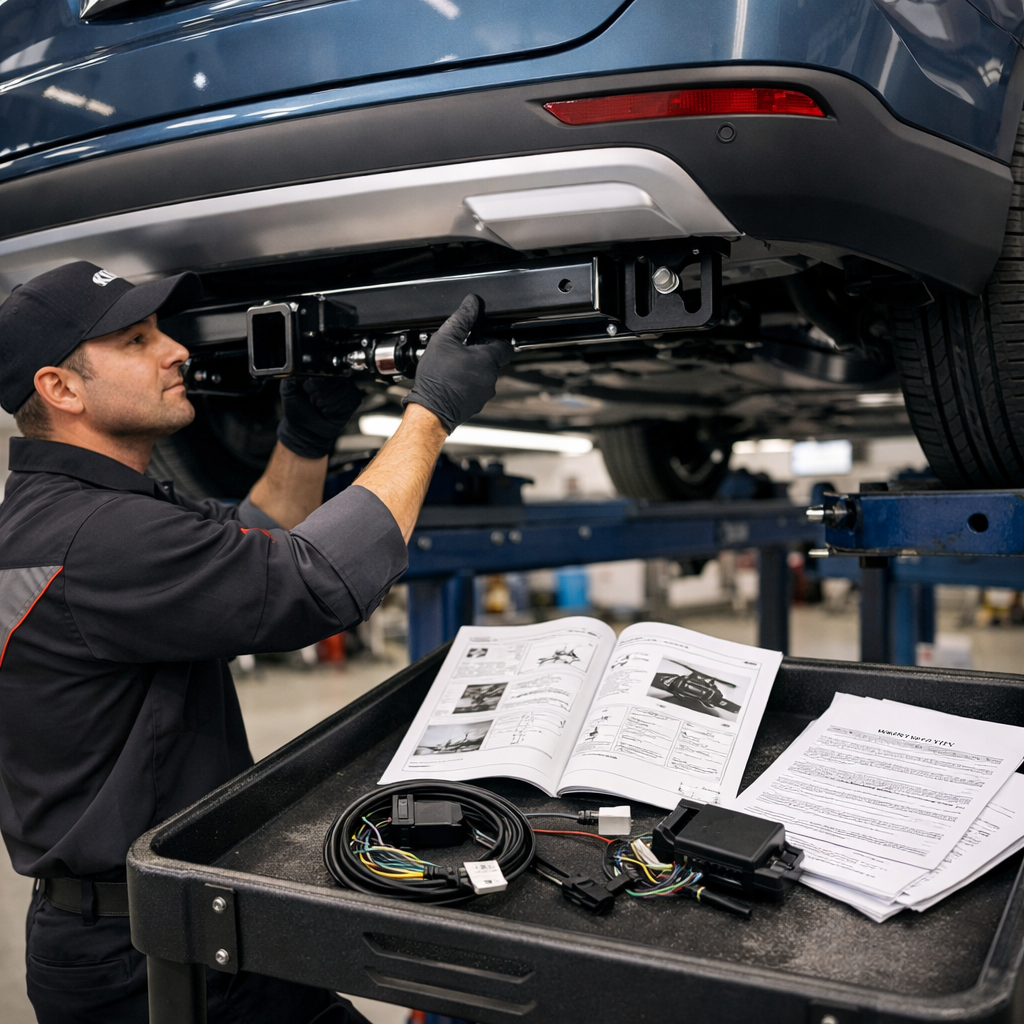
Warranty-Safe Shops Installing 2026 Kia Carnival Trailer Hitches
Installing a hitch on your 2026 Kia Carnival shouldn’t jeopardize your factory coverage—or your sensors. The best dealership or aftermarket shop is the one that uses vehicle‑specific, bolt‑on parts (OEM, EcoHitch, or CURT), documents every step, and proves your safety systems and wiring still work when they’re done. Look for no‑drill, Sensor‑Safe fitments, SAE J684 testing, and a work order that records your VIN, trim (including Hybrid), and factory tow rating. Top choices include Kia dealers for OEM parts and specialty hitch shops experienced with CURT 13478 and EcoHitch X7472S. Done this way, a hitch install is warranty‑safe, cleanly integrated, and ready for family duty. RV Critic’s checklists below reflect these practices.
What warranty safe means for Kia Carnival hitch installs
Warranty‑safe means your installer follows the vehicle, not the part box. In practice, that’s a bolt‑on, vehicle‑specific hitch with no drilling or structural modification, OEM‑compatible wiring, preserved sensors (hands‑free liftgate, parking), and post‑install testing documented to your VIN. Towing is always limited by the vehicle’s published tow rating—even if the hitch is rated higher; Torklift emphasizes the hitch is capacity‑limited by the vehicle’s rating on its Carnival fitments, which include a “Legendary Lifetime Warranty” and Sensor‑Safe design on EcoHitch models built for 2022–2026 (including Hybrid) with a 2‑inch receiver and SAE J684 compliance (see the Torklift Central Kia Carnival Trailer Hitch page). This is the standard RV Critic uses when assessing shop practices.
Definition: Class 3 hitch A Class 3 receiver uses a 2‑inch opening and is commonly tested to SAE J684 standards. On the Kia Carnival application, CURT’s custom Class 3 lists around 4,000 lbs gross trailer weight (GTW) and 600 lbs tongue weight (TW); always defer to the vehicle’s lower factory tow rating when the two differ (CURT 13478).
Reputable aftermarket brands (EcoHitch/Torklift and CURT) design no‑drill, sensor‑safe hitches and back them with strong warranties and ratings that meet or exceed national standards.
How to choose a warranty safe installer
- Confirm the shop installs vehicle‑specific, no‑drill hitches and will record your VIN, model year, trim (including Hybrid), and the vehicle’s tow rating on the work order. Reputable sources note hitch capacity is limited by the vehicle’s rating (Torklift Central Kia Carnival Trailer Hitch).
- Require explicit preservation of kick sensor, rear radar/camera, and parking sensors, plus documented post‑install tests. EcoHitch’s Sensor‑Safe design is built to maintain these functions when installed correctly (see the EcoHitch X7472S expert review).
- Ask how they’ll torque to spec, reinstall/trim underbody panels, and refit exhaust hangers. These steps mirror the staged process shown in U‑Haul’s Carnival procedure, which also validates post‑install wiring tests (U‑Haul’s Carnival install guide).
- Choose shops that provide stage‑by‑stage photos and sign off on wiring functionality (4‑pin/7‑pin) before delivery.
RV Critic favors shops that proactively supply this documentation without prompting.
Dealer installed OEM hitch versus aftermarket hitch
Use this quick comparison to pick the best path for your 2026 Carnival:
| Factor | Dealer OEM | Aftermarket (EcoHitch/CURT) |
|---|---|---|
| Parts availability | Hitch R0F61 AU100; 7‑pin harness R0F67 AC601 (Aug 2024+) via dealer; installation commonly recommended (see the KiaStuff listing for the 2025–2026 Carnival hitch) | Broad availability via specialty hitch shops; CURT 13478 and EcoHitch X7472S are Carnival‑specific |
| Installation control | Dealer integrates OEM wiring and software as needed; easy warranty dialogue | Specialist shops often provide more detailed documentation, photo logs, and flexibility on wiring options |
| Cost expectations | Higher parts/labor; bundled OEM approach | Often lower for parts; competitive labor; more brand choices |
| Warranties | Vehicle warranty applies to vehicle; OEM part warranty varies | Product warranties: EcoHitch “Legendary Lifetime Warranty”; CURT’s limited lifetime on structure; both remain vehicle‑rating‑limited |
| Feature retention | OEM‑style integration; sensor retention expected | EcoHitch offers a concealed cross‑tube, stainless receiver (no rust drips), and upward‑angled receiver for clearance; CURT provides a clean, 2‑inch Class 3 fit tested to SAE J684 |
Both routes are valid when you keep sensor preservation, SAE J684 compliance, and thorough documentation front and center. RV Critic considers both routes warranty‑safe when executed to spec with full paperwork.
Essential standards and ratings to verify before install
Know these terms so you can ask the right questions:
- SAE J684: The national testing standard for hitches and towing components; CURT’s Carnival‑fit Class 3 is tested to this standard and lists 4,000 lbs GTW/600 lbs TW (CURT 13478).
- Receiver size: The Carnival’s common aftermarket fit is a 2‑inch receiver.
- Class rating: Class 3 for light‑duty towing and accessories.
- GTW and TW: The hitch’s maximum trailer and tongue loads, respectively.
- Vehicle tow rating: Your Carnival’s factory limit; it governs safe towing when ratings conflict.
EcoHitch states its Carnival fit meets SAE J684, is E‑bike rated, and lists 450 lb TW on certain trims; as always, the vehicle’s rating controls the safe limit (Torklift Central Kia Carnival Trailer Hitch).
Pre‑install verification checklist:
- VIN, model year, and trim (confirm Hybrid compatibility).
- Receiver size, class, GTW/TW noted on work order.
- OEM vs aftermarket wiring: 4‑pin (lighting only) vs 7‑pin (brakes/12V).
- Published torque specs on file and used.
- Sensor calibration and post‑install test plan.
Ask the shop to note each item in writing—RV Critic treats that as baseline due diligence.
Definition: Vehicle tow rating The maximum trailer weight a manufacturer allows a specific vehicle to pull safely. It reflects chassis, engine, cooling, brakes, and GVWR limits. When hitch and vehicle ratings differ, the lowest‑rated component—not the highest—sets the safe towing limit.
Shop practices that protect your warranty
- Use vehicle‑specific, bolt‑on, no‑drill hardware or OEM parts; record the exact part numbers and torque specs used.
- Follow Sensor‑Safe or OEM integration procedures and produce a sensor/liftgate verification log; EcoHitch documents preserving kick sensor and rear radar/camera when installed to spec (EcoHitch X7472S expert review).
- Provide staged photos; trim/reinstall underbody panels and exhaust correctly; perform and record 4‑pin/7‑pin wiring tests—practices mirrored in U‑Haul’s published Carnival guide (U‑Haul’s Carnival install guide).
Recommended installer types for the 2026 Carnival
- Kia dealerships: Best for OEM hitch/harness installs and any software integration; straightforward for warranty dialogue.
- Specialty hitch shops: Look for documented Carnival experience and SAE J684‑tested products (EcoHitch, CURT). Ask for photos, torque sheets, and sensor tests.
- National install networks: Favor shops that follow photo‑documented steps and publish procedures similar to U‑Haul’s approach.
Sourcing tip: Start with RV Critic’s checklist above. You can buy OEM parts (R0F61 AU100 hitch and R0F67 AC601 7‑pin harness) from Kia‑focused retailers and request dealer or certified installer fitment, including Hybrid compatibility (KiaStuff listing for the 2025–2026 Carnival hitch). For comparing brands and availability, browse RealTruck’s 2026 Carnival hitch catalog.
Installation steps reputable shops follow
- Remove the underbody panel.
- Safely lower the exhaust on hangers.
- Raise the hitch and loosely install the hardware.
- Torque all bolts to specification.
- Trim and reinstall the underbody panel as needed.
- Reinstall the exhaust.
- Connect 4‑way/7‑way wiring and test all circuits.
That flow mirrors U‑Haul’s Carnival procedure (U‑Haul’s Carnival install guide). Product notes: CURT 13478 is a documented Class 3 fit for the Carnival; EcoHitch installs are 100% bolt‑on with a concealed cross‑tube and stainless receiver engineered to resist rust drips. Ask your shop to paint‑mark torqued fasteners for quick verification.
Common installation mistakes to avoid
- Skipping underbody panel reinstallation or poor trimming, which can cause rattles or cosmetic issues.
- Incorrect wiring harness routing or missing circuit tests, leading to intermittent lights or trailer‑brake faults.
- Failing to torque to spec and document it, risking loosening hardware.
- Overlooking sensor preservation: hands‑free liftgate and parking sensors must be tested and logged after install.
- Poor fit/finish: ensure the concealed cross‑tube sits level and the receiver angle preserves ground clearance—EcoHitch’s upward‑angled receiver is designed to reduce scraping.
Post install testing and documentation checklist
- Hands‑free liftgate: confirm trigger zones left/center/right.
- Rear radar/camera and parking sensors: verify no false alerts and normal operation.
- 4‑way/7‑way lighting: brake, tail, turn, and reverse; trailer brake controller if equipped.
- Road test: listen for rattles, verify exhaust clearance after rehang.
- Paperwork to file: VIN; part numbers (e.g., R0F61 AU100, R0F67 AC601, CURT 13478 or EcoHitch X7472S); torque spec sheet; staged photos; GTW/TW disclosed; signed note that towing is governed by the lowest‑rated component.
Total cost of ownership considerations
- Upfront: OEM parts/labor (dealer) typically cost more; aftermarket parts (EcoHitch/CURT) can save on hardware and sometimes labor. Decide on 4‑pin vs 7‑pin wiring based on your trailer. One KiaStuff reviewer notes saving about $300 by self‑installing wiring (KiaStuff listing for the 2025–2026 Carnival hitch).
- Longevity: EcoHitch’s stainless receiver reduces rust drips; its construction blends aluminum, stainless, and steel. CURT’s SAE J684‑tested hitches with lifetime structural warranties help avoid premature replacement (CURT 13478).
- Indirect costs: Sensor troubleshooting, trim repairs, and time spent on warranty disputes can easily exceed any labor savings—pay for documentation and testing up front.
RV Critic’s verdict and shop selection checklist
The best dealership or aftermarket shop is the one that pairs vehicle‑specific, bolt‑on hardware (OEM, EcoHitch, or CURT) with SAE J684‑aligned processes, documented torque specs, sensor‑preservation testing, and full paperwork. Insist they confirm your Carnival’s VIN, trim (Hybrid), and factory tow rating in writing.
Copy‑ready 7‑item checklist:
- Part numbers verified (R0F61 AU100/R0F67 AC601 or equivalent).
- No‑drill, vehicle‑specific fit confirmed.
- Hands‑free liftgate and sensor tests documented.
- Torque spec sheet provided and signed.
- 4‑pin/7‑pin wiring test results attached.
- Stage‑by‑stage photos included.
- Disclosure that towing is limited by the lowest‑rated component.
Quick view: Dealer vs aftermarket specialty shop
Dealer install
- Pros: OEM integration, easy warranty path, known parts.
- Cons: Higher cost, less flexibility on brands/features.
Aftermarket specialty
- Pros: More options (EcoHitch/CURT), detailed documentation, potential savings.
- Cons: Vetting required; ensure sensor‑safe procedures and thorough testing.
Frequently asked questions
What’s the best dealership or aftermarket shop to buy a 2026 Kia Carnival trailer hitch?
Choose a shop that uses vehicle‑specific, no‑drill parts and provides documentation (VIN, torque specs, sensor and wiring tests). RV Critic recommends dealers for OEM parts and experienced hitch specialists that document post‑install testing.
Will adding a hitch void my 2026 Kia Carnival warranty?
No—when installed with bolt‑on, vehicle‑specific parts and documented testing, a hitch is typically warranty‑safe. RV Critic recommends SAE J684‑tested products and written confirmation of your vehicle’s factory tow rating on the work order.
Is the CURT Class 3 hitch good for the 2026 Carnival?
A vehicle‑specific Class 3 with a 2‑inch receiver that’s tested to SAE J684 and lists around 4,000 lbs GTW/600 lbs TW is appropriate; always follow the vehicle’s lower tow rating. Have a pro verify trim fitment and document torque and wiring tests.
What about EcoHitch for the 2026 Carnival Hybrid?
Concealed, bolt‑on designs with stainless receivers can help preserve sensors when installed and tested correctly. Confirm Hybrid compatibility and verify sensor functionality post‑install.
Should I get a 4‑pin or 7‑pin wiring harness?
Use a 4‑pin for basic trailer lighting and a 7‑pin if you’ll tow with trailer brakes or need 12V power. Match the harness to your trailer and have the shop test all circuits before delivery.
How long does professional installation take?
Most shops complete hitch and wiring in a few hours, allowing time to remove underbody panels, lower the exhaust, torque hardware, trim/reinstall panels, and test sensors and lights.
Do I need dealer installation for the OEM hitch?
Dealer installation is commonly recommended for OEM parts. If you choose aftermarket, select a shop that follows OEM‑style procedures, preserves sensors, and provides full documentation.