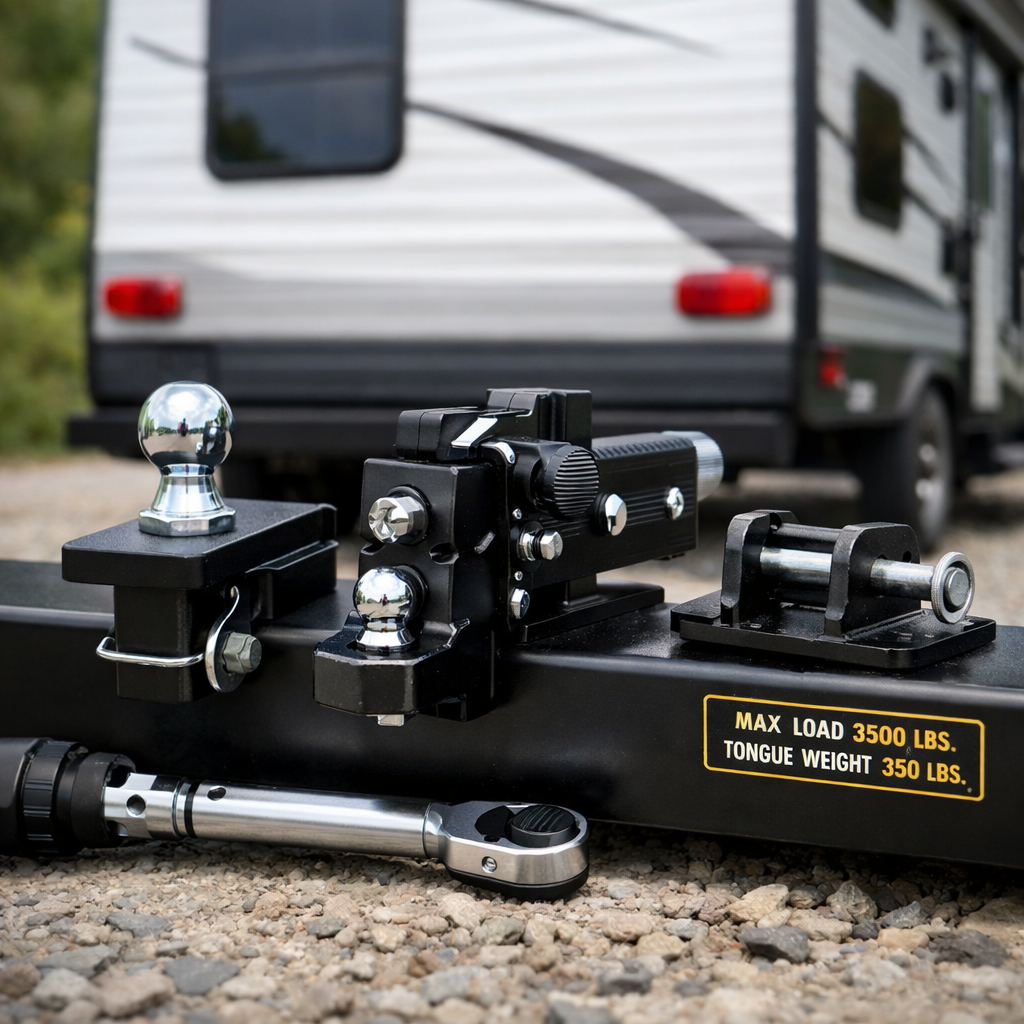
Top Bumper Hitches Compared: Safe Picks for Lightweight RVs
Lightweight RVs typically fall in the 5,000–7,000 lb gross trailer weight (GTW) range when loaded for travel. The safest pick is a hitch system rated above your true loaded weight with 10–15% tongue weight (TW) and a frame-mounted receiver if you’re anywhere near limits. Below, we compare trusted options—from simple starter ball mounts to adjustable heavy-duty hitches and premium sway control—so you can match receiver class, capacity, and stability features with confidence.
RV Critic quick picks at a glance:
- BulletProof Hitches: heavy-duty adjustable drop/rise for frequent, mixed-height towing.
- Towever Tri-Ball 84180: budget multi-ball for small RVs and mixed trailers.
- CURT and CURT Fusion: low-cost starter ball mounts for light campers.
- Reese Towpower Starter Kit: value Class III kit with clear 6,000/600 ratings.
- Weigh Safe LTB6: premium finish, moderate-capacity drop hitch.
- MaxxHaul Triple Ball: most economical multi-ball for casual users.
- ProPride 3P: premium weight distribution with sway control for maximum stability.
How to choose a safe bumper hitch for lightweight RVs
Gross Trailer Weight (GTW) is the trailer’s total loaded weight; Tongue Weight (TW) is the downward force on the hitch from the coupler. Plan for TW to equal 10–15% of GTW, and verify actual loaded numbers on a scale—not brochure estimates.
Key safety rule: match hitch GTW/TW to your RV’s loaded weight and your tow vehicle’s ratings. If you’re towing near limits, a frame-mounted receiver is the safer foundation than a bumper adapter, thanks to stronger attachment points and higher compatibility with sway/weight-distribution systems, as outlined in comparisons of bumper vs. frame-mounted hitches (see the differences explained by Patriot Hitches) Patriot’s bumper vs. frame hitch overview.
A simple, safe selection flow:
- Weigh your RV loaded for travel to get true GTW/TW.
- Confirm your vehicle’s tow rating and receiver class (Class I–III are common for light-duty; many lightweight RVs use a 2" receiver).
- Choose a hitch rated above your needs (aim for 15–20% capacity margin).
- Decide on stability aids: friction sway, integrated anti-sway, or a weight-distribution hitch if length/height or crosswinds cause instability; authoritative guidance consistently prioritizes sway control for safer towing ProPride’s premium trailer-hitch safety guidance.
- Install per manufacturer torque specs and instructions.
- Set a maintenance cadence: pre-trip torque checks, corrosion inspection, and component wear checks.
Secondary considerations: receiver size (2" is standard for Class III), adjustable drop hitches to level the trailer, and compatibility with anti-sway or weight-distribution hitch add-ons. For printable checklists that mirror this process, see RV Critic’s towing hub.
Comparison criteria for lightweight RV towing safety
Trusted hitches combine verified load capacity, clear fitment guidance, built-in stability options (or compatibility), corrosion resistance, and owner-friendly maintenance. RV Critic weighs these factors most when comparing options for lightweight RVs.
Score candidates on:
- GTW/TW rating that meets or exceeds your true loaded numbers.
- Receiver size compatibility (1-1/4" vs 2") and overall fitment clarity.
- Adjustability (drop/rise) to level the trailer across vehicles.
- Sway/weight-distribution support and accessory ecosystem.
- Corrosion protection (stainless/saltwater-safe hardware).
- Warranty, domestic manufacturing, and support. For example, BulletProof’s adjustable hitches are U.S.-made, notably high-capacity, and carry a lifetime guarantee—though they’re heavier than basic mounts, per a leading product roundup AutoGuide’s Top 10 Best Trailer Hitches.
Recommended comparison snapshot:
| Product/Type | GTW/TW (typical) | Receiver size | Adjustability (drop/rise) | Best for | Pros | Cons | Price range |
|---|---|---|---|---|---|---|---|
| BulletProof Adjustable (drop hitch) | Commonly 14,000+ GTW options; high TW | 2" (also 2.5"/3") | Yes, multiple positions | Frequent towing, mixed heights | Lifetime guarantee, U.S.-made, very robust | Heavy; can reduce ground clearance | $$$–$$$$ |
| Towever Tri-Ball 84180 (multi-ball) | Around 3,500 GTW/350 TW on 2" ball (varies by model) | 2" (Class III/IV) | No height adjust | Budget flexibility across coupler sizes | Quick ball-size swaps; broad receiver fit | Added weight/rattle; check stamped ratings | $ |
| CURT/CURT Fusion (starter ball mount) | Class I 2,000/200 to Class III ~6,000/600 | 1-1/4" or 2" | Fixed | First-time towers, light campers | Low cost, reliable baseline | Limited stability features | $ |
| Reese Towpower Class III Starter Kit | 6,000 GTW / 600 TW | 2" | Fixed | Heavier “lightweight” rigs near Class III | Clear labeling; value pricing | Add sway/WD for longer/taller trailers | $$ |
| Weigh Safe LTB6 (premium drop hitch) | ~6,000 GTW on 2" | 2" | Yes (6" model) | Owners wanting premium finish/moderate capacity | Excellent machining/finish; integrated adjust | Not for heavy-class towing | $$$ |
| MaxxHaul Triple Ball (multi-ball) | Check ball-specific stamps; 2" often 5,000–6,000 GTW | 2" | Fixed | Casual users, mixed small trailers | Cheapest way to get 3 ball sizes | Heavier mount; may rattle | $ |
| ProPride 3P (WD + sway control) | WD bars sized for lightweight–mid trailers | 2" | Adjustable offset bar | Maximum highway stability | Virtually eliminates sway; no-drill install | Premium price; more complex | $$$$$ |
RV Critic
RV Critic is independent and research-driven. Our recommendations prioritize verified fitment, real load ratings, and road safety over hype. Expect practical guidance on receiver classes and hidden receivers, stainless/saltwater-safe hardware options, EV/SUV fitment (including compact platforms), licensing/rental rules, roadside assistance scope, and regional upfitting resources. For deeper how-tos and checklists, see RV Critic’s towing hub at RV Critic.
BulletProof Hitches
An adjustable drop hitch is a ball-mount system with vertically spaced positions that let you change drop or rise to keep the trailer level across different tow-vehicle heights. BulletProof stands out for U.S.-made construction, high capacity, and a lifetime warranty; the tradeoff is extra mass and, on some vehicles, reduced ground clearance. Best for frequent towing, mixed trailer heights, and owners who want robust adjustability. Small SUVs may feel the added weight—choose conservatively and monitor departure angles.
Towever Tri-Ball 84180
Towever’s tri-ball is a budget-friendly, versatile pick for small RVs and mixed trailer fleets. It fits Class III/IV 2" receivers across major brands and lets you swap between 1-7/8", 2", and 2-5/16" balls in seconds. Many small-RV use cases fall around the 3,500 lb GTW / 350 lb TW range on the 2" ball—verify the exact stamped ratings on your unit. For longer, taller trailers, pair with friction sway or a WD system.
CURT and CURT Fusion mounts
CURT and CURT Fusion ball mounts are reliable, low-cost starters that deliver solid value for light campers and first-time towers. A noted roundup named Fusion-style mounts top entry-level picks, and highlighted Reese starter kits for clear capacity labeling; for example, Reese’s Class III kit is 6,000 lb towing and 600 lb TW Automoblog’s best trailer hitch guide. To illustrate receiver class differences, CURT’s Class 1 solutions use a 1-1/4" receiver and much lower TW, while many lightweight RVs need a Class III 2" receiver.
Reese Towpower Starter Kit
Reese’s Class III starter kit is a value pick for heavier “lightweight” rigs approaching Class III limits, with a straightforward 6,000 lb GTW / 600 lb TW rating that’s easy to match. If you notice push from passing trucks or feel light steering, add a friction sway unit or step up to an integrated weight-distribution system.
Weigh Safe LTB6
The Weigh Safe LTB6 is a premium, well-finished drop hitch with moderate capacity—commonly 6,000 lb on a 2" receiver. It’s a smart fit for lightweight RVs where precise drop/rise and high-quality machining matter. Choose the correct drop to keep the trailer level, then add sway/WD if crosswinds or trailer length demand extra control.
MaxxHaul Triple Ball Mount
MaxxHaul’s triple ball mount is the most economical way to cover multiple coupler sizes for casual users. It’s ideal for mixed small trailers with infrequent towing. Verify the stamped rating on the ball you’re using and consider an anti-rattle device if you notice movement. Tip: rotate unused balls away from the tailgate to reduce clearance conflicts.
ProPride 3P
Weight-distribution with sway control redistributes tongue load across the tow vehicle’s axles and uses mechanical or pivot-based systems to resist yaw. The result is less porpoising, improved steering/braking feel, and a trailer that tracks straighter in wind, next to semis, and during abrupt maneuvers. The ProPride 3P uses Pivot Point Projection to virtually eliminate trailer sway, installs without drilling, and includes an adjustable offset hitch bar; its one-piece yoke also reduces wear points. It’s a premium-priced system, but a top choice if you’re battling persistent sway or towing near payload/TW limits.
Fitment guidance for SUVs, EVs, and compact tow vehicles
- A Class 3 hitch with a 2" receiver is available for compact EVs like the 2020–2023 Tesla Model Y; always verify the vehicle’s tow rating and payload before selecting a hitch, and mind cooling/brakes and charging stops for EV road trips Amazon bumper-hitch best-sellers.
- Favor lighter ball mounts on compact SUVs/EVs and watch departure angle; heavy adjustable hitches can compromise clearance.
- Confirm wiring, brake-controller readiness, and consider professional installation for hidden receivers and EV-specific wiring.
Frame-mounted receivers vs bumper-mounted adapters
- A bumper hitch mounts to the bumper and is meant for light-duty towing; a frame-mounted receiver bolts to the vehicle’s frame for heavier loads and broader accessory compatibility (e.g., WD/sway).
- Choose frame-mounted receivers for frequent or near-capacity towing. Use bumper-mounted RV adapters only within their stated limits (some are as low as ~3,500 lb GTW) and avoid WD on bumpers not designed for it.
- Pros/cons:
- Frame-mounted receiver: highest capacity; WD/sway compatible; cleaner accessory ecosystem; install can be more involved.
- Bumper adapter (e.g., 4x4" RV bumper): simple add-on; light-duty only; often incompatible with WD; capacity varies widely—check stamps.
Sway control and weight distribution recommendations
- Premium safety guidance prioritizes sway control and WD for safer towing, especially as trailer size grows or loads approach limits.
- Use sway/WD if you feel instability, tow a long/tall trailer, or run near payload/TW ceilings; advanced pivot-based systems can dramatically cut sway.
- Quick setup flow: level the trailer (correct hitch height), confirm 10–15% TW, load cargo forward/low, road-test at low speed, then adjust WD tension to spec.
Stainless and saltwater-safe hardware considerations
Coastal and winter drivers should spec corrosion-resistant gear:
- Choose stainless balls, pins/locks, and marine-grade coatings where possible.
- Rinse after salt exposure, apply protectant, and re-torque fasteners periodically.
- Component checklist where stainless upgrades help most: hitch ball and shank, receiver pin/lock, safety chain hardware, and mounting fasteners.
Licensing, rental, and roadside assistance checkpoints
- Licensing and rental: verify state weight thresholds and any special endorsements; carry proof of insurance and rental agreements; confirm what the rental includes (hitch type, wiring, brake controller).
- Roadside assistance: ensure coverage for both tow vehicle and trailer, trailer tire service, winching, lockout, and fuel delivery; clarify exclusions related to towing mishaps.
Regional upfitting and professional installation tips
- Use professional installers when drilling, welding, or frame mods are required; improper installs can void warranties and risk failure.
- Routine maintenance: torque checks, corrosion inspections, and pin/lock verification before every trip.
- Sourcing: regional upfitters can add custom or hidden receivers and wire brakes; ask about experience with your SUV/EV platform and stainless hardware options. For more planning tools, see RV Critic’s buyer guides at RV Critic.
Verdict and best-use recommendations
- Frequent towing/heavy adjustability: BulletProof (adjustable, lifetime guarantee, heavier).
- Budget versatile: Towever Tri-Ball for small RVs and mixed trailers.
- Starter value: CURT Fusion or Reese Towpower Class III kit (6,000 lb/600 lb TW).
- Premium finish, moderate capacity: Weigh Safe LTB6 (about 6,000 lb on 2").
- Cheapest multi-ball: MaxxHaul Triple Ball; add an anti-rattle if needed.
- Maximum stability: ProPride 3P for sway control and weight distribution.
RV Critic’s safety bottom line: choose ratings above your loaded GTW/TW, prefer frame-mounted receivers near limits, and add sway/WD to keep your bumper pull hitch stable at highway speeds.
Frequently asked questions
What class hitch and tongue weight do I need for a lightweight RV?
RV Critic recommends choosing a hitch that meets or exceeds your loaded GTW and 10–15% TW. Many lightweight RVs pair well with Class III 2" receivers; verify your vehicle’s tow rating and leave a safety margin.
When should I add weight distribution or sway control to a bumper hitch setup?
RV Critic advises adding WD/sway if the trailer feels unstable, is long/tall, or you’re near payload/TW limits. Pivot-based designs reduce sway more than basic friction bars.
Can I tow a lightweight RV with a compact SUV or EV like a Tesla Model Y?
Yes—if it’s factory-rated to tow and has a 2" receiver and proper wiring. RV Critic suggests a lighter ball mount to preserve clearance and close attention to payload and cooling limits.
Is a frame-mounted receiver safer than a bumper-mounted adapter for regular towing?
Yes. RV Critic favors frame-mounted receivers for regular towing because they tie into the frame for higher capacity, while bumper adapters are light-duty and best for occasional, limited loads.
What pre-trip inspections keep a bumper hitch setup safe?
RV Critic’s pre-trip checklist: re-torque fasteners, inspect for corrosion, verify pin/lock engagement, confirm chains and breakaway cable, and test lights/brakes. Reconfirm TW and hitch height with the trailer fully loaded.