Small Airstreams: Rear Receiver Hitch Weight Ratings And Fitment Guide
Small Airstreams like the Bambi, Basecamp, and Caravel can safely carry bikes and cargo trays using a properly engineered rear receiver hitch—without cutting into storage or compromising the frame. The best rear hitch for small Airstream trailers is the one that matches your frame width, uses a 2" receiver for broad accessory compatibility, and stays within both the hitch’s tongue rating and your trailer’s published limits. Start by confirming receiver size and ground clearance, then calculate tongue weight (aim for 10–15% of loaded trailer weight) and add simple stabilization like anti-rattle clamps if needed. For model-specific solutions and ratings, cross‑check with the Airstream towing guide and brand‑engineered accessory hitches designed for these frames, and see RV Critic’s small‑Airstream fitment checklists.
Understand small Airstream hitch basics
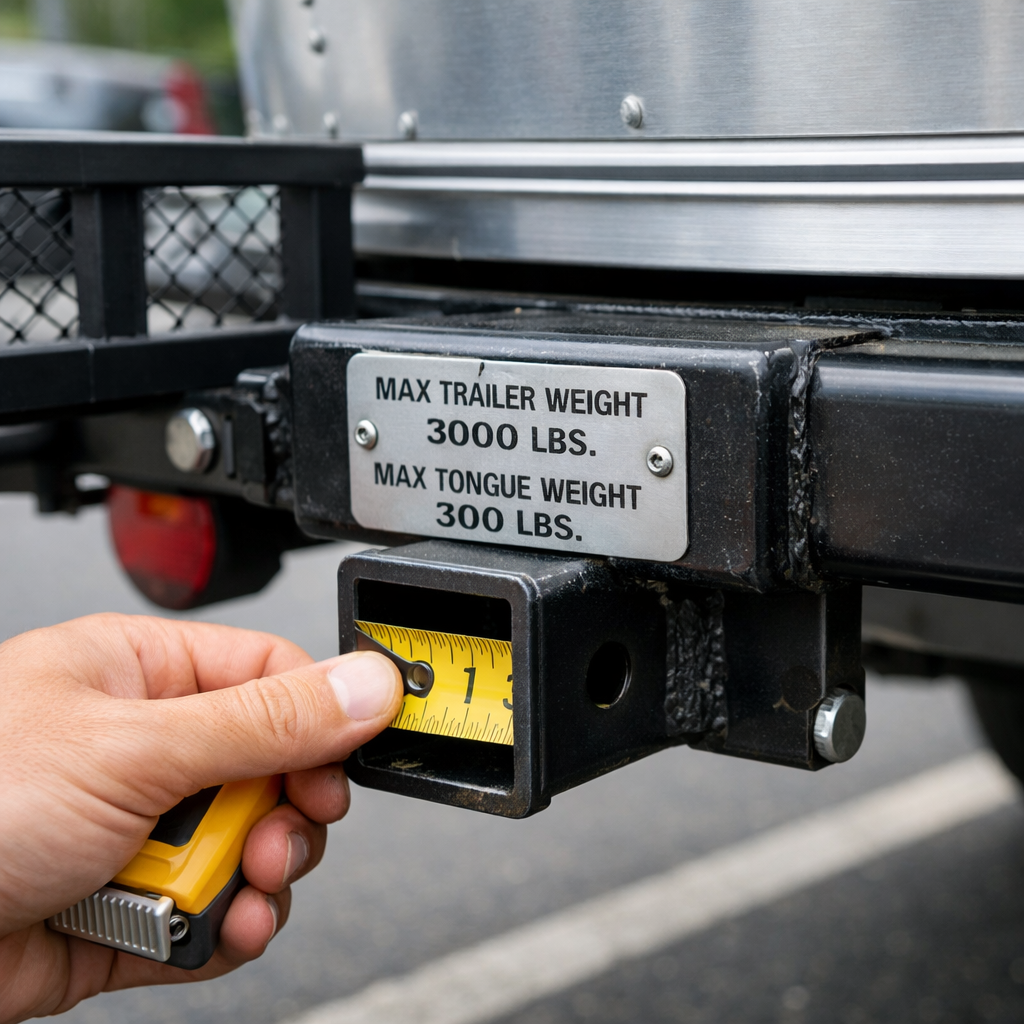
Rear receiver hitch: A steel, frame-mounted accessory point at the trailer’s rear with a square receiver opening (often 2"). It lets owners attach bike racks, cargo carriers, and similar add-ons while keeping the Airstream’s structure intact and weight safely distributed across the frame.
On small Airstreams, a rear receiver hitch is a dedicated mounting point for bikes and cargo trays that avoids internal frame modifications and preserves ground clearance when the mount is purpose-built for the shell and frame geometry. Many small Airstream hitch solutions use a 2" receiver to support common racks and carriers, and the best units spread loads across existing structural points to protect frame integrity and keep handling predictable at speed, as emphasized in an Airstream rear hitches guide from Torklift Central. RV Critic’s guides emphasize the same load-spreading approach for predictable handling.
Quick fact box (popular small Airstream hitch spec):
- TailoredHitch for Airstream: engineered to SAE J684, 2" receiver
- Ratings (standard models): 3,000 lb towing, 450 lb tongue weight
- Built in the USA with Lifetime Warranty
- Model-specific fits including frame width options
Source: Airstream Accessory Hitch X8000
Secondary terms to know: small Airstream hitch, rear receiver hitch, Airstream Bambi hitch, Airstream Basecamp hitch.
Measure receiver size, frame width, and clearances
Use this measurement flow to prevent wobble, misfit, or scrape issues:
- Confirm receiver size by measuring the inside opening: common sizes are 1.25", 2", 2.5", and 3" (most small Airstream solutions use 2"); see this hitch size chart for dimensions.
- Measure coupler and receiver heights on level ground to determine if your accessories need rise/drop shanks to stay level.
- Check ground clearance at the lowest point near the receiver. Target about 13" unloaded and no less than ~11" when fully loaded to reduce driveway-scrape risk.
- Measure outside-to-outside frame width at the rear crossmember and note if you have a factory storage bumper.
- Weigh intended accessories (racks plus cargo) and compare to the receiver’s tongue rating.
Fit callout: TailoredHitch X8000 fits Airstream frame widths 61"–62.5" with the factory storage bumper; X8001 fits 66"–67.5". Measure outside-to-outside frame width before ordering (Airstream Accessory Hitch X8000).
Pre‑purchase fit table (fill in your numbers)
| Item | Your measurement/notes |
|---|---|
| Receiver size | 2" (typical) / 1.25" / 2.5" / 3" |
| Rear frame width (O–O) | ______ inches |
| Bumper type | Factory storage bumper / None |
| Ground clearance (loaded) | ______ inches (target ≥11") |
| Accessory weights total | Rack ____ lb + Gear ____ lb = ____ lb |
Calculate safe tongue weight and rear cargo load
Keep tongue weight between 10–15% of the trailer’s loaded weight; under ~10% increases sway risk while 12–15% is typically stable according to Airstream Club towing ratings and the Airstream towing guide.
Three-step tongue weight calculator:
- Estimate GTW (gross trailer weight) = base unit + options + hitch + fluids + cargo + passengers.
- Target tongue weight (TW) = 0.10–0.15 × GTW.
- Compare TW to the trailer’s published hitch weight rating and ensure rear‑mounted accessory load stays within the rear hitch’s tongue limit (often up to 450 lb on small‑Airstream‑specific hitches; see Airstream Accessory Hitch X8000).
Worked example:
- Assumed GTW: 4,600 lb. Target TW: 460–690 lb.
- Planned rear cargo: two e‑bikes (130 lb) + rack (60 lb) = 190 lb on the rear receiver.
- Check 1: 190 lb is within a 450 lb rear hitch tongue rating.
- Check 2: Because weight at the extreme rear acts like a lever, it can reduce front‑hitch TW. Measure TW with a tongue‑weight scale after loading; aim to remain in the 12–15% range for stability.
Tip: E‑bikes, generators, and enclosed trays can quickly approach a 450 lb limit—always weigh the rack plus gear together before a trip (Airstream Accessory Hitch X8000).
Confirm model-specific fitment for Bambi, Basecamp, and Caravel
- Bambi/Caravel: Typically use 2" receiver Class III solutions. Verify rear frame width and the presence of a factory storage bumper against TailoredHitch X8000/X8001 specifications, then select the correct part number for your frame width (Airstream Accessory Hitch X8000).
- Basecamp: Designs are model‑specific; some variants have lower tongue allowances. Always match your setup to the Airstream towing guide’s GVWR and hitch weight tables before adding rear cargo.
- Remember: Factory ratings cap the entire setup. Adding a hitch or carrier never increases the trailer’s or tow vehicle’s published limits (Airstream towing guide).
For a quick cross-check while you measure, see RV Critic’s small‑Airstream fitment guides.
Secondary terms: Airstream fitment guide, small Airstream models.
Choose receiver class, anti-rattle, and stabilization add-ons
Most Airstreams pair best with Class III/IV components, and many small models use 2" receivers for broad accessory compatibility, consistent with both brand-specific hitch guides and ProPride’s best-practices for Airstream towing (see ProPride on sway control). RV Critic’s towing checklists align with these best practices.
Anti-rattle device: A clamp or wedge that tightens the connection between the receiver and the accessory shank. By removing play, it reduces noise and side-to-side or up-down movement, which can otherwise magnify stress on the hitch and make accessories feel unstable at speed.
If stability is marginal or loads approach limits, consider a weight‑distribution and anti‑sway system. ProPride highlights its 3P Hitch for robust sway control; verify compatibility with your tow vehicle and trailer before purchase.
Install correctly and torque to spec
Purpose-built small Airstream hitches mount to existing frame points, maintain ground clearance, and avoid drilling or welding when matched to the correct frame width (Airstream Accessory Hitch X8000). Follow the manufacturer’s torque values and sequence; if unsure, use a professional installer to avoid misalignment or under/over‑torquing that can degrade performance (Airstream rear hitches guide). RV Critic’s install checklists help you prep tools and steps before you start.
Quick install checklist:
- Confirm hardware grade and replace only with equal or higher spec.
- Use threadlocker if the instructions specify it.
- Re‑torque all fasteners after the first 50–100 miles and at regular intervals thereafter.
Test ride, rebalance cargo, and verify stability
Do a short shakedown drive with your actual load. If you notice sway, tail‑wag, or light steering, move cargo forward, reduce rear weight, or adopt weight distribution to restore 12–15% tongue weight.
Pass/fail checklist:
- Pass: no tail‑wag, precise steering, straight braking.
- Pass: loaded ground clearance ≥11" where feasible.
- Verify: hitch pin secured, anti‑rattle tightened, license plate and lights remain visible.
Maintain, inspect, and plan loads trip by trip
- Measure tongue weight with a scale before long trips and whenever your accessory mix changes to keep 10–15% TW.
- Before each trip: check bolt torque, inspect the receiver tube for deformation, accessory shank wear, and anti‑rattle hardware tightness; quarterly, check for rust/paint loss and re‑torque as needed (hitch size chart guidance is useful for identifying wear points).
- Keep documentation of your hitch ratings and SAE J684 compliance in your tow kit for quick reference (Airstream Accessory Hitch X8000).
Secondary terms: hitch maintenance, SAE J684, inspection checklist.
Budgeting and gear planning for compact Airstream setups
Budget checklist (plan by season):
- Hitch (model‑specific), anti‑rattle device, bike rack or cargo tray, tie‑downs/locks
- Torque tools (calibrated wrench), spare hitch pin/clip, reflective tape or auxiliary lighting if a tray obscures lights
- Optional: weight‑distribution/sway control
Note: E‑bikes and heavy trays can push you toward a 450 lb hitch limit—verify combined rack + gear weight and recheck tongue weight after loading (Airstream Accessory Hitch X8000).
Sample loadouts:
- Weekend cyclists: 2" receiver + anti‑rattle + two‑bike rack + small gear box. Confirm final tongue weight remains 10–15% of GTW (Airstream Club towing ratings).
- Remote work kit: 2" receiver + enclosed cargo tray + compact generator. Ensure loaded ground clearance ≥11" and rebalance forward if steering feels light.
Want more RV budgeting and compact‑space strategies? See RV Critic guides.
Frequently asked questions
Are there lightweight rear receiver hitch options designed for small Airstreams?
Yes. Purpose-built 2" receivers designed for small Airstreams keep weight low and preserve frame integrity; RV Critic’s hitch guides outline common fits and ratings.
How much weight can I safely carry on a small Airstream rear receiver?
Many small-Airstream-specific hitches are rated up to 450 lbs of tongue weight. RV Critic recommends keeping overall tongue weight at 10–15% of your trailer’s loaded weight and including the rack plus gear in your calculation.
Do I need weight distribution or anti-sway with a rear-mounted cargo tray or bikes?
If you’re near tongue limits or notice light steering or sway, consider a weight-distribution and anti-sway system. An anti-rattle device and balanced cargo placement can also improve stability and ride quality.
Can I tow from a rear receiver on a small single-axle Airstream?
Generally no—RV Critic notes rear receivers on small single-axle trailers are intended for accessories rather than towing. Always follow your trailer’s and hitch’s published ratings—no hitch increases your factory limits.
How often should I inspect bolts, welds, and accessory hardware?
RV Critic suggests a quick pre-trip inspection and re-torque after the first 50–100 miles post-install. Add a quarterly check for rust, paint loss, and any play in the receiver-to-accessory connection.