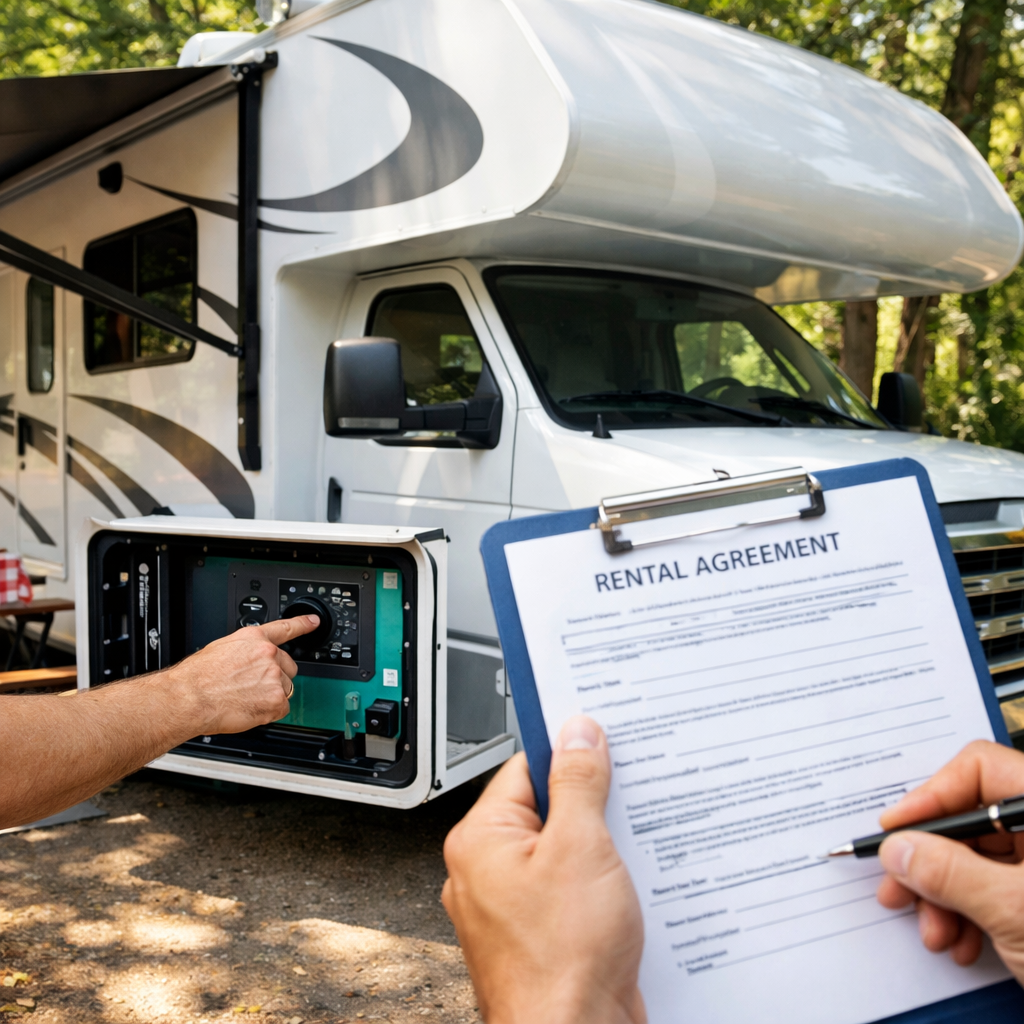
Skip Hidden Fees: RV Rentals With Generator Use Included
Planning to boondock or camp without hookups? The fastest way to avoid surprise costs is to book a generator‑included RV rental—listings that bundle generator use in the base price, often with “unlimited” or higher daily hour caps. On peer‑to‑peer marketplaces, many owner‑run Class C and trailer listings include generator use; corporate fleets, by contrast, commonly charge hourly for runtime (for example, Cruise America meters generator use and bills by the hour) (see Cruise America’s generator policy). RV Critic’s rule of thumb: verify the exact cap, overage rate, and how hours are recorded before paying.
Why generator fees inflate RV rental costs
Many rentals include only a small generator allowance—typically about four hours per day—then charge $3–$5 per additional hour. Inclusions and add‑ons vary by owner and platform, but fee patterns are remarkably consistent across listings (see Outdoorsy review fee examples).
“Generator overage fee” definition: A generator overage fee is the per‑hour charge a rental imposes once you exceed the daily generator allowance (often about four hours). It’s calculated from a runtime meter or log and typically runs $3–$5 per hour, billed against your security deposit at return.
Other common costs that compound total price:
- Included miles: usually 100–150/day, with $0.35–$0.75/mile overage.
- Delivery: $3.50–$7.00/mile.
- Cleaning: typically $50–$200 per trip (see SmarterTravel’s guide to RV rental hidden costs).
- Pet fees: $10–$25/day or $50–$150 flat; dumping $25–$75; prep $50–$100 (see Outdoorsy review fee examples).
Generator fees alone can add $150–$300 to a week of high‑usage camping, especially in hot weather when air conditioning runs frequently (see this warning on add‑on fees).
How generator policies work on rentals
Most listings follow a simple structure: a daily runtime cap (around four hours) with a posted overage rate of $3–$5/hour. Expect charges when dry camping or during heat waves when you need air conditioning and can’t plug into shore power (see SmarterTravel’s guide to RV rental hidden costs; see Outdoorsy review fee examples).
What to verify in any listing:
- How hours are measured (hour meter, telematics/app, or owner log).
- Whether unused hours roll over day‑to‑day.
- If “generator included” actually means unlimited, or just a higher cap tied to campground use.
“Electric hookups” definition: Electric hookups are campsite power pedestals that provide shore power, typically 30‑amp or 50‑amp AC service, via a cord and adapter set. When you plug in, your RV’s appliances run from the grid instead of the onboard generator, eliminating runtime charges and reducing noise and fuel use (see SmarterTravel’s guide to RV rental hidden costs).
Where generator use is typically included
Owner‑run listings on marketplaces often advertise “generator included,” “unlimited hours,” or a higher cap, while others stick to four hours/day and meter overages. Marketplaces display base fees clearly, but owner‑added extras can still surprise you—so always confirm in writing (see RVshare’s explainer on how marketplaces work; see Outdoorsy review fee examples). RV Critic advises getting those terms confirmed in the platform message thread.
Search smarter:
- Filter or keyword search for “generator included,” “unlimited generator,” or “no generator fee.”
- Clarify whether “unlimited” applies everywhere or only when connected to electric hookups.
- Capture screenshots of the price breakdown with generator terms visible before you book.
How to verify generator inclusion before booking
RV Critic checklist to lock down terms and preserve proof:
- Open the listing’s price breakdown and rules. Record the daily hour cap, overage rate, measurement method, and whether hours reset each day.
- Message the owner: “Is generator use included in the base price? If capped, what’s the exact overage per hour and how is usage recorded?”
- Confirm the security‑deposit hold amount, daily insurance cost, and platform/service fees before paying (see Outdoorsy review fee examples).
- At pickup and return, photograph the generator hour meter and note readings in the checkout form.
Power-smart alternatives that avoid generator fees
- Choose campgrounds with electric hookups so you can run air conditioning and high‑draw appliances from shore power—no runtime charges.
- Book rigs with larger solar arrays, lithium batteries, and true sine‑wave inverters to reduce or eliminate generator use. “Lithium battery bank” definition: A lithium battery bank is a set of lithium‑iron‑phosphate (LiFePO4) batteries paired with a charger and inverter to store significant DC energy and power AC loads. Compared with lead‑acid, it recharges faster, tolerates deeper discharge, weighs less, and supports solar expansion for quieter, generator‑free camping (see RV PRO’s power trends report; see Beckley’s RVs on 2026 camping trends).
- Bring a portable power station (often called a “solar generator”) as a quiet backup for electronics and small appliances during outages or cloudy stretches.
Platform transparency and owner policy differences
Marketplaces surface many fees up front, yet owner‑specific rules still vary, and some agreements can shift mechanical‑failure risk to renters—so read the contract carefully (see Outdoorsy review fee examples; see RVshare’s explainer on how marketplaces work).
Common add‑ons in real‑world quotes:
- Platform fees: around 10% plus roughly $15/day.
- Insurance: often $34–$42 per day, depending on rig class and coverage.
- Plus the usual cleaning, delivery, pet, dumping, and prep fees—compare these side by side, not just the nightly rate.
Budget scenario: included generator vs hourly charges
Example: Week‑long Class C rental, $180/night with a 20% weekly discount.
| Cost item | Scenario A: Generator included | Scenario B: 4 hrs/day included + overages |
|---|---|---|
| Base rate (7 nights, −20%) | $1,008 | $1,008 |
| Platform/service fees (10% + ~$15/day) | ~$206 | ~$206 |
| Insurance ($34–$42/day) | $238–$294 | $238–$294 |
| Generator fees (moderate use: 14 overage hours @ $3–$5) | $0 | $42–$70 |
| Generator fees (high‑usage week) | $0 | $150–$300 |
| Estimated weekly total (before taxes/mileage/cleaning) | $1,452–$1,508 | $1,494–$1,578 (mod) or $1,602–$1,800 (high) |
Context: A refundable deposit hold of $1,000–$1,200 is common and not part of trip spend (see Outdoorsy review fee examples).
Takeaway: Total‑cost comparison beats base‑rate shopping every time—RV Critic’s stance on rentals.
Safety, licensing, and campsite power basics for renters
“Boondocking” definition: Boondocking is camping without campground hookups—no electric, water, or sewer—often on public lands or in designated dispersed sites. Power must come from onboard batteries, solar, or a generator, so air conditioning and other high‑draw appliances usually require generator runtime that can trigger hourly rental fees (see SmarterTravel’s guide to RV rental hidden costs).
- Plan your loads: AC, microwaves, hairdryers, and heaters burn generator hours fast; hookups or lithium/inverter rigs reduce runtime.
- Most renters can drive typical motorhomes on a standard license, but always confirm state weight limits and any exceptions (see Harvest Hosts’ renting vs buying overview).
- Use correctly rated cords/adapters (30‑amp vs 50‑amp), and know late‑return, refuel, propane, and campground policy fees in advance.
Hitch and tow readiness for trailer rentals
“Receiver hitch classes” definition: Receiver hitch classes label a hitch’s tow capacity: Class I–II for light duty, Class III–IV for mid‑ to heavy‑duty travel trailers, and Class V for the heaviest loads. Options include heavy‑duty hitches for Class C motorhomes, hidden receivers, and stainless, saltwater‑safe hardware for coastal use (see RV Critic hitch fitment guide).
Before towing, verify:
- Tow rating and tongue weight vs the trailer’s GVWR/loaded tongue weight.
- Brake controller compatibility and a functional 7‑pin wiring connection.
- Correct ball mount size, weight‑distribution/sway control setup, and chain clearances.
- For coastal or ferry travel, use stainless hardware to resist corrosion and confirm hitch clearance for steep driveways or ramps.
Roadside assistance and deposit policies to confirm
- Ask if roadside assistance is included and what it covers (towing, flat repair, lockout, jump‑start). It’s invaluable if you rely on power for medical devices or during outages.
- Expect a refundable security‑deposit hold of roughly $1,000–$1,200; read damage and liability clauses carefully (see Outdoorsy review fee examples).
- Document pre‑trip condition with photos, including the generator hour meter, fuel levels, and propane status at pickup and return.
City and vehicle specific shopping tips
- In dense metros, prioritize listings that advertise “generator included,” unlimited miles, or free delivery. Where parking is tight, verify street parking, height limits, and delivery fees (often $3.50–$7/mile).
- Vehicle picks:
- Class C: family‑friendly and commonly equipped with onboard generators—seek unlimited or included runtime if you plan to dry camp.
- Towables: match to the right receiver hitch and book campgrounds with electric hookups to skip generator use altogether.
- Check local availability of full‑hookup sites versus boondocking areas to forecast generator dependence and costs.
Frequently asked questions
How many generator hours are usually included with an RV rental?
Many rentals include about 4 hours/day, with overage fees typically $3–$5 per hour. RV Critic recommends confirming the cap and overage rate in writing.
Can I avoid generator charges by choosing electric hookups?
Yes—electric hookups let you run AC and appliances without the generator, so you avoid hourly fees. RV Critic suggests booking full‑hookup sites if you expect heavy power use.
What’s the difference between an onboard generator and a portable “solar generator”?
An onboard generator burns fuel to produce AC power and is metered for hourly charges, while a portable “solar generator” is a battery‑inverter pack recharged by solar or shore power for small to medium loads. RV Critic considers these power stations helpful backups, not substitutes for metered onboard units.
Do I need a special license to rent and drive a motorhome?
In most states, a standard driver’s license works for typical rentals; confirm weight limits and any exceptions before booking. RV Critic advises checking your state DMV.
How do security deposits and damage liability work on RV rentals?
Most platforms place a refundable security‑deposit hold and outline damage responsibility in the rental agreement. RV Critic recommends photo‑documenting the RV’s condition, including generator hours, at pickup and return.