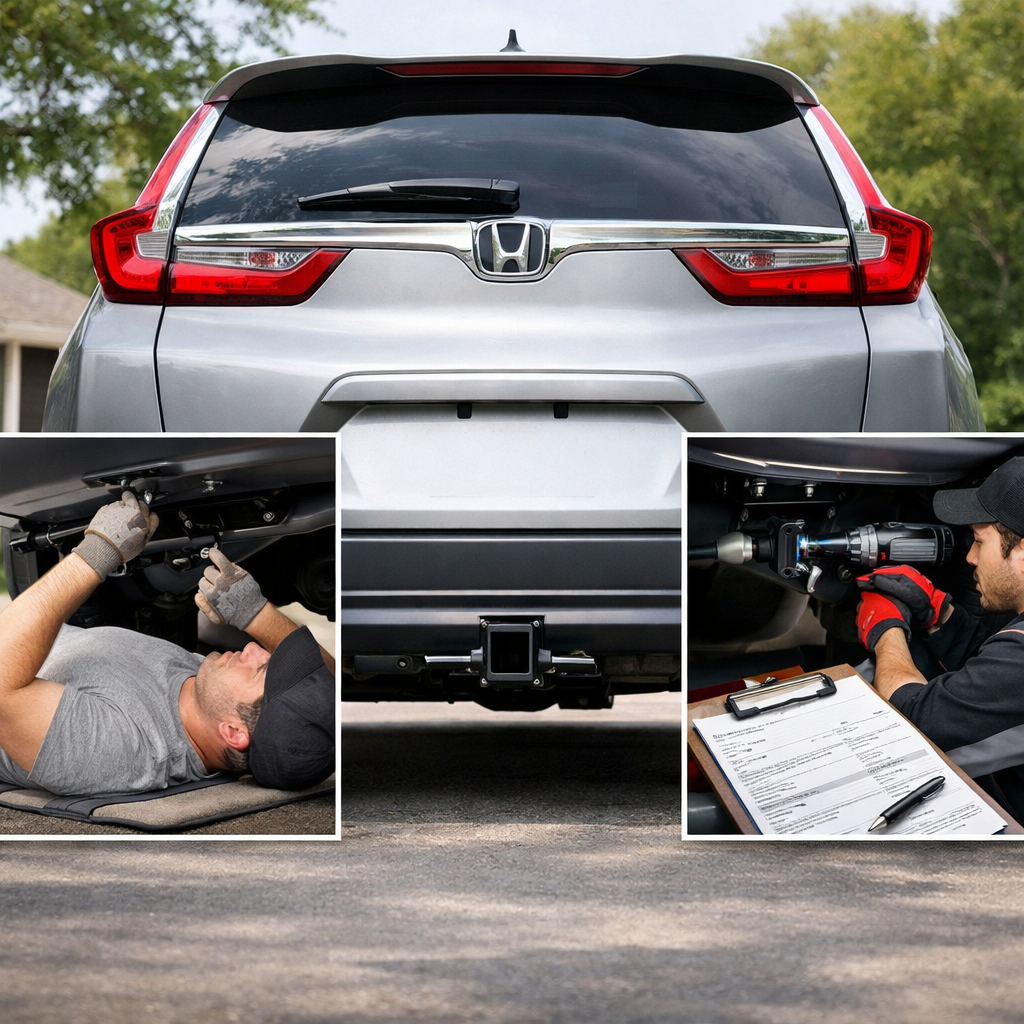
No-Drill Versus Dealer Install: Save on Honda CR‑V Trailer Hitches
If you’re deciding between a wallet-friendly no-drill add-on and a dealer-installed hitch package for your Honda CR‑V, here’s the bottom line: the best all-around hitch setup for most CR‑V owners is a custom-fit 2-inch Class III receiver from a reputable brand like Draw‑Tite or CURT, paired with clean, secure wiring. If you already have a hitch or you’re just organizing the plug, a no-drill trailer connector bracket is the fastest, cheapest upgrade. Dealer or pro installation makes sense when you want full towing readiness—receiver, wiring, and integration—done once and documented. RV Critic covers CR‑V hitch fitment, install paths, and total cost to help you choose with confidence. Below, we break down who should choose which path, what no-drill kits actually do, real costs, fit notes, safety, and ways to save.
Who should choose no-drill versus dealer install
No-drill brackets clamp to an existing hitch tube or bumper face to mount your trailer plug neatly without drilling into factory panels. They install quickly, maintain a clean look, and keep wiring from dangling. Use them when you need a tidy, accessible connector mount—not a structural upgrade.
Dealer or professional installs are the right call when you need the entire towing system set up to spec: a rated receiver, integrated wiring, and any vehicle-side activation for modules or brake controllers. That path protects load ratings and gives you service documentation that’s easy to reference later.
Quick decision guide:
- Choose no-drill if you want a no-drill trailer connector mount (4/5/6-way), prefer a low-cost, DIY-friendly solution, and can set aside about an hour with basic tools.
- Choose dealer/pro if you need an OEM-style or custom-fit hitch installed, factory-like wiring, and full towing readiness with paperwork that supports warranty confidence.
What no-drill kits cover and what they don’t
A no-drill mounting bracket is a clamp-on accessory that secures a trailer electrical connector to an existing hitch or bumper. It prevents the plug from hanging loose, improves access, and preserves factory trim—without adding towing capacity. Long-bracket variations, such as Tow Ready’s 18136, extend the plug to a more reachable location and are designed to clamp on with no holes drilled (Tow Ready no‑drill bracket review).
Examples you’ll see frequently:
- CURT’s C83DR no-drill mount accommodates common 4-, 5-, and 6-way connectors and uses a band-style clamp for quick placement.
- Tow Ready’s 18136 long bracket helps with plug reach and clearance on deeper bumpers or tucked receivers.
What it covers:
- A secure, visible mounting point for the connector
- Cleaner look with reversible, clamp-on hardware
- Keeps the plug from dragging or snagging while driving
What it doesn’t cover:
- Structural towing capacity (it’s not a hitch)
- Replacing the receiver or changing its rating
- Full vehicle wiring integration or brake controller setup
Cost comparison and where savings come from
Here’s a simple view of parts-versus-labor and where DIY pays off.
| Option | Typical parts cost | Typical labor | What you get |
|---|---|---|---|
| No-drill connector bracket (clamp-on) | $15–$30 | $0 (DIY) | Clean, secure plug mount; no drilling |
| Custom-fit Class III hitch + 4-way wiring (DIY) | $200–$370 | $0–$100 (tools/supplies) | Receiver + basic trailer lights |
| Custom-fit Class III hitch + 4-way (dealer/pro) | $200–$370 parts + $250–$500 labor | $250–$500 | Turnkey install, documentation |
| Class III hitch + 7-way + brake controller (pro) | $400–$700 parts | $300–$700 | Braked-trailer readiness and integration |
Savings drivers:
- No-drill brackets install in about an hour with hand tools, so DIY often makes sense.
- Avoid bundled dealer add-ons you don’t need; buy parts selectively and hire an independent installer if needed.
- Many retailers offer free shipping thresholds (often orders over $99), which can reduce parts costs when bundling a hitch and wiring together (etrailer product demo pages).
Negotiation mini-flow for pro installs:
- Get pre-approval or financing lined up elsewhere.
- Negotiate the out-the-door price, not just the line items.
- Collect 3–5 written quotes and leverage them during negotiations (dealer add-on thread).
Fit and compatibility for Honda CR‑V
For the CR‑V, prioritize custom-fit hitches engineered for the factory mounting points. A 2-inch Class III receiver offers the best compatibility with bike racks, cargo carriers, and light towing. Depending on model year, some installs require only underbody panel loosening, while others involve modest trim removal—custom-fit designs minimize guesswork. RV Critic organizes CR‑V fit notes by generation to reduce surprises.
Universal no-drill electrical brackets work well but should be test-fitted to ensure the connector clears trim, exhaust outlets, and parking sensors. Dry-fit before final tightening.
Fit checklist:
- Confirm CR‑V generation and trim level.
- Choose a 2-inch Class III receiver for maximum accessory compatibility.
- Dry-fit the clamp and connector to verify clearance and reach.
Installation time and skill required
No-drill brackets are DIY-friendly and typically install in about an hour using basic hand tools like sockets, wrenches, and a torque wrench. Video demos show clamp placement, band routing, and connector bolt-up steps that most owners can follow in a single session (CURT no‑drill bracket demo). RV Critic’s walkthroughs help you plan tools and steps so the install goes smoothly.
By contrast, hitch and wiring installs can require lifting the vehicle, removing underbody panels, fishing hardware through frame rails, and accessing wiring harnesses or ECU connections. If you’re not experienced, a professional install is safer and often faster.
Basic steps for a no-drill bracket:
- Measure and choose the clamp position on the hitch tube for visibility and clearance.
- Wrap the no-drill band and tighten to the manufacturer’s torque spec.
- Bolt the connector to the bracket, route the harness with strain relief, and secure slack.
Durability, load rating, and safety
“Towing capacity is the maximum weight a vehicle can pull safely, and it’s set by the lowest-rated component in the chain—the vehicle, hitch, ball mount, or coupler.” Clamp-on electrical brackets are not load-bearing parts; they don’t change your tow rating.
Safety checks for the CR‑V:
- Match hardware to the job: a Class III hitch is appropriate for most CR‑V uses.
- Torque all fasteners to spec and recheck after the first 50–100 miles.
- Keep wiring away from hot exhaust sections, sharp edges, and moving suspension parts.
Electronics and sensor considerations
Bracket placement matters on crossovers with hands-free liftgates and rear parking sensors. A clean, secure connector mount prevents dangling wires that can confuse sensors, trigger alerts, or snag debris. If you’re adding a 7-way and brake controller, factory-like routing and grounding reduce electrical issues—this is where a pro can help ensure a clean install.
Post-install sensor check:
- Test the hands-free liftgate.
- Verify backup sensors and camera views.
- If interference is detected, reposition the bracket slightly outward or inward on the hitch tube.
Warranty and documentation best practices
Protect your warranty standing by documenting everything:
- Keep dated receipts, packaging with part numbers, torque notes, and clear photos of the install.
- For full hitch and wiring, a professional install aligns with dealer expectations and simplifies service conversations.
- Follow manufacturer instructions; having vehicle systems verified by a qualified tech builds warranty confidence. RV Critic’s documentation checklist makes this straightforward.
Side-by-side verdict for common CR‑V use cases
- Bike rack or light cargo carrier: Custom-fit Class III hitch; add a no-drill connector bracket if you’re also installing trailer wiring and want a clean plug location.
- Occasional small trailer: Pro-installed Class III hitch + 4-way wiring; add a no-drill bracket to secure the connector and simplify plug access.
- Trailer with brakes or frequent towing: Dealer/pro install of hitch + 7-way wiring and a brake controller; prioritize integration, documentation, and long-term reliability.
How to save more on either path
- DIY route: Bundle parts to hit common free-shipping thresholds and watch install videos to avoid rework.
- Dealer/pro route: Negotiate the OTD price, secure financing pre-approval first, and gather 3–5 quotes to compare labor and fees (buyer negotiation thread).
- Partial DIY: Install the no-drill connector bracket yourself, then pay a pro for the receiver and wiring to balance cost and quality.
Frequently asked questions
Are there affordable no-drill options for a Honda CR‑V?
Yes. Clamp-on brackets in short or long styles are inexpensive, install with hand tools in about an hour, and keep the trailer plug secure without drilling; RV Critic highlights CR‑V fit tips to help you choose the right style.
Will a no-drill bracket replace a full hitch?
No. A no-drill bracket only mounts the trailer connector; it isn’t load-bearing and doesn’t provide towing capacity, and RV Critic’s guides clarify what each component does so you don’t overbuy.
Can a hitch affect the hands-free liftgate or sensors?
It can if components block or confuse sensors. Use RV Critic’s placement tips to avoid interference and verify operation after install.
Does an aftermarket hitch or no-drill install void my warranty?
Using rated parts and proper installation practices won’t automatically void a warranty. Keep documentation, and use RV Critic’s checklist to track receipts, torque notes, and photos.
What class hitch and receiver size should I pick for a CR‑V?
A 2-inch Class III receiver is the most versatile for bike racks, cargo carriers, and light towing. RV Critic’s CR‑V fit pages confirm sizing considerations by model year and trim.