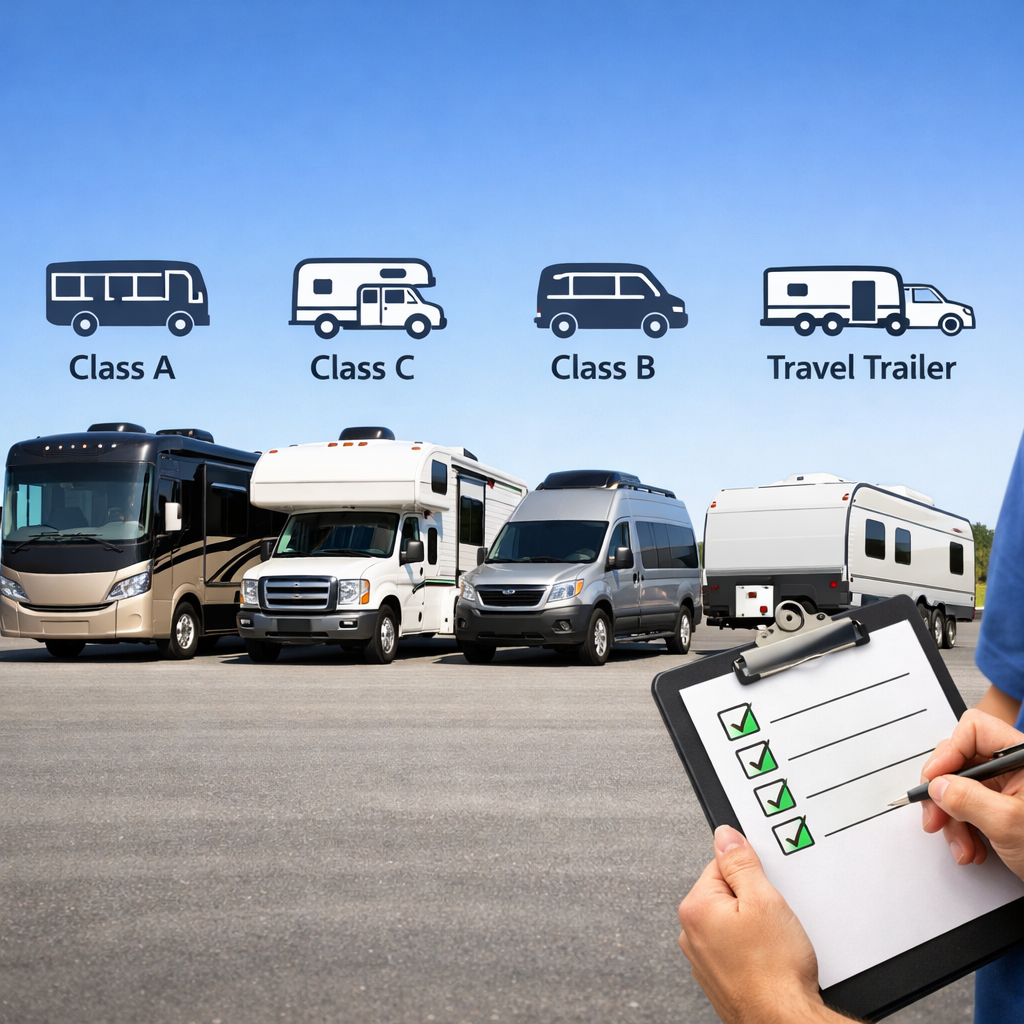
New to RVing? Pros and Cons of Top Styles, Simplified
Choosing between a motorhome and a travel trailer comes down to a few core tradeoffs: drivability vs. living space, towing vs. turnkey travel, and total cost vs. intended use (weekends, long trips, full-time, or off-grid). Expect motorhomes to be easier to set up but pricier to buy and fuel, while towables span the widest range of prices and sizes, from tiny teardrops to residential fifth wheels. For a plain-English primer, start with RV Critic’s RV classes explainer; for typical sizes, MPG, and layouts across classes, see Go RVing’s side-by-side comparisons for a quick snapshot. We’ve also included a price/MPG/towing table and a “who it fits” matrix below to fast-track your decision.
“RV styles (classes)” fall into two families. Motorhomes (Class A, B, B+, C) combine the engine and living area in one vehicle. Towables (travel trailers, fifth wheels, toy haulers, pop-ups/teardrops, truck campers) hitch to a capable vehicle and offer broad size and price variety, per the Types of RVs guide from RecNation.
How to choose your RV style
Follow this quick, four-step path from idea to fit:
Define primary use
- Weekend sprints, seasonal road trips, full-time RV living, or boondocking/off-grid? Short stays favor ease of setup; long trips and full-time reward space, storage, and amenities.
Pick motorized vs. towable
- Motorhomes skip towing and speed arrival-day setup; towables let you detach the vehicle for errands and cost less per square foot. If you’re unsure about RV class differences, skim RV Critic’s plain-English RV classes explainer for a quick overview.
Set a total cost envelope
- Include purchase price, fuel or diesel DEF, maintenance/repairs, insurance, storage, campsite fees, and gear. Motorhomes centralize costs in one vehicle; towables add hitch/brake hardware but let you use your current or upgraded tow vehicle.
Validate real-world fit
- Check campground length and height limits, city parking, driveway clearance, and storage options. Know your target rig’s overall length, height, and turning radius before committing.
Payload vs. towing capacity, simplified: Payload is how much weight your vehicle can carry inside/on it (people, cargo, hitch/tongue weight). Towing capacity is how much it can pull. Tongue weight (typically 10–15% of a travel trailer’s loaded weight) counts against payload and must be included in your math, as explained in Consumer Reports’ beginner’s trailer guide.
Simple decision prompts:
- Short trips or city parallel parking → Class B
- Family space and bunks → Class C or fifth wheel
- Toys/off-road basecamp → Toy hauler or truck camper
Comparison criteria that matter
Use this checklist to compare apples-to-apples:
- Drivability and parking: Wheelbase, visibility, turning circle, wind stability, and MPG.
- Sleeping capacity: Bunks, cab-over beds, convertible dinettes; check true adult-friendly lengths.
- Storage: Pass-through bays, garage space (toy haulers), roof racks, interior cabinetry.
- Cold/heat readiness: Insulation, dual-pane windows, and four-season packages.
- Towing math: GVWR (max vehicle weight), GCWR (vehicle + trailer), axle ratings, tongue weight, and payload.
- Upfront and ongoing costs: Price bands, insurance, maintenance, fuel (Class A vs. Class B differences are dramatic), tires, storage, and campsite fees.
Four-season package, in plain terms: It typically means an enclosed and heated underbelly, insulated tanks and water lines, upgraded wall/roof insulation (higher R-values), and often thermal windows. Some travel trailer brands emphasize four-season/off-grid readiness for boondocking and cold climates, as noted in RVezy’s review of top trailer brands.
Pull-quote ranges to calibrate expectations:
- “Class A motorhomes often average around 6–10 MPG under real-world conditions.”
- “Class B campervans commonly land near 18–22 MPG, helping with long-distance fuel costs.”
- “Travel trailers can range from roughly $10,000–$150,000, about 8–40 feet long, and 1,000–10,000 pounds, spanning ultralights to large bunkhouse models.”
Class A motorhome
Pros
- Maximum interior volume, tall ceilings, and residential amenities ideal for long stays.
- Best for a home-like feel on wheels, with generous storage and systems.
Cons
- High purchase cost, limited maneuverability in cities, and low fuel economy (about 6–10 MPG).
- May require a separate “toad” vehicle for local exploring.
Typical size/price: About 21–43 feet and roughly $75,000–$250,000, based on Go RVing’s Compare RV Types.
Use-case tip: Great for full-time travelers or families prioritizing space and comfort over urban drivability.
Class B van camper
Pros
- Nimble and parkable in cities; many models can be serviced at standard garages.
- Higher fuel efficiency for road-trip mileage (often 18–22 MPG).
Cons
- Limited storage and headroom; tight for more than two travelers.
- Premium pricing for compact, integrated builds.
Typical size/price: Around 16–21 feet; roughly $100,000–$150,000, per Go RVing.
Brand context: Winnebago’s Travato is a popular van-camper line, and Airstream touring coaches use aircraft‑grade aluminum; some vans add four-season insulation and heated tanks, as highlighted in Neighbor’s best RV brands overview.
Class B plus
Pros
- More interior space and amenities than most true Class B vans while staying easy to drive and park.
- Often better bathroom and galley layouts plus more storage.
Cons
- Typically higher cost than many B vans.
- Still less room than most Class C options; bunk layouts are uncommon.
Fit: Ideal for couples wanting extra comfort for road trips without stepping up to a full Class C footprint.
Class C motorhome
Pros
- Family-friendly floorplans with cab-over sleeping; balance of purchase price, space, and drivability.
- Broad range of layouts, often with slide-outs and decent storage.
Cons
- Lower MPG than vans; bigger footprint makes urban parking harder.
- Many owners add a toad for convenient local travel.
Typical size/price: About 25–35 feet; roughly $65,000–$140,000, per Go RVing.
Example: A compact, ~25.5-foot Class C can be manageable for parking and even short-stay programs, according to Harvest Hosts’ brand comparisons.
Travel trailer
Facts
- Lengths ~8–40 ft; weights ~1,000–10,000 lbs; prices ~$10,000–$150,000 (Consumer Reports).
- Many mainstream models cost $20,000–$35,000 and can sleep up to 10 (Go RVing).
Pros
- Huge variety of floorplans and price points; you can detach the tow vehicle for errands.
- Lighter models are accessible to midsize SUVs and half-ton pickups (check ratings).
Cons
- Requires a capable tow vehicle; tongue weight counts against payload.
- Stability improves with weight-distribution and anti-sway gear; setup time varies.
Brand context: You’ll see features like Arctic insulation and solar prep on lines such as Grand Design Reflection, and family-forward layouts (bunks, outdoor kitchens) on models like the Cherokee Grey Wolf, highlighted in a 2026 campers roundup from Bob Hurley RV.
Fifth wheel
Facts
- Residential-style kitchens and front bedrooms are common; many offer washer/dryer hookups (Camping World’s comparisons).
- Sizes ~21–40 ft; average costs ~$40,000–$65,000; sleep up to 8 (Go RVing).
Pros
- Exceptional space, storage, and towing stability with the in-bed hitch.
- Strong choice for full-time living or long-stay travel.
Cons
- Requires a heavy-duty truck with an in-bed hitch and adequate payload.
- Overall height can limit routes/campsites; setup is longer than a van.
Toy hauler
Facts
- Features an enclosed rear garage with a built-in ramp; many ramps convert into patio porches at camp.
Pros
- Safely hauls ATVs, motorcycles, or bikes; garage doubles as living, sleeping, or office space.
- Good weight distribution when properly loaded.
Cons
- Garage space reduces living room in the main cabin.
- Heavier builds increase tow demands and reduce MPG.
Pop-up and teardrop
Facts
- Pop-ups tow around 4 feet high and raise at camp; some are hard-sided for better insulation.
- Teardrops are typically ~13–20 feet, cost about $15,000–$30,000, and sleep 2–3 (Go RVing).
Pros
- Lightest tow demands and easiest storage; lowest purchase cost.
- Great for quick weekend trips and simple gear loads.
Cons
- Limited interior space and weather insulation; soft-sided pop-ups add setup time.
- Minimal tanks and amenities vs. larger towables.
Truck camper
Facts
- Slides into a pickup bed for compact living without towing.
- Typical length ~6–12 ft; weight ~1,000–3,000 lbs; price ~$15,000–$50,000 (Consumer Reports).
Pros
- Superb mobility on rough roads and tight sites; easy to park almost anywhere.
- Tow nothing—your hitch can remain free for gear or small trailers.
Cons
- Strictly payload-limited; heavy campers need 3/4-ton or 1-ton trucks.
- Smaller tanks and storage than larger motorhomes or towables.
Price, MPG, and towing snapshot
| Style | Typical Price | Typical Size/MPG | Notes |
|---|---|---|---|
| Class A | ~$75k–$250k | ~6–10 MPG | Max space; lowest MPG; best for long stays |
| Class B | ~$100k–$150k | ~18–22 MPG | Easiest to drive/park; limited space |
| Class C | ~$65k–$140k | ~25–35 ft | Family-ready; may add toad for errands |
| Travel trailer | ~$10k–$150k | 8–40 ft; 1,000–10,000 lbs | Detach tow vehicle; check tow/payload math |
| Fifth wheel | ~$40k–$65k | 21–40 ft | Residential feel; needs heavy-duty truck |
| Teardrop | ~$15k–$30k | ~13–20 ft | Minimalist; 2–3 sleepers; easy towing |
| Truck camper | ~$15k–$50k | 1,000–3,000 lbs | Payload-limited; go-anywhere mobility |
Towing tip: Tongue weight counts against tow-vehicle payload. Consider anti-sway or weight-distribution kits to reduce strain and improve stability.
Who each style fits best
- Class B: Solo travelers and couples; urban trips; frequent short getaways; fuel-conscious.
- Class C: Families needing cab-over beds; balanced budget and drivability.
- Class A: Full-time or long trips where luxury and space matter most.
- Travel trailer: Budget flexibility with a huge variety of floorplans.
- Fifth wheel: Residential comfort for longer stays; laundry hookups are common.
- Toy hauler: Riders carrying ATVs/motorcycles who want a garage and patio ramp.
- Pop-up/teardrop: Minimalists with small tow vehicles; weekenders.
- Truck camper: Off-roaders with adequate truck payload.
Brand impact note: Premium materials (e.g., Airstream’s aluminum), robust four-season/off-grid packages (e.g., Outdoors RV), and broad dealer networks and features (e.g., Winnebago) can influence build quality, ownership experience, and resale. RV Critic’s RV classes explainer and road trip budgeting guide can help you weigh these longer-term factors.
Recommendation by use case
- City breaks or stealthy parking: Class B; consider a lifted, gear-friendly van like the Airstream Interstate 24X for clearance and cargo flexibility.
- Family road trips with bunks: Class C or a bunkhouse travel trailer.
- Full-time living: Class A or a fifth wheel with washer/dryer prep.
- Toys/off-road basecamp: Toy hauler or a truck camper—confirm payload and axle ratings.
Before you buy, confirm tow rating, payload, and hitch setup for your exact vehicle and planned gear. If possible, rent your target style for a weekend to validate the fit.
Ownership costs and resale factors
Budget beyond the sticker price for insurance, fuel or DEF, maintenance and repairs, tires, campsite or storage fees, and depreciation. Fuel economy varies widely—Class A rigs often return about 6–10 MPG, while Class B vans can reach roughly 18–22 MPG, a major long-term cost lever. Towables add hitch, brake controller, and weight-distribution/anti-sway costs, plus potential upgrades like a transmission cooler. For detailed planning, see RV Critic’s road trip budgeting guide and our tow-hitch cost breakdown.
Resale signals that can help: premium construction (e.g., Airstream’s aluminum shells), four-season/off-grid readiness valued in cold or boondocking regions (e.g., Outdoors RV), and strong dealer support and service networks (e.g., Winnebago).
Frequently asked questions
What size RV is easiest for beginners to handle?
Class B campervans are the easiest to drive and park and usually deliver the best MPG among motorhomes. Small Class C models can also be manageable while adding sleep capacity; RV Critic’s RV classes explainer shows typical dimensions.
How do I match a trailer to my tow vehicle safely?
Verify tow rating and payload, then ensure the trailer’s tongue weight fits within your payload with passengers and cargo counted. Weight-distribution and anti-sway gear can further improve stability; RV Critic’s tow-hitch cost breakdown explains the hardware.
What hidden costs should I expect beyond the purchase price?
Plan for insurance, fuel, maintenance, tires, campsite or storage fees, towing hardware, and potential vehicle upgrades like a brake controller or transmission cooler; RV Critic’s road trip budgeting guide helps you estimate totals. Depreciation and seasonal maintenance also add up.
Is a motorhome or trailer better for weekend trips?
Motorhomes are faster to hit the road and set up, which suits short trips, while travel trailers offer strong value and let you detach the tow vehicle; RV Critic’s checklists simplify the tradeoffs.
How do off-grid features change which RV style I should choose?
If you’ll boondock often, prioritize four-season insulation, heated tanks, solar readiness, and larger batteries; RV Critic’s reviews highlight these packages. Fifth wheels and some travel trailers bundle robust packages, while well-equipped vans and truck campers excel at reaching remote sites.