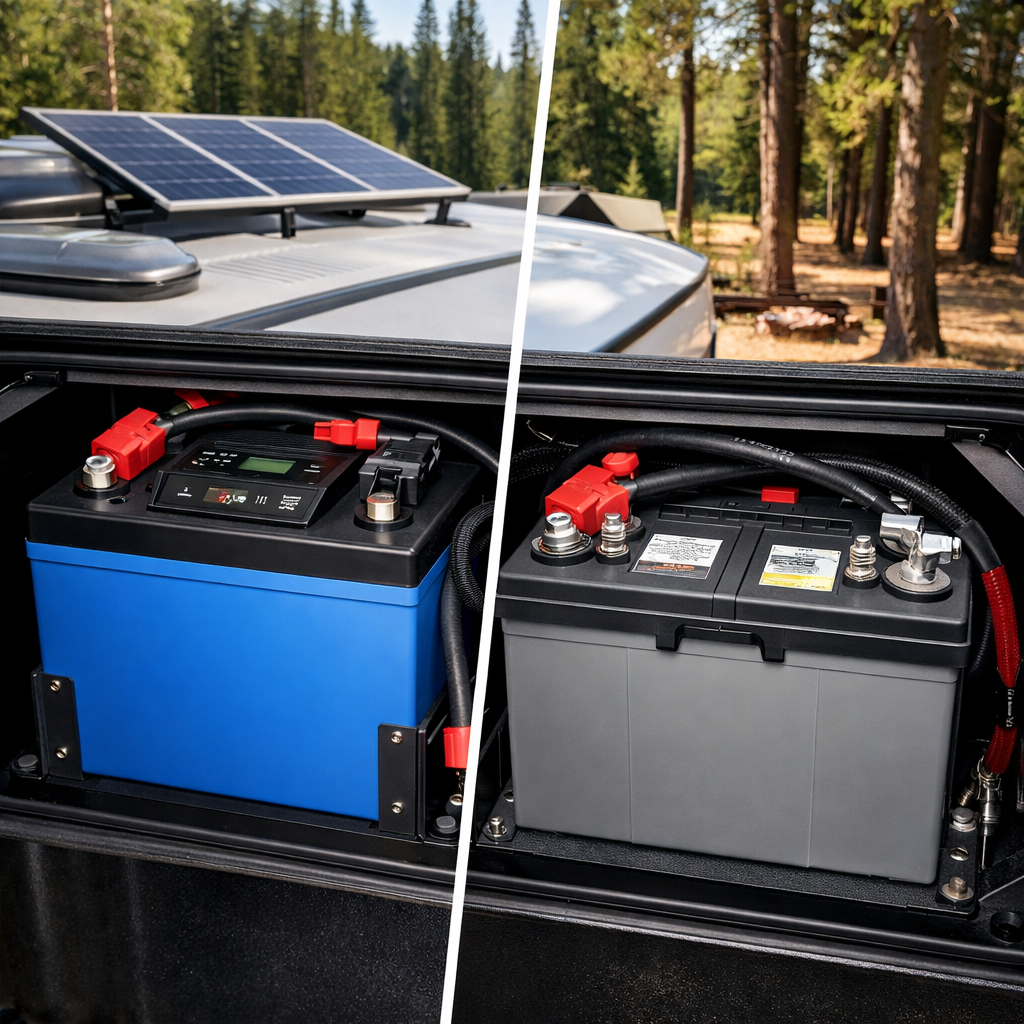
Lithium vs AGM for Off-Grid RVs: Which Setup Wins?
Off-grid RVing (boondocking) lives or dies on two things: how much energy you can store and how quickly you can replace it. For frequent or full-time boondocking, LiFePO4 (lithium) generally wins thanks to higher usable capacity, far longer cycle life, faster charging, and drastically lower weight. AGM still makes sense when upfront cost rules and trips are occasional. Below, RV Critic translates specs into real-world runtimes, solar sizing, payload, and total cost so you can match a battery bank to your rig and travel style with confidence.
Quick verdict for off-grid RVs
Verdict: For frequent or full-time off-grid RVing, LiFePO4 usually wins on usable capacity, cycle life, charge speed, and weight; AGM remains viable for tight budgets and occasional trips.
Boondocking is off-grid RV camping without hookups—no shore power, water, or sewer. Your power comes from onboard batteries, solar, alternator, or generator. Success depends on right-sizing your energy storage and charging, then conserving wisely, because you must generate, store, and manage all electricity and water yourself.
Fast stats for RV battery comparison:
- Usable depth of discharge: AGM ~50% vs lithium 80–100% (higher usable capacity per rated Ah) per Ave Battery’s AGM vs lithium overview.
- Typical cycles: AGM ~300–500 vs lithium 4,000–10,000, a 10x+ longevity advantage (Ave Battery’s comparison).
- Weight (100Ah): AGM about 70 lb vs lithium about 21 lb, roughly one-third the weight per Renogy’s buyer’s guide.
Sources: Ave Battery’s AGM vs lithium overview, Renogy’s buyer’s guide
How we compare RV batteries for boondocking
RV Critic uses the same framework to evaluate off‑grid battery choices.
Use these criteria to choose the right off-grid RV batteries:
- Usable capacity (depth of discharge)
- Charge speed/acceptance (solar, alternator, generator time)
- Cycle life and total cost of ownership (TCO)
- Weight and space (payload, balance, service access)
- Temperature performance (charging and discharging in heat/cold)
- Safety and maintenance (venting, BMS, self-discharge)
- Installation complexity (wiring, ventilation, programming)
- Compatibility with solar controllers, DC‑DC chargers, and inverters
Key definitions:
- Depth of discharge (DoD): The percentage of a battery’s capacity you use before recharging. Higher allowable DoD means more usable energy from the same amp-hours without harming lifespan.
- Total cost of ownership (TCO): The true lifetime cost including purchase price, replacements, and installation, divided over all cycles and energy delivered.
RV Critic references manufacturer and technical comparisons for DoD, cycle life, weight, charge acceptance, and TCO (Ave Battery, Renogy, RELiON, Discover Battery).
Usable capacity and runtime off the same amp hours
AGM batteries are typically limited to about 50% DoD to preserve lifespan, while LiFePO4 commonly supports 80–100% DoD. That means lithium yields roughly 60–100% more usable capacity from the same rated amp-hours (Ave Battery).
Concrete example: To get about 100Ah usable, you might need two 100Ah AGMs (around $800 total) versus a single 100Ah LiFePO4 (around $700) in one comparison (Ave Battery). Prices vary by brand and features.
Table: Same rated capacity, very different usable amp-hours
| Battery type | Rated capacity | Typical usable capacity | Approx. cost | Notes |
|---|---|---|---|---|
| 100Ah AGM | 100Ah | ~50Ah | ~$400 | Plan for 50% DoD to protect lifespan. |
| 2x 100Ah AGM | 200Ah | ~100Ah | ~$800 | Doubles weight and space. |
| 100Ah LiFePO4 | 100Ah | 80–100Ah | ~$700 | Higher usable capacity from same Ah. |
Takeaway: When sizing a battery bank for an RV fridge, fans, lights, or work gear, size to usable amp-hours—not just the label.
Charge speed and solar or alternator compatibility
Lithium batteries accept charge faster and more efficiently than AGM, often cutting generator run time and making better use of solar harvest. Lithium also tolerates partial and irregular charging well; lead-acid that sits partially charged can sulfate and lose capacity over time. See RELiON’s technical comparison for charge acceptance context: RELiON on lithium vs AGM for solar/RV.
Practical guidance:
- Alternator charging: Use a DC‑DC charger sized to bank size and cable limits—30–60A for small banks; higher for larger lithium banks if your alternator allows. This protects the alternator and ensures proper charging profiles.
- Solar: Favor MPPT controllers. Size the array to your daily Ah consumption (plus 20–30% margin). Lithium’s quick bulk and shorter absorption phases let you capture more energy during good sun windows.
Cycle life and total cost of ownership
Cycle life is the number of full charge‑discharge cycles a battery can deliver before capacity drops to an end‑of‑life threshold (often ~70–80%). More cycles spread your purchase cost over more delivered energy, lowering the cost per kWh.
Typical lifespans: AGM around 300–500 cycles; LiFePO4 roughly 4,000–10,000 cycles, with many packs maintaining over 80% capacity after thousands of cycles (Ave Battery).
TCO insight: Though lithium often costs more upfront, it usually delivers a lower lifetime cost per cycle because you avoid multiple replacements. Discover Battery’s analysis underscores why high-cycle chemistries reduce TCO for frequent users: Discover Battery on TCO.
Example: In one comparison, over 3,000 cycles, a two‑AGM setup can total about $4,800 due to replacements, versus about $700 for a single LiFePO4 that covers the same span (Ave Battery). Assumes typical cycle life and retail pricing; your market and usage may differ.
Weight, space, and payload implications
A 100Ah AGM can weigh up to about 70 lb, while an equivalent 100Ah lithium lands near 21 lb—roughly one-third the weight (Renogy). That’s meaningful for towing dynamics and cargo.
What that means in practice:
- Free 50–100+ lb for water, tools, or toys; reduce tongue/axle loads for better handling.
- Higher energy density saves space and simplifies service access.
Quick math: Replacing two 100Ah AGMs (~140 lb) with one 100Ah LiFePO4 (~21 lb) can free about 119 lb of payload—enough for 14+ gallons of fresh water.
Cold weather and temperature performance
AGM tends to be more tolerant in extreme cold and high heat than many lithium chemistries, especially for immediate winter usability (Renogy). Lithium charging below freezing is limited or blocked by the BMS to prevent damage, while AGM can accept charge at colder temperatures with proper voltage control.
Cold-weather tips:
- Lithium: Use insulated compartments or interior mounting, choose packs with low‑temp cut‑off and (if needed) self‑heating, and allow cells to warm before charging.
- AGM: Use correct charging profiles and avoid long-term undercharge to prevent sulfation during winter storage.
For broader cold-proofing ideas, see RV Critic’s winterization upgrades: 9 proven RV upgrades that beat winter freeze.
Safety, maintenance, and installation complexity
Safety facts:
- AGM is sealed, spill-proof, vibration-resistant, and maintenance-free, but can off‑gas hydrogen if overcharged or poorly ventilated (per Renogy and Ave Battery).
- Quality LiFePO4 packs include a battery management system (BMS) that protects against over/under‑voltage, overcurrent, temperature extremes, and short circuits. LiFePO4 is generally non‑toxic and leak‑free (Ave Battery; LithiumHub).
Maintenance notes:
- Lithium avoids equalization charging some lead‑acid systems require and typically has lower self‑discharge (~0.5–3%/month for lithium vs ~1–3%/month for AGM). See summary specs in LithiumHub’s comparison: LithiumHub lithium vs AGM.
Installation guidance:
- Lithium: Confirm inverter/charger lithium profile, BMS low‑temp protections, and proper cable sizing/fusing.
- AGM: Ensure ventilation and precise charge voltages to avoid off‑gassing and sulfation; use temperature-compensated charging where possible.
Real-world setups by use case
Weekend boondocker and tight budget
Choose AGM if cost is paramount: one 100–200Ah AGM bank sized for lights, fans, and a small 12V fridge; plan around ~50% usable DoD. Charging: 200–300W solar with PWM/MPPT plus a smart converter; avoid chronic undercharging, which shortens lead‑acid life. Inverter: 600–1,000W; skip heavy AC loads.
Seasonal traveler and moderate solar
Go hybrid if budget allows: 100–200Ah LiFePO4 for faster recharges and lower weight; otherwise dual 100Ah AGMs. Solar: 300–500W MPPT. Alternator: 30–40A DC‑DC to exploit lithium’s high acceptance. Inverter: 1,000–2,000W pure sine; plan loads around usable capacity.
Full-time off-grid and high-demand loads
Pick LiFePO4: 300–600Ah (or more) with a robust BMS for 80–100% DoD, flat voltage under load, rapid charging, and thousands of cycles. Solar: 600–1,200W+ MPPT; alternator via 60–120A DC‑DC; generator as backup. Inverter: 2,000–3,000W+ with low‑voltage cutoffs tailored to lithium’s flat curve. For broader planning, see RV Critic’s Full‑Time RV Living Checklist: full-time RV living checklist.
Winter camping and subfreezing storage
Frequent subfreezing use can favor AGMs for immediate cold tolerance. For lithium, use heated batteries or warm mounting locations and rely on BMS low‑temp protection. Size 200–400Ah total and insulate the battery bay. Maintain correct charging to avoid AGM sulfation or lithium cold‑charge damage.
What you need to switch chemistries
Chargers and converter settings
Verify your RV converter/charger supports a lithium profile; lithium’s faster acceptance cuts generator hours (RELiON’s comparison). For AGM, precise charging is critical and chronic undercharge reduces capacity over time. If your charger isn’t programmable, upgrade to a smart, chemistry‑compatible model.
Solar controller profiles
Use an MPPT controller with chemistry presets or custom voltages. Lithium typically uses shorter/no float and no equalization. AGM prefers standard absorb/float and must avoid overvoltage that risks off‑gassing; temperature compensation helps protect lifespan.
Inverter compatibility and low-voltage cutoffs
Lithium holds voltage flatter under load; AGM sags more as it discharges. Set inverter low‑voltage cutoffs to match chemistry so appliances run without nuisance trips. Confirm surge and continuous wattage, and upsize cabling and fusing as bank and inverter power grow.
Battery monitoring and BMS considerations
Install a shunt‑based battery monitor for accurate amp-hour tracking, and use temperature sensors in cold climates. A BMS protects lithium cells from over/under‑voltage, overcurrent, temperature extremes, and short circuits—key to safety and lifespan. Add accessible disconnects/breakers for BMS trip resets and service.
Recommendation by budget and rig type
Travel trailers and small campers
- Best value: One 100–200Ah LiFePO4 if towing weight and space matter; faster charging shortens generator time and boosts solar harvest.
- Budget alternative: One or two 100Ah AGMs—remember ~50% usable DoD and higher weight per battery.
Fifth wheels and toy haulers
- Recommended: 200–400Ah LiFePO4 to support larger inverters and heavier appliance loads; benefit from 4,000–10,000 cycle lifespans.
- If budget‑limited: 2–4×100Ah AGM with careful charge management; plan for earlier replacements and higher TCO.
Class B and Class C motorhomes
- Optimal: 200–400Ah LiFePO4 leveraging alternator charging via 30–60A DC‑DC; high acceptance cuts drive‑time to recharge.
- Minimalist: 100–200Ah AGM with precise charging and conservative loads; expect more frequent replacements.
Class A coaches and high-appliance use
- Go lithium: 400–800Ah+ LiFePO4 with 2,000–3,000W inverter and 800–1,200W+ solar for long runtimes and lower generator hours; weight savings improve cargo margins.
- Avoid stacking many AGMs unless necessary; consider payload and multiple future replacements impacting TCO.
Frequently asked questions
How many amp hours do I need for off-grid camping?
For weekends with lights, fans, and a 12V fridge, plan 100–200Ah; for daily off-grid living with cooking and work gear, 300–600Ah+ is common. RV Critic recommends sizing to your daily Ah use and adding a 20–30% buffer.
Can I mix lithium and AGM in the same bank?
RV Critic advises against mixing chemistries—different voltages, internal resistance, and DoD cause uneven charging/discharging and shorter life.
Will my stock RV charger work with lithium batteries?
Often not; use a charger or converter with a dedicated lithium profile or adjustable voltages. RV Critic recommends upgrading if yours isn’t programmable.
Is lithium safe to mount inside the RV?
Yes—LiFePO4 is generally non‑toxic and leak‑free, and packs include a BMS. Mount securely with correct wiring and fusing, and follow low‑temperature charging guidance.
How cold is too cold to charge lithium batteries?
Below 32°F (0°C) most BMSs restrict charging to prevent damage. Use heated batteries or warm compartments, or wait until the cells are above freezing; RV Critic favors built‑in low‑temp protection for winter use.