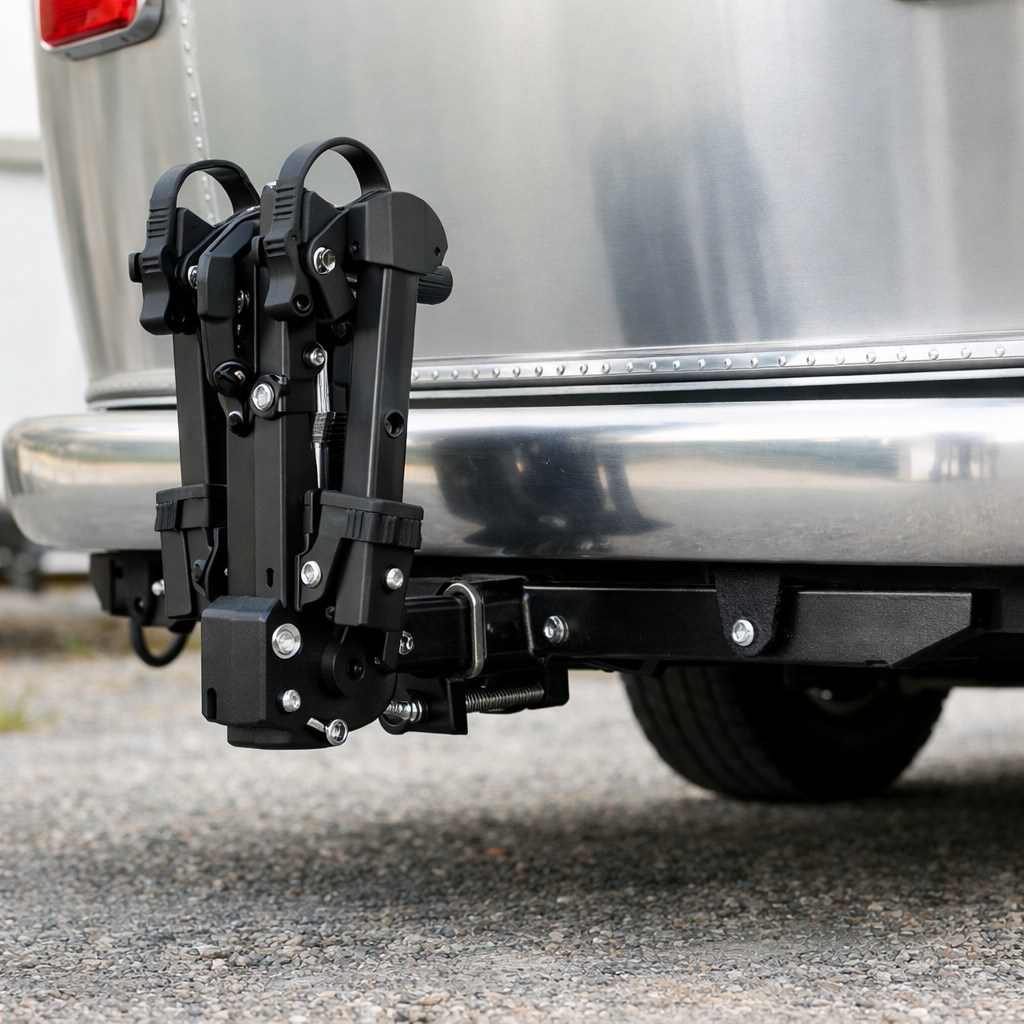
Lightweight Rear Receiver Hitches for Small Airstreams: What Fits Safely
Adding a rear receiver to a small Airstream can be done safely—if you choose a trailer-specific, frame‑mounted design and keep loads light. Purpose-built options for Bambi and Basecamp advertise around 300 lb capacities and claim SAE J684 compliance, with stainless variants for corrosion resistance, but stability still depends on maintaining proper tongue weight and careful loading. Thin aluminum bumpers are not structural attachment points and should never be used for mounting. Community experience—and RV Critic’s guidance—is clear: frame mount only, weigh the trailer before and after, and avoid heavy, cantilevered cargo that can trigger sway. If you’re unsure, carry bikes or gear on the tow vehicle or consider a front rack instead. See how to assess fit, install correctly, and travel confidently below.
Quick answer for small Airstream owners
- RV Critic’s guidance: Yes—lightweight, trailer-specific receivers exist for small Airstreams, including options marketed for Bambi and Basecamp with roughly 300 lb ratings and SAE compliance; safe use hinges on frame mounting, correct hardware, and light cargo only, not towing another trailer (per manufacturer guidance and claims in Torklift’s Airstream-focused materials). See the product and fit details summarized by the TailoredHitch lineup and its stainless variant, as explained by Torklift’s team. Torklift’s overview of lightweight Airstream receivers.
- Avoid universal or bumper-only mounts. Airstream bumpers are thin aluminum and not designed to carry significant loads; owners frequently warn that rear weight can worsen sway on small campers. Owner reports in the AirForums community.
- One-line takeaway: Weigh your trailer loaded, mount to the frame, keep rear loads light (skip heavy e-bikes), and use the tow vehicle or a front rack if in doubt.
How a rear hitch affects small Airstream handling
Tongue weight is the downward force the trailer places on the hitch ball. For stable towing, it’s typically about 10% of the trailer’s loaded weight; too little increases trailer sway, while too much can overload the tow vehicle’s rear axle and degrade steering and braking.
On small Airstreams, even modest weight hung behind the axle acts like a lever that can lower tongue weight and alter handling. Owners have blamed rear-hung cargo for heightened sway and in some cases wrecks—especially on compact, single-axle rigs where small balance changes matter more (as discussed widely by experienced owners).
Illustrative effect of rear-added weight (example ranges only—always weigh your actual setup):
| Added at rear | Illustrative tongue weight change | Relative sway risk |
|---|---|---|
| 40 lb | −20 to −40 lb | Low to moderate increase |
| 60 lb | −30 to −60 lb | Moderate increase |
| 80 lb | −40 to −80 lb | Moderate to high increase |
Note: The actual change depends on trailer geometry and where the weight is placed. Use a tongue weight scale after loading.
Weight and balance basics for safe fit
Weigh the trailer fully loaded and measure tongue weight with a scale. Target roughly 10% tongue weight for stability. ProPride’s technical guidance for Airstream owners echoes the 10–15% range and stresses keeping tongue weight from dropping too low. ProPride’s Airstream towing basics.
Confirm your tow vehicle’s tow and tongue ratings on the door sticker and in the owner’s manual; never exceed them.
If added rear cargo drops tongue weight below your target, shift cargo forward or add front ballast to restore balance before towing.
Definition you can use:
Weight distribution is the practice of shifting or balancing load so the tow vehicle and trailer maintain recommended axle loads and tongue weight, improving steering, braking, and sway resistance.
Simple 10% guide for quick checks:
| Trailer loaded weight | Recommended tongue weight (≈10%) |
|---|---|
| 3,000 lb | 300 lb |
| 3,500 lb | 350 lb |
| 4,000 lb | 400 lb |
| 4,500 lb | 450 lb |
| 5,000 lb | 500 lb |
Use the table as a starting point—verify actual numbers on a scale.
What fits on Bambi, Basecamp, and single axle Flying Cloud
Torklift’s TailoredHitch is engineered for single‑axle Airstreams (including Bambi and Basecamp), lists a 300 lb accessory rating, and claims SAE J684 compliance, with stainless versions for coastal use. It’s designed to attach to the frame and preserve ground clearance, with fitment mapped to specific model years and trim. Torklift notes the product is unaffiliated with Airstream and is not intended to tow another trailer behind a Basecamp or Bambi. TailoredHitch model page with Bambi fit details.
Because frame geometry varies by model and year, trailer-specific engineering is strongly preferred over generic receivers. Some owners choose to avoid rear receivers entirely on small single-axle models; if you proceed, mount to the frame only and verify tongue weight after installation. RV Critic favors trailer-specific, frame‑mounted kits with documented ratings and SAE claims when available.
Trailer specific vs universal receivers
SAE J684 is a safety standard that sets testing and performance requirements for trailer couplings, hitches, and safety chains. Compliance indicates the hitch met standardized strength and durability criteria under defined load conditions; it does not guarantee safe results for every installation or loading scenario.
Comparison at a glance:
- Trailer-specific receivers: engineered around Airstream frame geometry, preserve ground clearance, mount to the frame, include documented ratings, and cite SAE compliance.
- Universal/makeshift receivers: common fitment conflicts; improvisation may compromise clearance or structure; bumper-only mounts are unsafe on Airstreams because the bumper is thin aluminum and not a structural member (a frequent owner caution).
RV Critic’s bottom line: Choose a model-specific, frame‑mounted kit with clear ratings and hardware, not an adapter solution that needs improvisation.
Mounting the right way
- Mount to the frame using the manufacturer’s specified hardware and torque sequence. Do not attach to the thin aluminum bumper or body panels.
- Installation flow:
- Verify intended frame attachment points and confirm no conflicts with tanks, wiring, or stabilizers.
- Dry-fit the receiver; confirm departure angle and ground clearance.
- Install with new, graded hardware; torque to specification in sequence.
- Route any wiring away from heat and moving parts; secure with abrasion protection.
- Re-weigh tongue weight with your typical cargo to confirm balance.
Some owners pursue reinforcement brackets or upgrades to stiffen the shell‑to‑frame interface when adding rear loads. This is specialized, often expensive work—consult a qualified RV fabrication shop and weigh benefits against simply avoiding rear loads. A practical discussion of upgrade tradeoffs is outlined in this analysis of premium hitch systems and reinforcement paths. Independent perspective on hitch upgrades and reinforcement considerations.
What you can safely carry
Keep it light and compact. Small Airstream owners commonly report good results with:
- Two lightweight non-electric bikes
- A small, mostly empty cargo case with camp chairs or soft goods
Avoid high-mass, long-lever items that amplify sway risk:
- E-bikes (often 50–70 lb each before the rack)
- Generators, firewood, full coolers
Calculate effective capacity for accessories and extensions. Manufacturer guidance typically reduces receiver capacity by about 25% for accessories/extensions under 12 inches and about 50% when they extend more than 12 inches from the hitch. Apply reductions before loading, and then check tongue weight.
When a rear hitch is not the right choice
- If your loaded tongue weight is already near the lower limit (around 10%), any rear cargo may push it below that threshold and increase sway risk. ProPride’s Airstream guidance underscores maintaining adequate tongue weight for stability.
- Some owners prefer never to add rear receivers to small single-axle models due to sensitivity to weight shifts—risk tolerance varies, and that’s reasonable.
- For demanding travel—long mountain descents, gusty crosswinds, heavy packing days—avoid rear loads that could degrade stability.
Alternatives to a rear receiver
- Consider the Airstream-recommended back-mounted Fiamma bike rack on applicable models. It bolts on with lighter structure than a receiver plus rack, reducing cantilevered mass that affects tongue weight (a frequent owner recommendation).
- Front-mounted bike racks over the propane tanks can keep weight forward and preserve tongue weight on some models.
- Use the tow vehicle’s hitch or roof system for bikes and cargo when possible; it’s often simpler and more stable for families.
Installation checklist for first timers
- Pre-install:
- Verify tow vehicle tow and tongue ratings.
- Weigh the trailer loaded; measure tongue weight with a scale.
- Select a trailer-specific, SAE‑compliant, frame‑mounted receiver with a documented rating; plan for light cargo only.
- Install:
- Use frame-mounted hardware only; avoid bumper attachment.
- Follow torque specs and sequence; confirm ground clearance and departure angle.
- Post-install:
- Re-measure tongue weight; adjust ballast as needed.
- Take a short, low-speed test drive and re-check hardware.
- Record accessory and extension lengths to apply capacity reduction rules correctly.
Maintenance and on road checks
Airstream owner guidance emphasizes regular pre-travel inspections of hitch hardware and connections; treat the rear receiver and rack the same way. RV Critic recommends building this quick routine into every fuel stop:
- Verify tire pressure and tread—proper load capacity is foundational to stability.
- Re-check tongue weight if cargo changed materially.
- Inspect pins, clips, and rack fasteners.
- Confirm all exterior lights and wiring stays secure.
- Listen for new rattles; investigate immediately.
For coastal or winter use, choose corrosion-resistant hardware (stainless variants are available) and apply periodic anti-corrosion treatment to fasteners and receivers. Airstream’s maintenance checklists for road trips cover similar safety habits and inspections. Airstream owner guidance on pre-travel checks and road safety.
Frequently asked questions
Can I put a rear receiver on a small Airstream without voiding anything?
Yes—use a trailer-specific, frame‑mounted receiver installed correctly and follow your owner’s manual; RV Critic also recommends keeping rear loads light.
How much weight can I carry on a small Airstream’s rear hitch?
Many trailer-specific receivers advertise around 300 lb, but real capacity depends on accessory length and maintaining proper tongue weight. Verify with a tongue weight scale before travel—RV Critic’s baseline check.
Will a rear bike rack reduce my tongue weight too much?
It can. Rear-mounted weight acts like a lever that often lowers tongue weight; measure before and after and stick to lighter bikes or move gear forward if you drop below about 10%.
Do extensions or adapters reduce hitch capacity?
Yes. Expect roughly 25% reduction with accessories under 12 inches and about 50% when over 12 inches; use the reduced number for your load plan.
Should I upgrade weight distribution or sway control after adding a rear hitch?
If you notice increased sway or borderline tongue weight, quality weight distribution and sway control can help. On very small trailers, RV Critic’s first step is minimizing rear load.