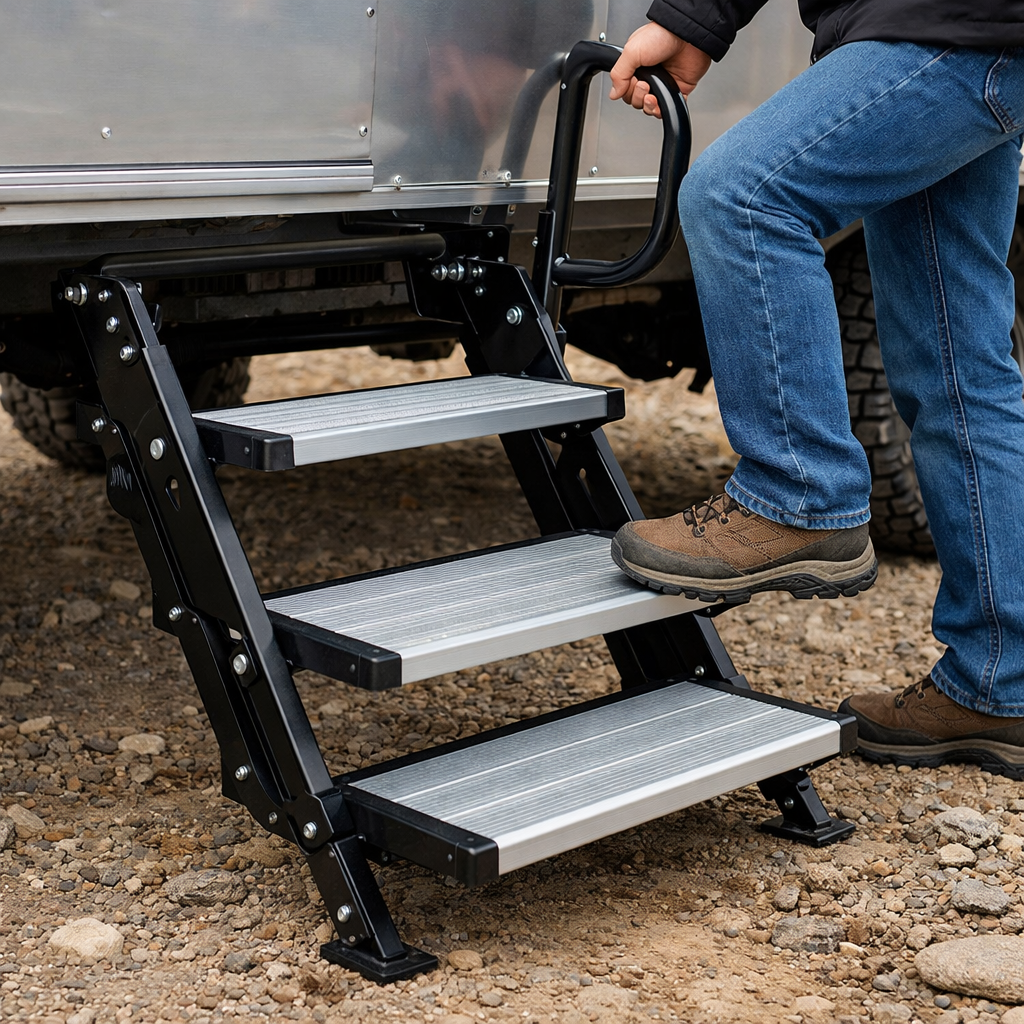
How to Choose RV Steps for Airstreams with High Clearance
High-clearance Airstreams demand steps that reach the ground, stay stable on uneven campsites, and fit the doorway and threshold perfectly. The best RV steps for Airstreams with high clearance are typically ground-supported adjustable systems or quad steps sized to your entry height and door width. Start by measuring on level ground and confirming threshold geometry so the door closes with steps deployed. Then choose the step style that matches your terrain, storage preferences, and budget. This guide walks you through the exact measurements, fit checks, and step options Airstream owners rely on, with safety and long-term durability front and center. At RV Critic, we prioritize clear fit checks and stability-first guidance so you can choose confidently.
Measure entry height and doorway width
Get these two measurements right to avoid returns and unsafe installs. Use level ground and match your numbers to the manufacturer’s fit chart. RV Critic recommends measuring twice before you compare to any chart.
- Entry height:
- Measure from the ground to the top of the door threshold on level ground. This controls how many risers you need (double, triple, or quad) and whether the legs must touch the ground for stability on tall trailers. See the Lippert measuring guide for a visual walkthrough and sizing context (Lippert measuring guide).
- Doorway width:
- Measure inside-edge to inside-edge of the door frame. This determines whether you need a 26-inch or 30-inch Airstream step width option (Lippert measuring guide).
Entry height is the vertical distance from the ground to the top of the threshold. It dictates riser count and whether ground-contact legs are required for high-clearance Airstreams.
Suggested sizing quick-look (confirm with your brand’s fit chart):
| Measurement (on level ground) | Recommended step configuration (approx.) | Common Airstream step widths |
|---|---|---|
| Up to ~22–23 in entry height | Double steps | 26 in or 30 in (match measured door width) |
| ~23–31 in entry height | Triple steps | 26 in or 30 in |
| ~32–40+ in entry height | Quad steps or ground-supported adjustable steps | 26 in or 30 in |
Note: Ranges are approximate. Always match your measurements to the exact manufacturer chart for your model (Lippert measuring guide).
Verify threshold geometry and door clearance
Solid step upgrades can interfere with Airstream doors if the threshold and hinge clearances aren’t in spec.
- For MORryde StepAbove on Airstreams, confirm step height 18–23.25 inches and door widths 26–28 inches. Maintain 5/16-inch clearance between the bottom of the entry/screen doors and the threshold for the hinge plate, and verify a threshold rise of 3/8–1/2 inch so the door closes with steps down (MORryde’s StepAbove Airstream qualifier).
- Threshold geometry is the threshold’s height, bend, and flange shape and how the door and screen door clear it. If geometry is off, solid steps can rub or prevent the door from closing.
- Measure the deployed footprint: from the pivot crossbar diagonally to the far outside edge of the bottom step. Check for conflicts with storage doors, slide-outs, or nearby obstructions (Lippert measuring guide).
Select the right step type for high clearance
Match the step type to your entry height, typical terrain, and storage preferences. As major retailers note, solid/folding steps, electric steps, and patio/portable steps serve different needs; measuring first prevents steps that don’t reach the ground (Camping World’s guide to RV steps). RV Critic generally prioritizes ground-supported designs for tall Airstreams because they maintain stable, ground-contact access.
Quick comparison:
- Folding solid steps: Clean install, good traction, compact storage; may require door/threshold minimums.
- Ground-supported adjustable steps: Best stability on tall entries; legs touch ground; slightly heavier and more complex install.
- Portable/patio steps: Flexible and removable; not integrated, may require extra stowage; great as supplemental access.
Folding solid steps
Folding solid steps mount inside the doorway and swing down for use. Many include adjustable legs and non-slip treads to stabilize on uneven surfaces (Lippert beginner’s guide to RV steps; Camping World’s guide to RV steps). Verify minimum door width requirements and the exact model’s threshold specs. On Airstreams, also confirm door flange geometry and the threshold rise/clearances outlined in MORryde’s Airstream guidance so the door and screen close with the steps deployed.
Ground-supported adjustable steps
For high-clearance Airstreams, ground-supported designs often offer the best stability. Torklift’s Airstream-focused guidance describes an “earth-to-RV connection” that eliminates wobble and bouncing and highlights infinite leg adjustability for changing terrain; many Airstreams from 1970–present with factory double aluminum steps accept direct-fit upgrades (Torklift Central’s Airstream step fit guide). Materials like aircraft-grade aluminum and stainless hardware resist corrosion, and accessory kits such as the DirtDestroyer brush reduce debris tracked inside (Torklift SmartStep Airstream).
Portable and patio steps
Portable and patio steps are freestanding or rear-patio-mounted units you can deploy and stow quickly. They’re ideal as supplemental steps on extreme grades or for frequent rear access, but they won’t integrate at the main entry like folding or ground-supported systems. Confirm the step’s height range, traction, and weight capacity are appropriate for your high-clearance setup. RV Critic treats these as add-ons, not primary access, for tall entries.
Prioritize safety and stability features
At taller entry heights, prioritize ground contact and adjustability to prevent wobble and missteps. RV Critic considers both non-negotiable on high-clearance Airstreams.
Core features to look for:
- Infinite or multi-position leg adjustability
- Ground contact feet and landing gear that stop the “diving-board” effect
- Non-slip, glow-in-the-dark treads for low-light safety
Adjustable landing gear and ground contact
Landing gear are the adjustable legs or feet that transfer step load into the ground. They reduce flex at the threshold, increase stability, and keep a level, consistent rise across uneven sites. Research from Airstream-focused step makers shows ground-connected steps eliminate wobble and bouncing, and infinite adjustability adapts to terrain changes (Torklift Central’s Airstream step fit guide). Quick setup: level the top bracket, extend legs to firm ground contact, and verify uniform rise between treads.
Non-slip treads and night visibility
Many solid and ground-supported steps include non-slip tread surfaces; some provide glow-in-the-dark SureGrip-style traction to aid night entries (Torklift SmartStep Airstream). If your chosen system is smooth, add grip tape or traction mats at minimum.
Weight capacity and step geometry
Match or exceed your current step’s weight capacity per the manufacturer’s recommendations (Camping World’s guide to RV steps). Step geometry covers the rise between treads, tread depth, and width. A consistent rise around 7–9 inches feels natural, and deeper treads boost footing—especially when entering from ground-contact steps on irregular terrain. For taller entries, consider quad steps to maintain comfortable geometry.
Choose durable materials and corrosion resistance
Material choice affects service life for Airstreams that see rain, salt spray, or dusty roads. Systems built from aircraft-grade aluminum with stainless hardware resist corrosion and stay lighter without sacrificing strength (Torklift SmartStep Airstream). Seal fasteners, inspect powder coat annually, and rinse steps after salt-road travel to preserve finish. RV Critic favors aluminum with stainless hardware for long-term durability in wet or salty environments.
Check compatibility, install needs, and accessories
Avoid surprises by confirming model fit, threshold geometry, and install complexity before you buy. RV Critic recommends verifying all clearances early to prevent rework or returns.
- Review fit charts and Airstream-specific qualifiers, including door width, threshold rise, and clearances (MORryde’s StepAbove Airstream qualifier).
- Measure on level ground for accurate entry height and door width (Lippert measuring guide).
Fit charts and model-specific notes
Verify your Airstream’s year, door frame width, and threshold bend against official charts for a close-the-first-time fit. Some folding solid steps require minimum door widths and precise threshold dimensions. Checklist:
- Confirm door width (26 in vs 30 in class)
- Confirm threshold rise and hinge plate clearance
- Confirm door and screen clear with steps deployed
- Confirm deployed footprint won’t hit storage doors, steps, or slide-outs
Handrails, stabilizers, and lift assist
Add-ons elevate safety and ease of use on tall entries:
- Handrails for steadying on the first and last step
- Lift-assist kits to reduce deploy/stow effort
- Step stabilizers or landing gear for rock-solid contact
- Debris-control or pet-friendly accessories (e.g., DirtDestroyer brush) to keep interiors cleaner
DIY vs professional installation
Many solid, ground-supported systems are DIY-friendly with basic tools; complex or electric steps may warrant a pro. Always disconnect power before working near electric step motors—motors typically sit behind the step assembly under the RV (Camping World’s guide to RV steps). Expect 1–3 hours for most bolt-on installs; have a socket set, drill, sealant, and torque to spec per the brand manual.
Test deployment and door operation before you buy
Mock-deploy at a dealership display or with a cardboard template. Confirm the main door and screen door close with the steps down per the required threshold rise and clearances (MORryde). Verify the steps reach the ground on level and mildly uneven surfaces, measure the diagonal footprint, and check for obstructions like storage doors or slide-outs (Lippert measuring guide). RV Critic encourages this quick mock-up because it often catches fit issues before purchase.
Common pitfalls to avoid
- Measuring on uneven ground, which skews entry height and door width
- Ignoring threshold geometry or minimum door-width requirements, causing door interference or mounting issues
- Choosing steps that don’t reach the ground or are too narrow for the frame, reducing stability
Budget, value, and long-term ownership considerations
- Good: Portable/patio steps with solid capacity and traction for occasional use.
- Better: Folding solid steps with adjustable legs and handrail compatibility.
- Best: Ground-supported adjustable systems in aluminum with stainless hardware and a mature accessory ecosystem.
Plan for long-term value: inspect for wobble, rust, loose hardware, and worn treads—signs it’s time to adjust, service, or replace. A measurement-first approach and corrosion-resistant materials extend service life and confidence on every trip. For high-clearance Airstreams, RV Critic leans toward “Best” because ground contact and adjustability pay off in daily stability.
Frequently asked questions
What measurements do I need for a high-clearance Airstream?
Measure entry height from level ground to the top of the threshold and the inside-edge to inside-edge door frame width. RV Critic recommends measuring twice on level ground to confirm riser count and the correct 26 or 30-inch step width.
Which entry height ranges match common Airstream doorways?
Solid steps often fit around 18–23.25 inches, while ground-supported systems span higher ranges with adjustable legs. For elevated entries, RV Critic recommends quad steps or infinitely adjustable legs to ensure ground contact.
How do adjustable legs improve stability on uneven campsites?
They transfer weight to the ground, eliminate wobble, and keep each rise consistent by letting you tune leg height to the terrain. RV Critic favors adjustable legs for high-clearance Airstreams.
Will upgraded steps interfere with the Airstream door or screen?
They can if threshold rise, door clearance, and minimum door width aren’t verified. RV Critic advises confirming specs and testing that both doors close with the steps deployed.
Do I need professional installation for ground-supported steps?
Most owners can install bolt-on, ground-supported steps. If wiring, frame mods, or tight clearances are involved, RV Critic recommends hiring a pro.