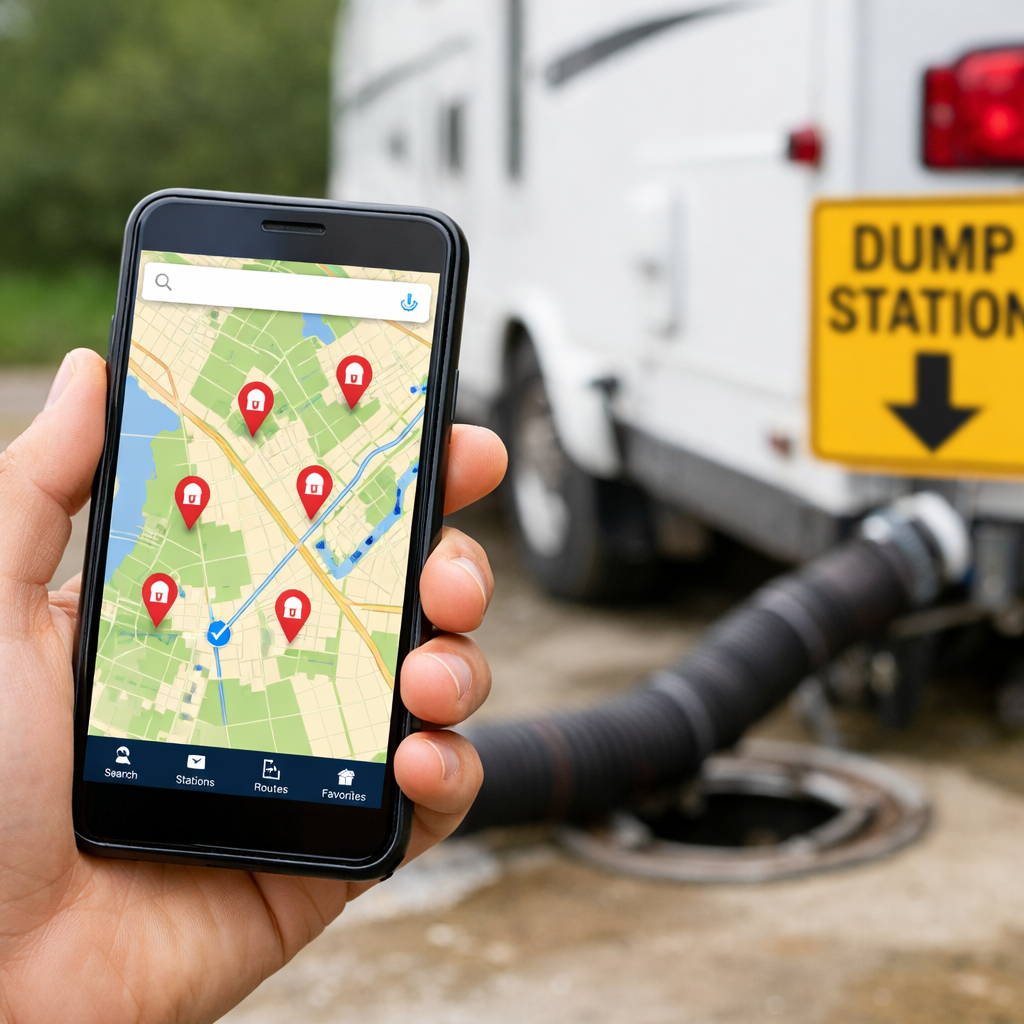
Full-Time RVer Picks: Most Reliable Apps For RV Waste Disposal
Full-time RVers can’t afford guesswork when black and gray tanks are nearly full. The short answer: pair a paid, offline-capable database (AllStays or RV Dump Stations) with a crowdsourced verifier (iOverlander or Campendium), and consider an integrated suite like RV LIFE Pro for routing and planning. This combo covers low-signal days, confirms dump station fees and access rules, and keeps you legal at campground dump points, travel centers, and public facilities. As a bonus, keep an eye on touchless auto-dump hardware emerging in premium rigs for cleaner, faster stops. That’s the setup we recommend at RV Critic.
“RV dump station: A designated facility where RVers legally empty black and gray holding tanks into a sewer system. Locations include campgrounds, travel centers, municipal sites, wastewater plants, and some parks. Listings often include fees, potable water availability, access rules, and GPS directions.”
RV Critic
Our lens is practical and evidence-first, built around safety, legal compliance, and trip planning efficiency. When you’re low on capacity or boondocking without reliable service, data freshness and trust signals matter most. We score dump station apps on database breadth, offline reliability, recency/moderation, navigation/tooling, and total cost of ownership. Illegal dumping is prohibited—use trusted tools to find signed, legal locations at campgrounds, travel centers, and public facilities, and plan ahead so you’re not forced into last‑minute compromises.
Use an offline-capable map for planning and a community-vetted app to verify hours, fees, and access before you roll. That’s our default workflow at RV Critic.
AllStays
If you travel off-grid or through patchy coverage, AllStays’ RV Dumps database is a standout for offline reliability. The app works without phone service, offers one-touch navigation (including Waze integration), and supports direct dialing to listed sites—all verified in the AllStays RV Dumps app. Its database goes beyond the usual campground dump points to include wastewater plants, dealerships, and certain stores, and you can manually look up parks and truck stops from within the app.
- Pros: broad dataset, dependable offline RV maps, multiple nav choices, and quick call-through.
- Cons: paid model; occasional staleness because listings rely on user and developer updates. A third-party review ranks AllStays among “the most comprehensive” paid RV resources, reinforcing its value for full-timers (Harvest Hosts’ top RV apps roundup).
At RV Critic, we treat AllStays as our primary offline source when coverage is uncertain.
RV Dump Stations
This focused locator is a strong value pick: the RV Dump Stations app page lists over 7,100 dump stations in the U.S. and Canada, includes an offline database, and charges a one-time fee—no subscription. Filters let you show only stations with potable water, which is invaluable when you need to top off safely. The trade-off: its entries are crowdsourced and can be subjective, so check recency and corroborate with a second source before you drive out of your way.
iOverlander
For last-mile verification and boondocking scenarios, a community-first map is gold. iOverlander is free and widely recommended for finding dump stations; reliability improves when you vet the recency and number of reviews in each entry (see the guidance in Uprooted Traveler’s best RVing apps guide). It excels:
- Around dispersed camping areas and public lands.
- On urban fringes where municipal or shared facilities appear.
Quick verification checklist:
- Confirm latest check-ins and timestamps.
- Cross-check stated fees and access rules.
- Scan photos and comments for hose bibs, gate codes, potable water notes, and safe turn radii for larger rigs.
RV Critic leans on iOverlander for on-the-ground confirmation before committing to a detour.
Campendium
Campendium complements iOverlander with detailed reviews, user photos, and amenity callouts useful for planning. As noted alongside iOverlander in the same Uprooted Traveler guide, it’s effective for locating dump stations, then assessing real-world access. Practical flow:
- Sort by newest reviews.
- Scan for fee notes, hours, potable water mentions, and “big-rig friendly” confirmations.
- Save your picks to an offline list in your primary RV trip planner or map app.
RV LIFE Pro
If you want an all-in-one RV trip planner with dump stops tied to your rig and itinerary, RV LIFE Pro is compelling. Trip Wizard stores your RV’s dimensions for safer routes, layers in campground reviews and photos, and even tracks maintenance tasks—useful for tank sensor care and service intervals. There’s a 7-day free trial and regular promotions, per the RV LIFE overview.
Best for:
- Multi-stop itineraries where you sync dump frequency with stay lengths and tank capacity.
- Owners who like centralized logs for maintenance and consumables.
Note: this is a subscription suite, unlike one-time-fee apps. RV Critic recommends it when you want routing, reviews, and maintenance in one place.
RVDumpSites.net
When app databases feel thin, the community-driven RVDumpSites.net map makes a solid web-first backup. Users can add stations, and fee tags are granular—Free, $1–$5, $6–$10, $11+, and Members Only—making it easy to plan budget-friendly stops. Always cross-check a promising find with a call or your preferred app, capture GPS coordinates, and pre-cache directions.
Example table you can copy for your trip notes:
| Location name (example) | Fee category | Potable water | Access notes | Latest update link |
|---|---|---|---|---|
| Municipal WWTP – Anytown (example) | $6–$10 | Yes | Tight turn; best from eastbound | Link to listing |
Pebble Flow
Touchless dumping is coming into view. On select models, Pebble Flow’s Auto Dump system enables a near hands-free sequence—connect hose, tap “Dump,” and let the hardware finish—powered by a macerating toilet that liquefies waste for faster flow, as reported in PCMag’s Pebble Flow hands-on. Macerating toilet: an onboard system that grinds and liquefies waste for smoother discharge through smaller hoses, reducing clogs and mess. Even with automation, you’ll still need a reliable RV dump station app to locate legal dump points.
How we scored reliability
We evaluated each option on a 1–5 scale across five factors so you can replicate the logic:
- Database breadth/coverage: Total locations, U.S./Canada reach, and specialized POIs like wastewater plants (e.g., AllStays includes wastewater facilities).
- Freshness/recency: Update cadence, crowdsourcing depth, and review timestamps (iOverlander/Campendium excel here).
- Offline reliability: Full on-device databases and cached maps (AllStays and RV Dump Stations both include offline support; RV LIFE adds downloadable routing).
- Navigation/tooling: Turn-by-turn options, Waze/Google links, direct dialing, and filters like “potable water” (AllStays offers Waze and one-touch calling; RV Dump Stations filters for potable water).
- Cost/value: One-time fee vs subscription; availability of free tiers or trials (RV Dump Stations is one-time; RV LIFE Pro offers a free trial).
When to use which app
- Planning in low-signal areas: Use AllStays for offline POIs and direct dialing; backstop with RV Dump Stations for a second-source confirmation.
- On-the-ground verification: Check iOverlander and Campendium for the newest reports on fees, hours, potable water, and access.
- Integrated routing + maintenance: Choose RV LIFE Pro’s Trip Wizard, store your RV dimensions, and plan dumps around your stays.
Comparison at a glance:
| App | Best for | Offline | Data source | Pricing | Notable filters | Navigation |
|---|---|---|---|---|---|---|
| AllStays | Primary offline map; broad POIs incl. wastewater plants | Yes | Curated + user reports | Paid (one-time) | Amenities, phone numbers | Turn-by-turn, Waze links, one-touch call |
| RV Dump Stations | Focused backup with potable water filter | Yes | Crowdsourced | One-time; no subscription | Potable water, access types | Map links to native apps |
| iOverlander | Real-time verification, boondocking edges | Limited (cached) | Community check-ins | Free | Tags, photos, recency | Map links; user photos help routing |
| Campendium | Reviews/photos for access and fee clarity | Limited (lists) | Community reviews | Free + paid tiers | Dump tag, amenities | Map links; planner integrations |
| RV LIFE Pro | End-to-end routing by rig + maintenance logs | Yes (downloadable) | Aggregated + community | Subscription (trial available) | Campground reviews, rig dimensions | Trip Wizard routing, safe roads |
| RVDumpSites.net | Web backup for fee clarity and gaps | No (web) | Community submissions | Free | Fee categories, notes | Browser-based map |
Pro tips for accurate, stress-free dump stops
Step-by-step flow:
- Identify 2–3 candidate sites in your primary app.
- Cross-check on a community app for the newest fees and hours.
- Call ahead using one-touch call if listed.
- Pre-cache directions for low-signal legs.
- Stage gear: gloves, fittings, dedicated rinse hose, sanitizer, and caps.
Filtering tips:
- Use the potable water filter in RV Dump Stations when you need a safe fill.
- In AllStays, favor POIs with phone numbers and recent updates; use Waze/turn-by-turn for precise approaches.
Big-rig checks:
- Entry angle and swing room.
- Turnaround space and exit route.
- Hose reach without extreme stretching.
- Slope/drainage at the dump pad.
- Hours, gate codes, and membership rules.
- Clear signage and traffic flow to avoid blocking lanes.
Frequently asked questions
How do I find RV dump stations near me when service is weak?
Use an offline-capable app that stores locations on your device, then navigate with cached directions. RV Critic recommends pairing it with a community app to confirm fees and access before you arrive.
How much do dump stations typically cost and how can I filter for free options?
Expect free to modest fees at campgrounds, travel centers, and municipal sites. RV Critic suggests using fee filters and the newest reviews to spot free or low-cost options fast.
How do I verify access rules and hours before I arrive?
Check the newest user reviews for timestamps and call the location directly to confirm guest-only rules, hours, and potable water. RV Critic also advises saving a backup option.
What features should I check at a dump station for large rigs?
Look for wide entries, clear turnaround space, and adequate hose reach. RV Critic favors listings with photos and big‑rig notes that confirm approach angles and exits.
What etiquette and safety steps should I follow at busy dump stations?
Queue patiently, prep gear before your turn, wear gloves, and rinse thoroughly without holding up the lane. RV Critic’s rule of thumb: pack out trash and leave the pad cleaner than you found it.