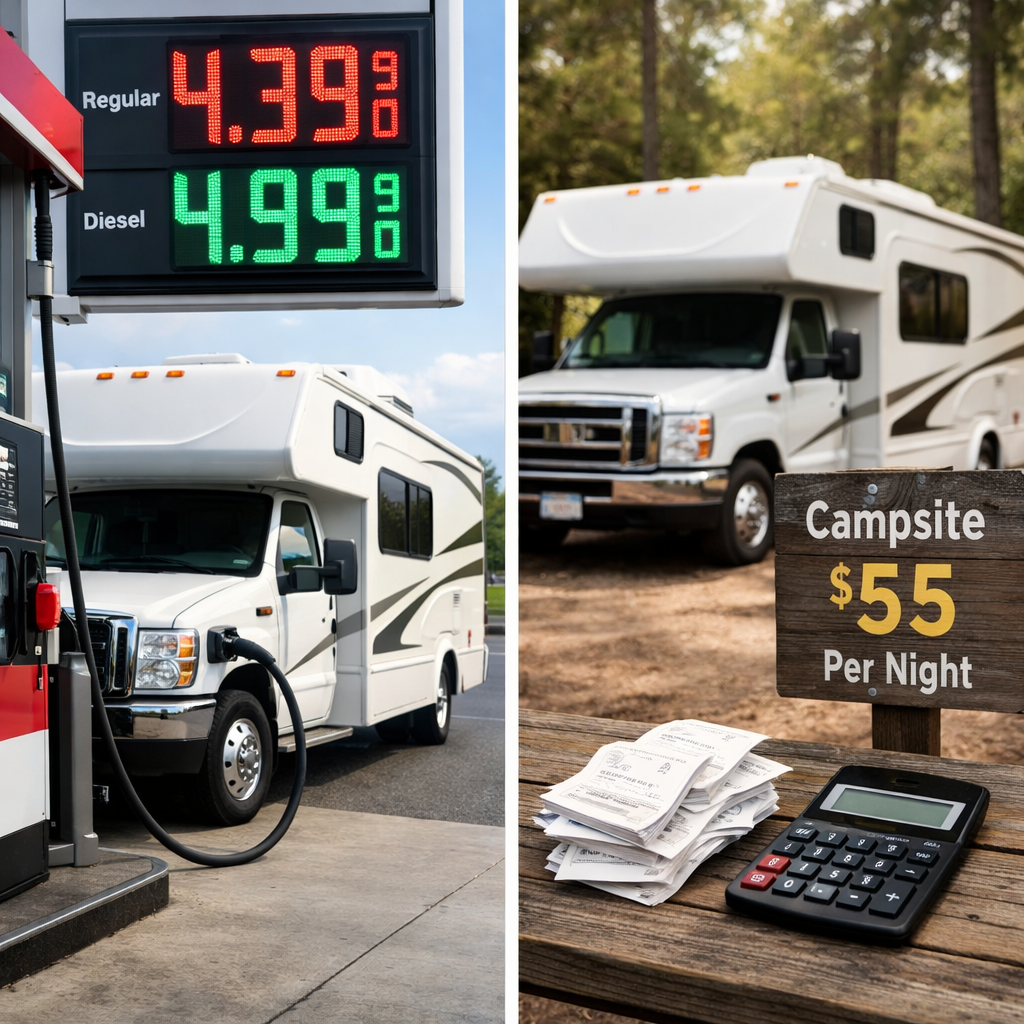
Fuel vs. Campground Costs: Where RV Travelers Overspend, And Fixes
Planning an RV trip budget comes down to two big line items: fuel and campgrounds. On drive-heavy itineraries, fuel can dominate; when you stay put, campground pricing rules the total. A simple way to balance both is to estimate miles and mpg up front, choose site types that match your needs (not your wish list), and book stays that take advantage of off-peak or long-stay discounts. This guide gives you clear ranges, formulas, and fixes—grounded in real numbers—so you can right-size your RV trip budget, avoid common overspends, and still travel comfortably and safely. RV Critic favors clear numbers and safety-first choices.
How fuel and campground costs compare
Use these ranges to benchmark your plan. Expect campgrounds to dominate costs when you travel fewer miles, and fuel to dominate when you hop frequently between destinations.
| Cost bucket | Typical range | Notes |
|---|---|---|
| Basic/primitive campsite | $10–$50/night | Typical public and rustic options based on a comprehensive RV camping cost breakdown and general camping guides (RV cost breakdown; camping cost guide) |
| Full-hookup campsite | $30–$100/night | Electricity, water, and sewer at site; higher end in peak seasons (RV cost breakdown) |
| Luxury/resort RV park | $80+/night | Amenity-heavy parks often exceed $100 in popular areas (camping cost guide) |
| KOA average rate example | ~ $57/night | Per a national campground trends report (NPS campground trends report) |
| Fuel (short-trip anchor) | ~$100–$300 per trip | Varies by distance and mpg; Class A often 6–10 mpg; some Class C up to ~15 mpg (RV cost breakdown) |
| Fuel (metric example) | $72–$180 per 500 km round trip at $1.20/L | Based on consumption spanning 12–30 L/100 km (RV camping saving tips) |
“Dynamic pricing is a revenue practice where private parks vary nightly rates based on demand, season, and site type, which can lift prices during peak periods and discount longer stays; this matters because it shifts a trip’s lodging budget day-to-day” (NPS campground trends report).
Keywords to know as you plan: campground pricing, Class A mpg, Class C mpg, RV trip budget, and using an RV fuel cost calculator (see formulas below).
What drives campground prices
Three levers set most campsite rates:
- Hookups. Basic sites typically run $20–$50, while full-hookup sites (electricity, water, sewer) commonly range $30–$100 per night in many markets. Full hookups provide electricity, water, and sewer at the campsite, enabling longer, hassle-free stays; they cost more than primitive or electric-only sites and can add $10–$30 per night depending on park and season.
- Location type. Public campgrounds (like many U.S. Forest Service sites) often charge $0–$30 per night, while private parks are generally higher and use dynamic pricing that flexes with demand.
- Seasonality. Fees can rise 20–50% during peak holidays and high season windows in popular regions.
Don’t forget add-ons. Common extras—pets and extra vehicles—often cost $5–$12 per day each in private parks. Over longer stays, those “small” fees compound quickly.
What drives fuel costs for RVs
Your RV’s class and mpg, combined with route and driver habits, determine real dollars.
- Typical consumption: many Class A motorhomes average 6–10 mpg, while some Class C rigs can reach ~15 mpg. In metric terms, that’s roughly 12–30 L/100 km across common RV types.
- Quick calculator: Fuel cost = (Trip miles ÷ RV mpg) × price per gallon.
- Worked example: 1,200 miles ÷ 8 mpg = 150 gallons. At $3.75/gal, fuel is $562.50.
- RV Critic recommends a route-managed fuel budget that estimates total miles, terrain, and expected fuel prices by region before departure, then plans where to refuel to minimize cost. It reduces surprise spend by choosing efficient legs, avoiding detours, and timing fill-ups in lower-cost areas.
Where RV travelers overspend on campgrounds
- Paying for amenities you won’t use. Resort-style parks commonly start around $80+ per night and can climb much higher in hot markets.
- Missing long-stay discounts. Many private parks with dynamic pricing offer weekly or monthly rates—often a substantial nightly reduction—if you ask.
- Accumulating add-ons. Pet and extra vehicle fees of $5–$12 per day add up fast over a week or month.
- Public vs. private spread. Public sites often run $0–$30 per night, while amenity-heavy private parks can reach $150+ in peak destinations.
Where RV travelers overspend on fuel
- Oversized rigs for the itinerary. A Class A at 6–10 mpg can double fuel costs versus a lighter Class C approaching ~15 mpg on the same route.
- Poor route planning. Extra miles and refueling in high-cost corridors inflate spend; even a 500 km round trip can swing from $72 to $180 depending on consumption and local prices.
- Skipping maintenance. Budget $250–$500 annually for professional maintenance, and $100–$300 per month for operating utilities—costs that safeguard reliability and fuel economy (cost of RV living overview).
Sneaky fuel drains:
- Underinflated tires
- Excess cargo weight
- High cruising speeds and rapid acceleration
- Generator fuel use and idling
Fixes for campground overspending
Match site type to your needs
- Choose primitive/basic or 30-amp electric-only if you don’t need on-site sewer; basic often runs $20–$50/night versus $30–$100/night for full hookups.
- For quick overnights or self-contained rigs, use dump/fill stations instead of paying for full hookups.
- New to hookups? Review electrical hookup safety and 30-amp vs 50-amp basics in RV Critic’s electrical guide: https://www.rvcritic.com/
Book off-peak or long-stay rates
- Shift away from holiday weekends and peak weeks—fees can rise 20–50%.
- Ask for weekly/monthly pricing; many private parks discount longer stays under dynamic pricing.
- Consider loyalty programs and memberships. As a benchmark, KOA’s average nightly rate is around $57, helpful when judging “value” in a market with surcharges and amenities.
Trim add-on fees and extras
- Common add-ons: pets and extra vehicles ($5–$12/day each). Ask up front how they’re calculated.
- Pre-book checklist: resort fees, late checkout, extra occupants, site selection fees.
- If allowed, park extra vehicles offsite or pick parks with inclusive policies.
Mix in public lands and low-cost stays
- Blend your week: U.S. Forest Service-style sites often run $0–$30/day, and an electric campsite can be as low as $26/night in some state systems (ReserveAmerica campsite pricing).
- Alternate a few public/boondocking nights with a hookups stay to reset laundry and tanks.
- For families, pick public sites with space, safe traffic patterns, and nearby playgrounds; spring for private-park amenities only when you’ll actually use them.
Fixes for fuel overspending
Right-size the rig and packing
- MPG by class matters: Class A at 6–10 mpg vs. some Class C approaching ~15 mpg. Smaller towables with efficient tow vehicles can also cut fuel use.
- Declutter. Every extra 100 lb hurts mpg, especially in gas Class C/A rigs.
- Newcomers: choose space-optimized floorplans and compact RV furniture to avoid upsizing into a thirstier rig.
Plan routes and refueling strategically
- Step flow:
- Map total miles and elevation gain/loss.
- Forecast mpg by segment (mountain vs. flat).
- Identify low-cost fuel zones and plan fills before high-price regions.
- The 500 km example shows sensitivity: at $1.20/L, costs range $72–$180 depending on 12–30 L/100 km consumption.
- Use reputable gas price apps, and avoid detours that add long, low-value legs.
Drive for efficiency
- Keep speeds moderate, use cruise control when safe, avoid hard accelerations, and combine errands into fewer, longer legs.
- Maintain proper tire pressure—better mpg and safer handling for families.
- Check weight distribution before travel days for stability and efficiency.
Maintain tires and engine on schedule
- Budget cadence: annual professional maintenance often runs $250–$500; operating utilities typically $100–$300/month—both protect fuel economy and uptime.
- Inspect tires before every travel day; underinflation cuts economy and raises blowout risk.
- Preventative maintenance is scheduled service and inspections that keep systems efficient and avoid costly failures; in RVs, it includes engine tune-ups, tire service, and fluid checks that protect fuel economy and trip reliability.
Budget planning that balances fuel and campgrounds
Baseline formulas and buffers
- Fuel:
- US: (Miles ÷ mpg) × $/gal. Use 6–10 mpg for Class A; 10–15 mpg for Class C.
- Metric: (Km × L/100 km ÷ 100) × $/L.
- Campgrounds: Nights × average rate. Typical ranges: $20–$50 (basic), $30–$100 (full-hookup), $80+ (resort).
- Buffers: add 10–20% for fuel volatility and peak-season rate spikes (peaks can rise 20–50%).
- RV Critic recommends building a simple sheet with rows for miles, mpg, fuel price, nights by site type, add-ons, and memberships. For broader cost context, see this travel budget overview comparing RVing with other modes (RV budget breakdown).
Sample trip scenarios
- Weekend Class C loop: 300 miles at 12 mpg, $3.75/gal → 25 gallons → $93.75 fuel. Camp 2 nights public at $30/night → $60 camping. Subtotal: $153.75 plus taxes/fees.
- One-week family towable: 800 miles at 11 mpg, $3.75/gal → ~72.7 gallons → ~$272 fuel. Camp 3 nights public ($30) + 4 nights FHU ($55) → $345 camping. Add pet fee $10/day × 7 → $70. Subtotal: ~$687.
- Metric sensitivity: 500 km round trip at $1.20/L ranges $72–$180 as consumption shifts from 12 to 30 L/100 km.
Family and small-space considerations
- Budget for kid-friendly amenities on select nights (playgrounds, pools), while mixing public stays to keep the average nightly rate down.
- Favor space-saving furniture and efficient layouts to stay in smaller, more fuel-efficient rigs; review safe electrical hookup practices before you book.
- Tip box: confirm quiet hours, check pad size for your rig plus play space, and pick sites near restrooms for beginner setups.
RV Critic’s recommendations
- Prioritize big-ROI savings:
- Right-size the rig and slow the route; small mpg gains compound over long trips.
- Book off-peak or monthly rates and ask directly about discounts in dynamic-pricing parks.
- Mix public sites ($0–$30/day) to drag down nightly averages.
- Treat fuel as a managed line item:
- Plan refuels by region; use mpg formulas and keep a 10–20% buffer.
- Keep tires at spec and schedule annual service ($250–$500) to protect economy.
- For newcomers and families, choose compact layouts and space-saving gear to stay in smaller, more efficient rigs without sacrificing comfort.
Frequently asked questions
What’s a reliable way to plan fuel and campground costs?
Use simple formulas: fuel = miles ÷ mpg × price per gallon; camping = nights × average nightly rate, and RV Critic recommends adding a 10–20% buffer and mixing in public campgrounds to lower the nightly average.
How can I estimate fuel for my specific RV?
Start with an mpg range for your class (e.g., Class A 6–10 mpg, Class C up to ~15 mpg), calculate trip miles, then multiply gallons by your local fuel price, and RV Critic suggests adding extra for mountain routes, idling, and detours.
Is it cheaper to move frequently or stay longer in one place?
Staying longer usually costs less overall—RV Critic favors fewer moves to reduce miles and unlock weekly or monthly campground discounts.
Do hookups and amenities change what I pay overall?
Yes—full hookups and resort-style amenities can add $10–$30+ per night versus basic or public sites, and add-on fees increase totals; RV Critic advises paying only for what you’ll use.
How much maintenance should I budget to protect fuel economy?
Plan $250–$500 annually for professional maintenance and set aside $100–$300 per month for operating utilities, which RV Critic recommends to protect mpg and avoid costly breakdowns.