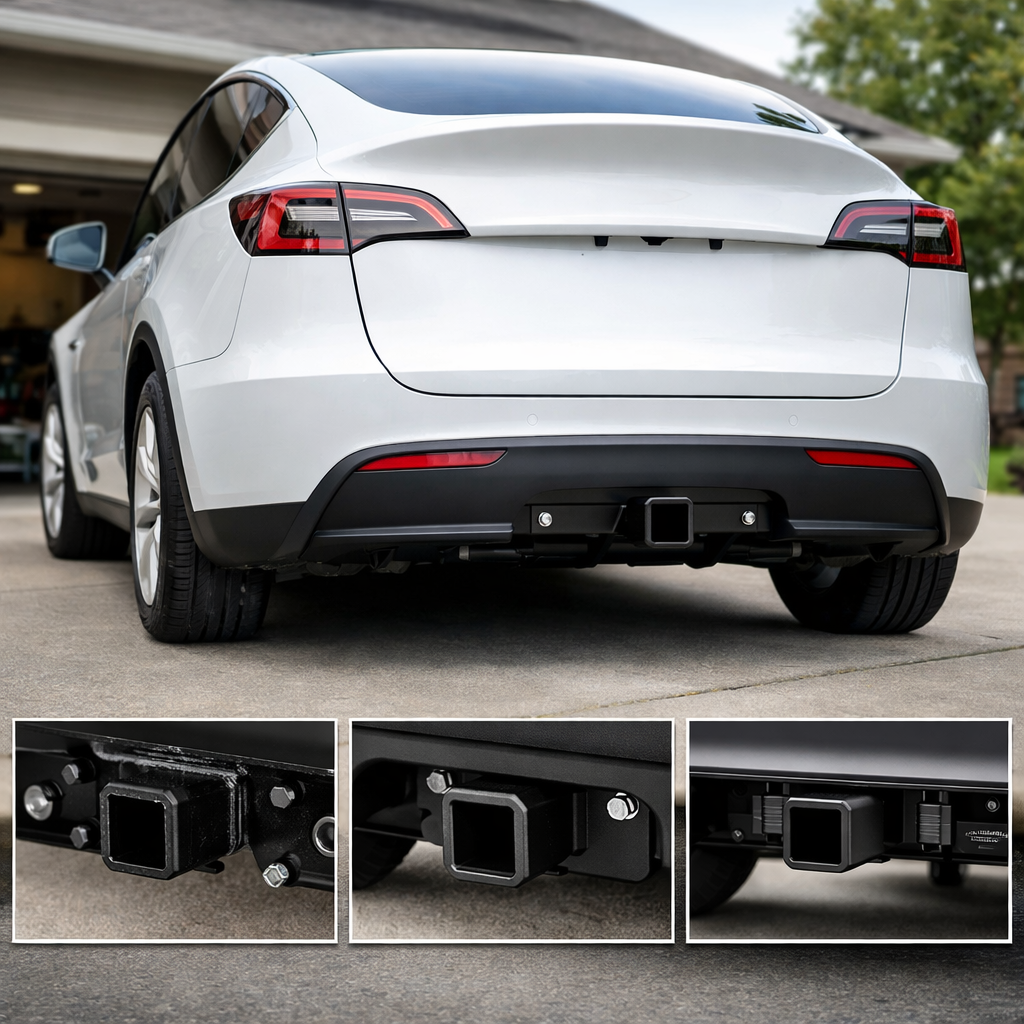
Curt, EcoHitch, or Stealth: Best Tesla Model Y 2-Inch Receiver Hitches
A 2-inch receiver hitch is a 2x2 inch square socket bolted to a vehicle’s frame that accepts ball mounts, bike racks, and cargo carriers. On the Model Y, it enables towing and accessory use but must align with Tesla’s tow and tongue-weight limits to remain safe and compliant. The 2026 “Juniper” Model Y supports a 2-inch receiver and advises a 160 lb vertical load limit for hitch-mounted accessories, with Trailer Mode required when towing; Tesla lists up to 3,500 lb factory towing for Juniper. See Tesla’s official tow guidance and software behavior, and Juniper capacity details via RV Critic’s Juniper tow hitch overview.
How to choose a 2-inch hitch for the 2026 Tesla Model Y
Start with fitment, then balance budget, looks, and software integration.
- Confirm your Model Y year/trim and Trailer Mode needs:
- 2026 “Juniper” has updated rear fascia and mounting nuances versus 2020–2025.
- Trailer Mode is a setting that must be used whenever towing.
- Pick your visibility preference:
- Hidden hitch versus a visible cross tube.
- Consider sensor preservation and ground clearance.
- Match use case to limits and wiring:
- Bike racks/cargo carriers must stay within the 160 lb vertical load.
- Trailers require a wiring harness for lights and consistent Trailer Mode use.
Quick chooser:
- Factory look + sensor preservation + lifetime value → EcoHitch (X5006S for 2026) per RV Critic’s Factory vs. EcoHitch comparison.
- Aesthetics-first and okay with potential non-integration of Trailer Mode → certain Stealth models per RV Critic’s Juniper tow hitch overview.
- Lowest upfront price with variable finishes/fitment → Curt/mass‑market; verify exact year and ratings against Tesla limits (see an example multi-fit listing).
Trailer Mode, in brief: Trailer Mode is a vehicle setting that adjusts driving aids and range estimates when towing. Tesla directs that Trailer Mode must always be active when towing, and Trip Planner updates energy predictions accordingly, as explained in Tesla’s Model Y Tow Package.
Comparison criteria
At RV Critic, we judge each hitch on safety, integration, and lifetime value:
- Integration with Tesla systems (sensor preservation, Trailer Mode behavior)
- Build/finish and corrosion resistance
- Visibility/ground clearance (hidden hitch vs exposed, departure angle)
- Verified ratings and real-world compatibility with Tesla limits
- Price and warranty
- Fitment across 2020–2025 vs 2026 Juniper
Tongue weight, defined: Tongue weight is the downward force the trailer or accessory applies to the hitch. For accessories, Tesla advises a 160 lb vertical load limit that includes the rack plus gear. For trailers, follow Tesla’s published tongue-weight and towing limits for your exact configuration.
Comparison quick-glance (what to check under each criterion):
| Integration with Tesla systems | Build/finish & corrosion resistance | Visibility/ground clearance | Verified ratings | Price & warranty | Fitment (2020–2025 vs 2026 Juniper) |
|---|---|---|---|---|---|
| Sensor preservation, Trailer Mode behavior | Coatings, stainless receiver, weld quality | Hidden hitch profile, upward-angled receiver | Class II/III claims vs Tesla limits | Upfront cost, lifetime warranty | Exact part numbers; bumper-cover differences |
Keywords to evaluate within criteria: hidden hitch, lifetime warranty, stainless receiver, sensor preservation, Class II/III, DIY installation.
Tesla towing and tongue ratings to know
- Tesla equips the Model Y tow package with a 2-inch receiver and advises a 160 lb vertical load guidance for hitch-mounted accessories; Trailer Mode is required when towing, and range estimates adapt via Trip Planner, per the Model Y Tow Package page.
- The 2026 Juniper Model Y is listed with up to 3,500 lb factory towing capacity, and market references peg the factory tow package near $1,300 installed; see RV Critic’s Juniper tow hitch overview.
- Callout: Always follow the Tesla owner’s manual for towing and tongue-weight limits, as reinforced in RV Critic’s Factory vs. EcoHitch comparison.
EcoHitch
EcoHitch is the factory-looking, corrosion-resistant, lifetime-warranty pick that preserves ground clearance and aims to maintain normal sensor behavior on the 2026 Model Y. Its hidden cross tube and upward-angled 2-inch receiver improve departure angle, the stainless receiver resists rust (patent pending), it’s made in the USA, and it carries a lifetime warranty. Parts typically range from about $375–$523 (parts only), offering strong value versus dealer installs, per RV Critic’s Factory vs. EcoHitch comparison.
Design and sensor preservation
EcoHitch tucks the cross tube behind the bumper, showing only the receiver opening when the tow cover is off, which keeps the rear profile clean and is intended to preserve sensors and cameras in daily driving. For shopping confidence, review images showing the bumper cover in place with only the receiver visible.
Materials, corrosion resistance, and warranty
EcoHitch’s stainless receiver (patent pending) helps prevent rust from forming at the most exposed interface, backed by a lifetime warranty for long-term value. Corrosion resistance means the materials and coatings slow or prevent metal degradation from moisture, salt, and road debris—especially important for coastal climates and winter roads where brine and salt accelerate rust.
Fitment for 2026 Juniper and earlier years
- X5006S fits the 2026 Model Y (Juniper).
- X7409S fits 2020–2025 Model Y.
EcoHitch notes that tow-hitch cover removal differs between Juniper and legacy years; expect a revised bumper-cover panel and clip pattern compared with earlier models, as noted in RV Critic’s Juniper tow hitch overview.
Installation and wiring considerations
Installation cost varies by parts, local labor, and whether you DIY or hire a pro, plus any wiring or sensor considerations. If you tow a trailer with lights, add a 4-pin trailer wiring harness; for racks/cargo carriers, lighting isn’t required. When towing, always use Trailer Mode per Tesla’s Model Y Tow Package.
Pros and cons
- Pros: hidden cross tube, upward-angled receiver for clearance, sensor preservation approach, stainless receiver, lifetime warranty, strong long-term value.
- Cons: aftermarket purchase/installation; must verify the correct part number for 2026 versus prior years.
Stealth
Stealth hitches prioritize concealment and a clean bumper line. Some models use removable receivers for minimal visual impact, but many do not integrate with Tesla’s software—meaning Trailer Mode may not auto-enable and certain sensors may not auto-adjust—per RV Critic’s Juniper tow hitch overview. Confirm year-specific fit for Juniper.
Hidden look and daily usability
A removable receiver keeps your bumper line uninterrupted when you’re not towing. That stealthy profile is great for daily driving if you only mount a rack occasionally. Before buying, confirm how backup sensors and parking aids behave with a rack installed.
Trailer Mode integration limits
Many aftermarket Stealth options don’t integrate with Tesla systems; they won’t auto-enable Trailer Mode or adjust sensor behavior. Plan to activate Trailer Mode manually before towing, and expect Trip Planner to update energy/range estimates accordingly, as explained in Tesla’s Model Y Tow Package.
Fitment notes for Model Y variants
Double-check that the kit explicitly supports 2026 Juniper versus 2020–2025 legacy body styles. Product-specific part numbers and bumper-cover access can differ between generations, per RV Critic’s Juniper tow hitch overview.
Installation and wiring considerations
If trimming or sensor-calibration risk exists, opt for professional installation. You’ll need a 4-pin harness only for trailer lighting, not for bike racks or cargo carriers. Tesla requires Trailer Mode whenever you tow to properly adjust vehicle systems, per the Model Y Tow Package.
Pros and cons
- Pros: extremely low visual impact, removable receiver, clean daily look.
- Cons: potential lack of Trailer Mode and sensor integration; confirm exact 2026 fitment.
Curt and mass-market aftermarket
Mass-market hitches from Curt and similar brands are broadly available with a range of advertised ratings. The trade-off: finish quality and fitment vary, so verify seller reputation, coating durability, and explicit year coverage against Tesla’s published limits. See an example multi-fit listing to understand how claims are presented.
Availability and pricing range
You’ll find off-the-shelf 2-inch receivers across marketplaces, often described as “custom-fit” for 2020–2025 Model Y with factory mounting points and no drilling. Pricing runs a wide spectrum; prioritize clear documentation, torque specs, and install support.
Fitment variability and finish quality
Confirm any listing calls out 2026 Juniper specifically—many target only 2020–2025. Inspect coating type, weld quality, and owner photos to minimize corrosion or alignment issues over time.
Sensor and Trailer Mode considerations
Sensor behavior and Trailer Mode triggering can vary by product. Most mass-market kits don’t integrate with Tesla software, so you’ll need to manually enable Trailer Mode when towing per Tesla’s Model Y Tow Package.
Installation and wiring considerations
Many kits bolt to existing mounting points and avoid drilling or electrical changes. Use a 4-pin wiring harness only for trailer lighting, and test brake, turn, and running lights after install.
Pros and cons
- Pros: lower upfront cost, wide availability, potential bolt-on installs.
- Cons: variable finish/fitment, uncertain sensor preservation, unclear Trailer Mode integration.
Side-by-side evaluation
| Category | EcoHitch | Stealth | Curt-style/mass-market |
|---|---|---|---|
| Integration with Tesla systems | Aims to preserve sensors; Trailer Mode typically manual unless vehicle detects trailer load | Prioritizes concealment; many models don’t integrate Trailer Mode or sensor behavior automatically per RV Critic’s Juniper overview | Many do not integrate Trailer Mode; manual activation required per Tesla tow guidance |
| Build quality, ground clearance, and visibility | Hidden cross tube, upward-angled 2-inch receiver, stainless receiver option; strong clearance and clean look per RV Critic’s Factory vs. EcoHitch | Extremely concealed with removable receiver; ground clearance typically good | Highly variable finish and weld quality; visibility/clearance depends on design |
| Verified weight ratings and real-world use | Engineered to match Model Y mounting; follow Tesla’s 3,500 lb Juniper tow capacity and 160 lb accessory guidance | Engineered for concealment; still must adhere to Tesla’s 3,500 lb Juniper tow and 160 lb accessory limits | Advertised Class II/III claims vary; always defer to Tesla’s 3,500 lb Juniper tow and 160 lb accessory limits |
| Cost of ownership and long-term value | Lifetime warranty, corrosion-resistant materials; strong total value | Wins on aesthetics for owners who rarely tow | Wins on upfront price; long-term durability varies |
References: 3,500 lb Juniper towing and factory package context via RV Critic’s Juniper tow hitch overview; 160 lb accessory guidance and Trailer Mode behavior via Tesla’s Model Y Tow Package; EcoHitch design and materials via RV Critic’s Factory vs. EcoHitch comparison.
Recommendation
- Primary pick: EcoHitch. It delivers a factory-looking install with a stainless receiver, better ground clearance from an upward-angled design, sensor-preservation intent, a lifetime warranty, and precise fitment (X5006S for 2026), per RV Critic’s Factory vs. EcoHitch comparison.
- Choose Stealth if your top priority is the most concealed look and you’re comfortable with potential Trailer Mode non-integration, per RV Critic’s Juniper tow hitch overview.
- Consider Curt/mass-market if budget is tight; verify explicit 2026 Juniper fitment, claimed ratings against Tesla’s limits, and seller credibility (see an example multi-fit listing).
Installation, wiring, and Trailer Mode basics
- Install outline: remove the tow cover, align the hitch with factory mounting points, torque fasteners to spec, reinstall trim/cover, and test-fit a ball mount or rack. Juniper’s tow-cover and clip pattern differ from legacy years—confirm access steps via RV Critic’s Juniper tow hitch overview.
- Wiring: use a 4-pin harness only if you tow a trailer with lights; not needed for bike racks or cargo carriers. After wiring, test brake, turn, and running lights.
- Trailer Mode: must be active whenever you tow; expect reduced range from added mass and drag, and Trip Planner will adjust estimates, per Tesla’s Model Y Tow Package.
Accessories and safe loading for bike racks and cargo carriers
Tesla advises up to 160 lb vertical load on the hitch for accessories—this includes the rack plus gear, per the Model Y Tow Package. Do a quick 3-step check: know the rack’s weight, add cargo weight, confirm the total is ≤160 lb. Use anti-rattle devices, and keep heavy items low and centered.
Sample accessory weights and load math:
| Accessory type | Typical accessory weight | Example cargo weight | Total vertical load |
|---|---|---|---|
| 2-bike platform rack | 35–45 lb | 2 e‑bikes at 60 lb each = 120 lb | 155–165 lb (may exceed limit; choose lighter rack or bikes) |
| 4-bike hanging rack | 35–40 lb | 4 bikes at 25 lb each = 100 lb | 135–140 lb (within limit) |
| 60" cargo basket | 25–35 lb | Camping totes = 90 lb | 115–125 lb (within limit) |
Some owners report higher tongue ratings on specific aftermarket hitches in an owner discussion thread, but always follow Tesla’s 160 lb accessory guidance and vehicle manual.
Frequently asked questions
What is the towing and tongue weight limit for the Tesla Model Y?
The 2026 Model Y (Juniper) lists up to 3,500 lb towing capacity, and Tesla advises a 160 lb vertical load guideline for hitch-mounted accessories; always follow the owner’s manual. For added context, see RV Critic’s Juniper tow hitch overview.
Do I need wiring for trailer lights and how is it added?
You need a 4-pin wiring harness only if you’re towing a trailer with lights. RV Critic’s installation notes above cover basic routing and post-install light checks.
How does Trailer Mode change vehicle behavior when towing?
Trailer Mode adjusts driving aids and range estimates for towing, and it should be on whenever you tow so systems and Trip Planner account for added weight and drag, per Tesla—an approach RV Critic recommends.
Will a hidden or invisible hitch affect sensors or Autopilot features?
Many hidden hitches preserve sensors when the receiver is removed, but behavior can vary by brand and setup. If the vehicle doesn’t auto-enable Trailer Mode, manually turn it on whenever you tow—a practice RV Critic recommends.
Can I install a Model Y hitch myself or should I use a professional?
Confident DIYers can bolt on many hitches using factory points, but professional installation is smart if trimming, wiring, or sensor calibration is involved, and RV Critic favors a pro to ensure correct torque and preserve safety systems.