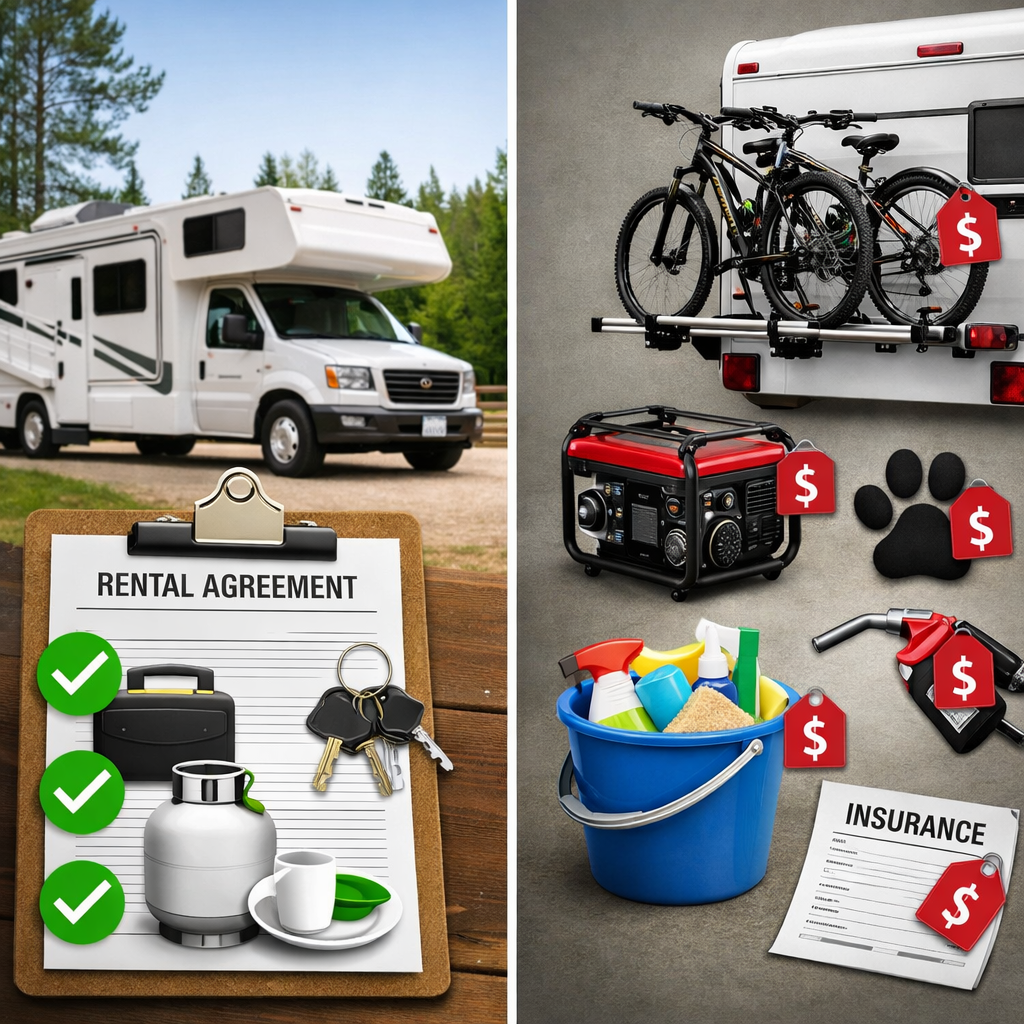
Compare RV Rental Fees: What’s Included Versus Costly Add-Ons
Renting an RV shouldn’t feel like decoding a phone bill. This guide walks you through base rate vs. add-ons so you can forecast your real trip budget—before you click Book. Total trip cost equals base rate + usage-based charges (miles, generator/propane) + mandatory or conditional fees (cleaning, dump, delivery) + insurance + campsite utilities. The bottom line: headline rates are only a starting point. Ask for an itemized quote and estimate your own usage to avoid surprise RV rental fees. It’s not just an RV thing—across industries, starter prices rarely reflect the true total once add-ons and setup costs are tallied, a pattern well documented in software pricing comparisons (see this overview of documented extras in document management platforms for context). SuiteFiles’ pricing analysis illustrates how common those add-ons can be. To reality-check your numbers fast, plug your route and hookups into RV Critic’s budget calculators linked below.
How RV rental pricing works
“Base rate” is the nightly fee for the vehicle. “Add-ons” are optional or conditional services like insurance waivers, delivery, or premium roadside. “Usage charges” are metered costs—mileage, generator hours, propane—billed per unit used. Your total is the sum of these, plus taxes and platform fees.
Many providers use modular, usage-based pricing to keep headline prices low, then expand the bill as you drive more or add services—just like SaaS tiers and metered connectors. Starter prices often exclude capabilities most travelers value, a dynamic echoed in other sectors where core features shift into higher tiers or add-ons (Aircall pricing overview; Sprout Social tiering overview).
Use RV Critic’s map as you evaluate quotes:
- Headline price → Included items → Common add-ons → Usage meters → Taxes/fees
| Pricing stage | Typical inclusions or charges | What to confirm in writing |
|---|---|---|
| Headline/base nightly rate | RV, basic cleaning between guests, standard linens | Nightly rate by date range/season |
| Included items | Miles/day, generator hours/day, minimal liability insurance | Exact mileage and generator allotments |
| Common add-ons | LDW/insurance, delivery/setup, premium roadside, pet fees, extra linens/kits | Daily costs and triggers |
| Usage meters | RV mileage fees, generator charges, propane refill | Per-mile and per-hour rates |
| Taxes/fees | Sales tax, platform/booking fee, local surcharges | Percentages and flat fees |
For a deeper RV-specific breakdown, see RV Critic’s guide to mileage, generator, and cleaning fees in rentals: Ultimate Guide to RV Rental Costs.
What the base rate usually includes
You can typically count on the rig itself, standard linens, and a light cleaning between guests. Minimal insurance is often just third‑party liability required to rent; collision/comp coverage or a lower deductible usually costs extra via a Loss Damage Waiver (LDW). What’s usually excluded from the base: mileage overage beyond the daily allowance, generator hours beyond the daily free allotment, propane refills, delivery/pickup, campsite utilities, and upgraded roadside assistance.
Platforms frequently advertise an appealing entry tier, then place what many consider basics—like unlimited miles or low deductibles—behind add-ons or higher bundles. That’s the same packaging move you see in other subscription services that reserve everyday features for pricier plans (content platform pricing comparisons; social management tiering)—a pattern we see across listings.
Add-ons that often cost extra
The most common RV rental hidden fees track with how you use the rig or the support you choose. Expect line items for:
- Insurance/Loss Damage Waiver
- Mileage overage
- Generator hours overage
- Propane refills
- Cleaning or prep upgrades
- Waste tank dump service
- Delivery and campsite setup
- Pet fees
- Premium roadside assistance
| Add-on | Typical trigger | How to minimize |
|---|---|---|
| LDW/insurance waiver | Opting for lower deductible or added coverage | Compare deductible vs. risk; check if your auto policy applies |
| Mileage overage | Driving beyond included miles/day | Map route up front; consider unlimited/bigger-mile bundles |
| Generator hours | Exceeding free hours/day | Favor electric hookups; use campground power instead |
| Propane refill | Returning tank not full | Refill locally before return; cook on electric where possible |
| Cleaning/deep clean | Excess dirt, pet hair, smoking | Follow return checklist; quick interior wipe/vacuum |
| Dump service | Tanks not emptied before return | Book full-hookup sites and dump on final night |
| Delivery/setup | Transport and leveling at campsite | Choose closer campgrounds; ask about flat-fee bundles |
| Pet fee | Bringing pets | Confirm pet policy and deposit; bring seat covers |
| Premium roadside | Faster response, more coverage limits | Verify included basics; upgrade only if remote routing |
Enhanced support and LDW function like paid upgrades in software—valuable when you need them, but optional if your risk and usage are low (Supermetrics’ metered connectors model is a good analogy). RV Critic’s rule: only pay for upgrades that reduce a real risk or replace work you don’t want to do.
Mileage policy comparison
A mileage policy sets the included miles—often expressed per day—and the per‑mile fee for every mile above that cap. It mirrors à la carte data connectors: the more you use, the more you pay (metered add-on models in analytics tools).
Mini-calculator:
- Estimated trip miles – included miles = overage miles
- Overage miles x per‑mile rate = mileage cost
Always get the per‑mile figure and included miles in writing on the quote. RV Critic sees these two numbers drive most overages.
Generator and propane charges
Generators often include limited free hours per rental day, with hourly overages billed after that. Propane is typically pay‑to‑refill at return or billed per pound/gallon used. Common examples: 3 free generator hours/day, then $3–$5 per hour; propane refill charged if returned below the starting level. Confirm your included hours, overage rate, and refill policy on the estimate. These are classic usage‑based meters: separate add-ons that scale cost with how you camp—much like advanced AI/analytics features sold separately in calling platforms (voice platform add-on costs overview).
Cleaning and dump fees
A basic prep/clean is frequently included, but deep-cleaning for excessive dirt, pet hair, or smoke is an add-on. Black/gray tank dump fees apply if you return without emptying. Ask the owner for a return-condition checklist that specifies:
- What base cleaning covers
- What triggers deep cleaning and its cost
- Pet cleaning fees and smoking penalties
- Dump fee amount and how to avoid it
As with many services, small add-ons can stack up; the remedy is clarity on exact amounts up front (industry-wide “starter price vs. total price” gap).
Insurance and damage coverage
Loss Damage Waiver (LDW) explained: LDW is an optional daily fee that reduces your financial responsibility for covered damage or theft. Plans commonly lower a high base deductible to a more manageable amount and may bundle roadside assistance; exclusions and limits vary by provider.
Ask these before you decide:
- Daily LDW cost and the deductible with/without it
- What’s excluded (tires, windshield, roof, awnings)
- Whether your auto policy extends to RV rentals
- Whether any credit card perks apply to this rental type
Think of LDW like a premium support tier: it costs more but unlocks key protections that risk‑averse renters value (tiered protections in other platforms). RV Critic suggests comparing the daily LDW price to how much it reduces your deductible and the risks on your route.
Delivery and setup costs
Delivery and setup means the owner transports the RV to your campsite, levels it, and connects utilities so you don’t tow or drive. Pricing is usually a per‑mile delivery rate with minimums, plus a setup or teardown fee. Many quotes calculate delivery as round‑trip miles.
Delivery checklist:
- Per‑mile rate and minimum miles charged
- Round-trip or one-way calculation
- Setup and teardown fees
- After-hours, holiday, or tough-access surcharges
Some operators offer flat delivery bundles that simplify budgeting if they match your use—similar to flat-fee plans in other verticals that trade precision for predictability (flat-fee plan logic example).
Campsite hookups and utilities
Campground fees are separate from rental costs and can materially sway the total. Typical ranges:
- Full-hookup private resort: about $60–$120+ per night
- State park with electric/water: about $25–$55 per night
- Boondocking/dispersed: $0, but expect higher generator and propane use
Full hookups reduce generator charges; state parks may limit generator hours; boondocking shifts more cost to fuel/propane. Fold nightly campsite fees and likely utility usage into your total trip cost modeling. For planning tools and estimators, try our roundup of route and budget apps: Top RV Trip Budget Calculators.
Roadside assistance and support
Roadside assistance typically covers towing, mobile tire changes, and jump-starts; premium support layers on priority dispatch and trip-interruption benefits. Many rentals include basic coverage, while premium support sits behind an add-on—again echoing how services gate faster response at higher tiers (metered and premium support analogs). Confirm what’s included, common exclusions (tires, lockouts), response times, and a 24/7 contact number before departure. RV Critic also recommends saving the 24/7 number in your phone before you roll out.
Bundled plans versus à la carte pricing
Bundled pricing rolls features like unlimited miles, LDW, and roadside into a higher nightly rate. À la carte keeps the base low, then bills per feature and per unit used. Different providers emphasize modules vs. bundles, and the cheaper option depends on how you’ll use the rig (ERP suite vs. module cost tradeoffs; telephony tiers and add-ons). RV Critic models both options in the scenarios below.
Which is likely cheaper?
| Trip profile | Bundle (unlimited miles + LDW + roadside) | À la carte (pay per mile/feature) |
|---|---|---|
| Short, stationary weekend (delivery to local campground) | Often more expensive than needed | Usually cheaper; low usage minimizes add-ons |
| Long, high-mileage road loop | Often cheaper if per‑mile overage would be high | Can be costly once mileage and LDW stack |
| Off-grid boondocking with frequent generator use | Bundle only helps if it includes generous generator policy | Plan for generator/propane meters; à la carte can work if you manage hours |
Sample trip scenarios and true total cost
Below are simplified examples. Taxes/fees vary by location; numbers are illustrative.
- Weekend local trip (3 nights, 150 miles, hookups)
- Base: $150/night x 3 = $450
- Miles: 300 included; 150 driven → $0 overage
- Generator/propane: within free allotment → $0
- Cleaning/dump: returned clean/emptied → $0
- LDW: $25/day x 3 = $75
- Campsite: $55/night x 3 = $165
- Taxes/fees (10% on rental + LDW): ≈ $53 True total ≈ $743
- 7-night road loop (1,200 miles, mixed hookups)
- Base: $160/night x 7 = $1,120
- Miles: 700 included; 500 over x $0.45 = $225
- Generator: 4 hours over x $4 = $16
- Propane refill: $35
- Cleaning/dump: $150 (owner service)
- LDW: $25/day x 7 = $175
- Campsites: $60/night x 7 = $420
- Taxes/fees (10% on above rental/add-ons): ≈ $172 True total ≈ $2,313
- 10-night delivery-only stay (no driving, full hookups)
- Base (travel trailer): $110/night x 10 = $1,100
- Delivery/setup: 80 mi round-trip x $2.50 = $200 + $75 setup = $275
- LDW: $15/day x 10 = $150
- Propane: $20 (light cooking)
- Campsite resort: $85/night x 10 = $850
- Taxes/fees (10% on rental + delivery + LDW + propane): ≈ $155 True total ≈ $2,550
What‑if (Scenario 2): unlimited miles bundle vs. à la carte
- Bundle nightly $210 incl. LDW: $210 x 7 = $1,470 (saves $225 mileage vs. à la carte, but costs $175 more than base+LDW)
- Net: bundle is ≈ $50 cheaper for this high‑mileage trip
As usage increases, costs scale—just like analytics platforms that charge more for data sources and users (metered feature models). Use our cost guide to sanity-check assumptions: RV Rental Costs—What’s Included.
How to request an itemized estimate
Copy-paste RV Critic’s checklist into your message to owners or platforms:
- Base nightly rate by date range and total nights
- Included miles (per day and total), per‑mile overage rate
- Included generator hours per day, overage rate
- Propane policy (return full vs. refill charge; per‑unit rate)
- Cleaning fees (what’s included vs. deep clean), dump fee and trigger
- LDW/insurance options with daily cost and deductibles
- Delivery/setup rates (per‑mile, minimums, setup/teardown, after‑hours)
- Pet/smoking policies and fees
- Roadside assistance details (what’s included/excluded, response times)
- Taxes, platform/booking fees, and any “admin” surcharges
Spelling out must‑haves and confirming whether they’re included or add-ons prevents surprises. Remember, sticker price rarely equals total price; insist on line‑item clarity (pricing transparency patterns across services).
Cost-saving strategies without surprises
- Right-size the rig: smaller Class B vans or compact trailers cost less and sip fuel.
- Limit miles: cluster attractions; consider a stationary delivery to a nearby campground.
- Book shoulder seasons for lower base rates and better site availability.
- Compare bundles vs. à la carte using your usage forecast; bundles help only if you’ll use most inclusions.
- Reserve full‑hookup sites to avoid generator charges and dump fees.
- Use planning tools: map routes and costs with our RV trip budget calculators.
RV type impact on fees and usage
Rig choice shapes both base rate and metered costs. Class A and larger Class C motorhomes command higher nightly prices and fuel consumption; Class B campervans and small towables are cheaper and more fuel‑efficient, lowering exposure to mileage and generator charges. Larger rigs may also require bigger (costlier) sites and can be tougher to deliver or place off‑grid. Match RV type to your route length and campground style to optimize for mileage and utilities. New to choosing? Start here: Motorhome vs. Travel Trailer—9 Factors.
Red flags in rental agreements
- Unclear mileage overage rates or “to be determined” language
- “Market rate” propane refills with no posted cap
- Vague “excessive cleaning” clauses with discretionary charges
- Mandatory “admin” or “processing” fees without specifics
- Requiring premium roadside just to access basic towing
Watch for add‑on stacking that escalates total cost over time—the same way plugin renewals can creep in software ecosystems (ecommerce cost creep examples). Get all fees in writing and keep email confirmations.
RV Critic’s recommendations
- Define your route and estimated miles.
- Choose the smallest rig that comfortably fits your group and sites.
- Request an itemized quote covering every meter and add‑on.
- Model usage costs (miles, generator, propane) and campsite utilities.
- Compare bundle vs. à la carte and book the best‑fit plan.
Rule of thumb: expect add-ons and usage to add 30–60% to the base for typical trips—then verify with your own mileage and campground estimates. Use RV Critic’s calculators and campground guides to forecast and control costs.
Frequently asked questions
What are the most common hidden fees in RV rentals?
Mileage overage, generator hours, propane refills, cleaning and dump fees, delivery/setup, and paid insurance waivers are the usual suspects. Use RV Critic’s itemized estimate checklist to surface them before you book.
What is typically included in the base nightly rate?
The RV itself, a light cleaning between guests, and standard linens are typical. Extras like excess miles, generator/propane, delivery, enhanced roadside, and low‑deductible coverage usually cost more—confirm with RV Critic’s request list.
How do mileage limits and overage fees work?
Rentals include a daily or trip mileage allowance; every mile beyond that cap is billed at a posted per‑mile rate. Map your route and compare with RV Critic’s calculator to decide if a bundle is cheaper.
Do I need extra insurance or a damage waiver?
A Loss Damage Waiver lowers your deductible and caps financial risk but adds a daily fee. If your auto or card benefits don’t cover RV rentals, RV Critic suggests LDW for longer or higher‑risk trips.
How can I estimate the true total trip cost before booking?
Add base nights plus estimated mileage overage, generator/propane, cleaning/dump, LDW, delivery/setup, campsite utilities, and taxes. Use RV Critic’s budget calculators and request a line‑item quote to validate.