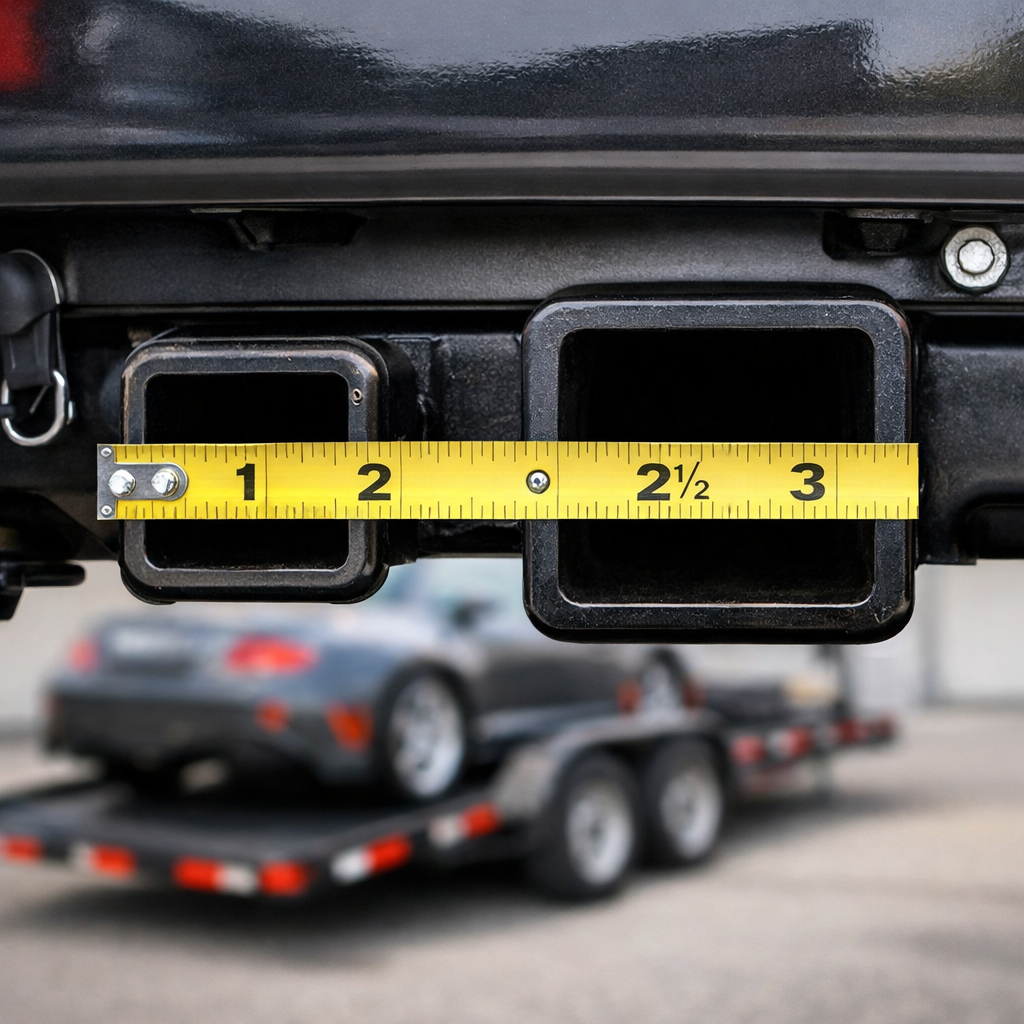
Compare 2-Inch vs 2.5-Inch RV Receiver Hitches for Car Haulers
An RV receiver hitch is the square tube mounted to your tow vehicle’s frame that accepts ball mounts and towing accessories. Common sizes are 2-inch, 2.5-inch, and 3-inch—and the size does not automatically equal the hitch’s strength rating. As a safety baseline, “Always verify both receiver size and the hitch’s weight rating; size alone doesn’t equal strength” (see the Trailer Hitch Receiver Sizes Guide by Proven Locks). RV Critic follows the same rule—confirm the stamped ratings on both the hitch and tow vehicle before you choose mounts or accessories. For car haulers, the key difference is usable capacity and stiffness: 2.5-inch receivers are typically Class 5, rated around 18,000–20,000 lb GTW and up to about 2,700 lb tongue weight, while 2-inch receivers span Class 3–5, roughly 3,500–17,000 lb GTW depending on class and design (CURT’s 2-1/2-inch and 2-inch guides). If you tow near the limits often, a 2.5-inch generally offers more margin and stability.
How receiver size affects towing a car hauler
Long, heavy car haulers amplify any play at the hitch. The larger contact area and heavier-gauge steel in most 2.5-inch receivers reduce flex and “shank movement,” improving tracking and control on uneven roads and in crosswinds—benefits called out by Proven Locks’ comparison of 2.5-inch vs 2-inch receivers. By contrast, a 2-inch receiver is fully capable within its class rating but typically shows more deflection when pushed near max loads. RV Critic prioritizes the stiffer connection when routinely hauling at the higher end of a setup’s rating.
Accessory ecosystem matters, too. The 2-inch standard has the broadest, most affordable options—ball mounts, cargo carriers, steps, bike racks, and locks—while equivalent 2.5-inch accessories exist but are fewer and usually pricier (Proven Locks).
GTW and tongue weight, in brief: Gross Trailer Weight (GTW) is the fully loaded weight of your trailer. Tongue Weight (TW) is the vertical load on the hitch—commonly 10–15% of GTW for conventional trailers. Always match both to the lowest-rated component across your hitch, tow vehicle, and mounts.
Selection criteria for car haulers
Start with weight math, then layer in usage and fitment. Use this checklist to right-size your receiver:
| What to verify | How to check |
|---|---|
| Vehicle tow rating (max trailer, GCWR) | Owner’s manual and door-jamb/tow sticker; stay within the lowest limit |
| Car hauler GTW (loaded) | Trailer spec plate plus cargo/vehicle weight |
| Tongue weight (%) | Target 10–15% of GTW; measure or estimate from layout |
| Towing frequency and routes | Frequent/heavy, hills, heat favor stiffer 2.5-inch |
| Accessory needs | 2-inch has the widest, lowest-cost ecosystem |
| Planned upgrades | Expect heavier trailer or HD truck? Consider 2.5-inch |
Before buying, confirm the tow rating in your owner’s manual and the hitch’s sticker plate for GTW/TW—size is not strength (Proven Locks sizes guide).
Good/Better/Best decision flow:
- Under ~10,000 lb GTW and <1,000 lb TW with broad accessory needs: 2-inch Class 3–4.
- 10,000–16,000 lb with higher TW: 2-inch Class 5 (XD) or 2.5-inch depending on vehicle and use.
- 16,000–20,000 lb with frequent towing: 2.5-inch Class 5.
2-inch receiver hitch
CURT’s 2-inch guide frames realistic ranges:
- Class 3: up to 8,000 lb GTW and 800 lb TW
- Class 4: up to 10,000 lb GTW and 1,000 lb TW
- Class 5 (XD) 2-inch designs: around 16,000–17,000 lb GTW with roughly 2,400–2,550 lb TW (vehicle limits still apply)
Best fit: SUVs and many 1/2-ton pickups running single- or lightweight tandem-axle car haulers. The 2-inch is the do-most standard—widest accessory ecosystem and often lower accessory cost—provided your trailer and loading keep you within ratings (CURT; Proven Locks comparison).
2.5-inch receiver hitch
CURT’s 2-1/2-inch guide classifies most 2.5-inch receivers as Class 5, commonly rated 18,000–20,000 lb GTW and up to about 2,700 lb TW. Real-world example: the Draw‑Tite Titan Class 5 2.5-inch hitch lists 20,000 lb GTW and 3,000 lb gross tongue weight, with some applications bolt-on and no drilling. These hitches are commonly found on 3/4‑ton and 1‑ton diesel trucks and are a strong match for long, heavy car haulers or multi-car rigs where stiffness and margin matter.
Side-by-side comparison
| Attribute | 2-inch receiver | 2.5-inch receiver |
|---|---|---|
| Typical class | Class 3–5 (XD) | Class 5 |
| GTW/TW range (typical) | ~3,500–17,000 lb GTW; ~350–2,550 lb TW (by class/design) | ~18,000–20,000 lb GTW; up to ~2,700–3,000 lb TW |
| Accessory availability | Widest selection, generally lower cost | Fewer, heavier-duty, generally higher cost |
| Stability/road feel | Adequate within rating; more flex near max | Noticeably stiffer with reduced shank play |
| Typical vehicles | SUVs, many 1/2-ton trucks | 3/4‑ton and 1‑ton HD trucks |
| Best for | Midweight car haulers, broad accessory use | Heavy/long car haulers, frequent high-load towing |
Class rating, in brief: Hitch class groups receivers by engineered capacity and intended use. Class 3–4 serve mid/heavy consumer towing; Class 5 targets very heavy and commercial-duty loads. Class is independent of your vehicle’s rating—always abide by the lower limit among hitch, vehicle, and towing components.
Pin sizes note: 2-inch and 2.5-inch receivers use 5/8-inch hitch pins; 1‑1/4‑inch receivers use 1/2‑inch pins (Proven Locks sizes guide).
Accessory ecosystem and cost of ownership
Expect lower lifetime costs with 2-inch: adjustable ball mounts, cargo carriers, steps, bike racks, and locks are abundant and competitively priced. The 2.5-inch ecosystem is robust for heavy towing but has fewer SKUs and higher prices on average (Proven Locks comparison). If you run a 2.5-inch receiver, plan dedicated 2.5-inch mounts for your heavy towing setup to avoid adapters and rattle. For parked stability, a hitch-mounted stabilizer can help illustrate the breadth of 2-inch accessories (see this example video overview on stabilizers).
For budgeting, also factor in locks, anti-rattle devices, and spare pins/clips. RV Critic’s breakdown of real-world hitch ownership costs can help you plan.
Vehicle compatibility and future upgrades
Quick fitment guide:
- 2-inch receivers: common on nearly all SUVs and 1/2-ton pickups.
- 2.5-inch receivers: typical on 3/4‑ton and 1‑ton diesel trucks.
- 3-inch receivers: found on some 2017+ Ford Super Duty models—verify before you buy.
Industry size overviews, including BulletProof Hitches’ charts, echo this lineup and why HD trucks move to larger receivers for stiffness and capacity. To measure, clean the tube and measure inside edge-to-edge to confirm 2, 2.5, or 3 inches (Proven Locks sizes guide). If you plan to upgrade to a heavier car hauler or HD truck within 12–24 months, a 2.5-inch Class 5 often futureproofs your setup—so long as it matches the new vehicle’s ratings. RV Critic typically advises sizing with the next truck or trailer in mind to avoid re-buying mounts.
Safety, stability, and road feel under load
A stiffer connection improves control. The thicker steel and larger contact area of most 2.5-inch receivers help resist fatigue, flex, and corrosion, which translates into less porpoising and rattle felt in-cab—advantages noted in the 2.5 vs 2-inch comparison by Proven Locks. Use correctly rated ball mounts, torque hardware to spec, and re-check torque after initial miles. On heavy-use rigs, inspect the receiver, mounts, and hardware every 1,000–2,000 miles for looseness, corrosion, and wear.
Adapters and reducer sleeves
Reducer sleeves let you run 2-inch accessories in a 2.5-inch receiver, but they can introduce slop, rattling, and even rust seizure over time (Proven Locks comparison). Treat adapters as short-term convenience; for frequent heavy towing, invest in purpose-built 2.5-inch mounts to maintain fit and reduce noise.
Maintenance tips:
- Apply anti-seize to sleeve surfaces and pins.
- Remove, clean, and dry the adapter regularly.
- Use anti-rattle devices where appropriate.
- Never assume an adapter increases capacity—it does not.
Weight distribution and braking considerations
Weight Distribution (WD), in brief: A WD hitch uses spring bars to shift tongue load from the rear axle to the front axle and trailer axles. This restores level ride height, braking, and steering feel. The WD system must match your receiver size and class to function safely (Proven Locks sizes guide).
WD only works as rated when receiver, shank, and bars are all compatible. Mismatched components can reduce control and void ratings. Also verify brake controller setup and trailer brake capacity at combined weight, and always follow the lowest rating among hitch, vehicle, or WD components.
Our recommendation by trailer weight and use case
- Up to 8,000 lb GTW (10–15% TW), light/occasional towing: 2-inch Class 3; broad accessory selection (CURT).
- 8,000–10,000 lb frequent towing or hilly routes: 2-inch Class 4; consider a WD system.
- 10,000–16,000 lb: choose a 2-inch Class 5 (XD) if available and properly rated, or step to 2.5-inch for added stiffness and margin (CURT).
- 16,000–20,000 lb or high-TW long car haulers: 2.5-inch Class 5 for the lowest flex and best control (CURT 2-1/2-inch guide). As range context, heavy-duty 2.5-inch ball mounts are rated 18,500–20,000 lb, such as this 18,500-lb adjustable 2.5-inch ball mount.
RV Critic POV: Prioritize stability and margin. If you routinely run within 10–15% of limits, size up to a 2.5-inch Class 5 to reduce stress, flex, and fatigue over the long haul.
How to find a top-rated RV receiver hitch
Evaluate brands using RV Critic’s criteria: published GTW/TW, warranty, corrosion protection, and testing. CURT’s dual-coat finish (A‑coat plus powder coat) and USA testing/manufacturing are strong quality signals. Confirm fitment via vehicle-specific selectors and read install notes—many Class 5 frame-mount hitches are bolt-on with no drilling (e.g., Draw‑Tite applications).
Quick buyer checklist:
- Verify receiver size (2/2.5/3 in) and pin diameter (5/8 in for 2/2.5 in).
- Match hitch class to vehicle tow rating and trailer weight; follow the lowest rating.
- Ensure WD compatibility and map your accessory plan (locks, anti-rattle, ball sizes).
- Consider ground clearance and driveway angles if you’ll run a deep drop mount.
For more on dialing the right hitch, see RV Critic’s guide to choosing a reliable 10,000 lb RV receiver hitch.
Frequently asked questions
How do I confirm my vehicle’s tow ratings and hitch class?
Check your owner’s manual and the door-jamb/tow sticker for GVWR/GCWR and maximum trailer weight, then read the hitch label for class and GTW/TW. RV Critic’s rule: always go by the lowest rating among the vehicle, hitch, and setup.
What is the safe tongue weight range for car haulers?
Aim for 10–15% of the loaded trailer’s weight as tongue weight, staying within both vehicle and hitch limits. RV Critic recommends weight distribution when the manufacturer calls for it.
Can I tow a heavy car hauler with a 2-inch hitch if it is rated high enough?
Yes—some 2-inch Class 5 hitches are rated around 16,000–17,000 lb GTW. RV Critic’s guidance: if you tow near max often, step up to a 2.5-inch Class 5 for added stiffness and stability.
Do reducer sleeves or adapters reduce capacity?
They can introduce slop and are best for occasional use. RV Critic advises purpose-built mounts for frequent heavy towing, since adapters may affect ratings or performance.
How should I measure for proper drop or rise to level the trailer?
Measure receiver and coupler heights on level ground and subtract to find the needed drop or rise. RV Critic favors adjustable ball mounts to fine‑tune a level tow.