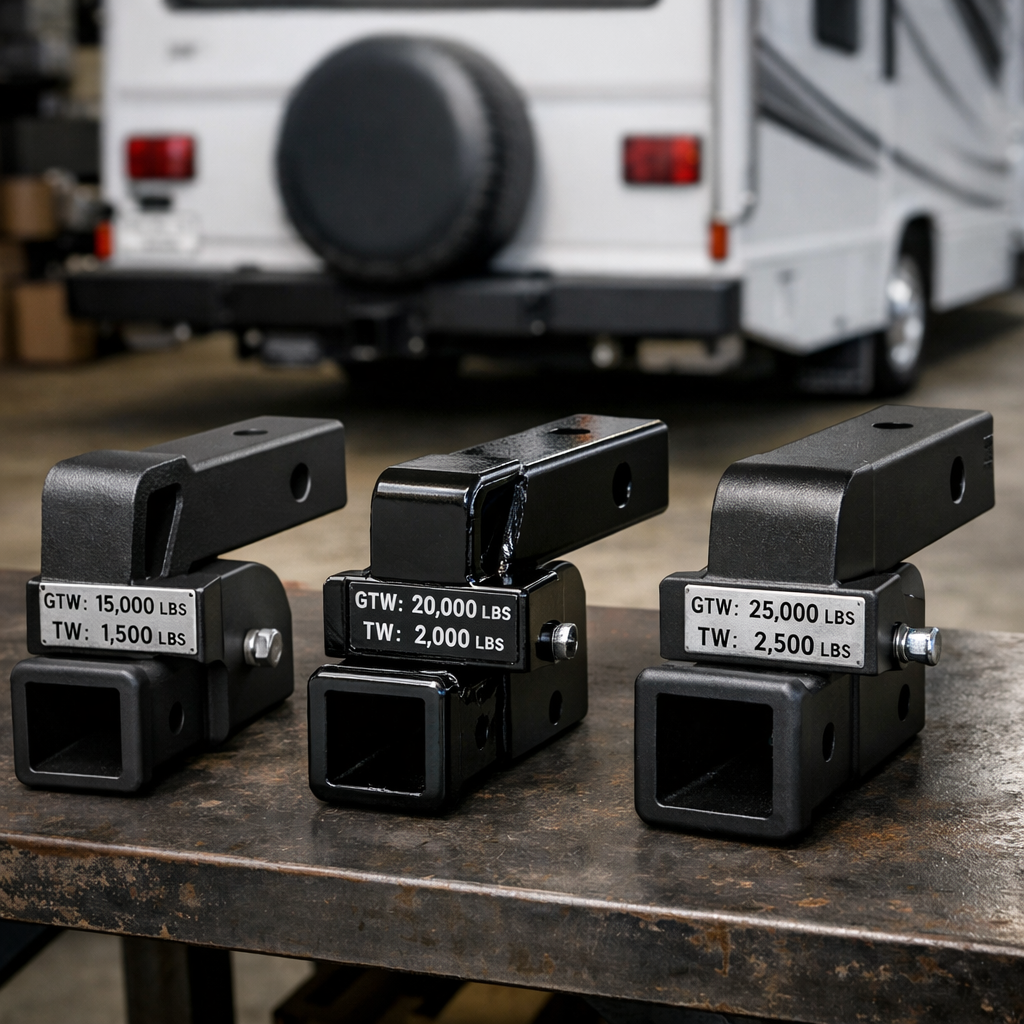
Class C Receiver Hitch Showdown: Heavy-Duty Options Compared by Capacity
Choosing the best heavy-duty receiver hitch for a Class C comes down to honest tow math and the right class: Class III covers most mid-weight trailers, Class IV adds margin for 8,000–10,000 lb loads, and Class V is true commercial-duty that only makes sense if your chassis and hitch label support it. Start with your motorhome’s tow rating, then match the hitch class and receiver size to your actual, loaded trailer weights and stability needs. At RV Critic, we prioritize real-world, loaded weights over brochure specs.
“Gross trailer weight (GTW) is the trailer’s actual, loaded weight ready to tow. Tongue weight (TW) is the downward force the trailer applies at the hitch ball, typically 10–15% of GTW for travel trailers. Both numbers must stay within the ratings stamped on your equipment.” See the spec ranges in CURT’s hitch class guide.
How to match hitch class to your Class C’s tow needs
Receiver hitch: a frame-mounted hitch that accepts interchangeable ball mounts and accessories. That’s the base of nearly every Class C towing setup, and the right choice depends on your motorhome’s ratings and your trailer’s real-world weight.
Follow this 5-step flow from RV Critic:
- Verify your motorhome’s tow rating. Use the owner’s manual, door/VIN labels, or the chassis manual to confirm max towing capacity and any frame limitations (extensions, overhang).
- Calculate your loaded trailer’s GTW and TW. Weigh your trailer as you actually travel, then confirm tongue weight (use a tongue weight calculator or scale). Target 10–15% TW for most travel trailers.
- Choose receiver size by class. Class III/IV typically use a 2-inch receiver; Class V/Xtra Duty often steps to 2.5 inches for higher capacities.
- Add stability tools as needed. Long overhangs on Class Cs benefit from a weight-distribution hitch and dedicated sway control for better tracking and steering feel.
- Confirm the lowest-rated component governs capacity. Your safe limit is the smallest rating among motorhome, hitch, ball mount, ball, coupler, and tires; never exceed it (see the “lowest-rated component” rule from TrailersPlus).
Capacity benchmarks and receiver sizes
Use this at-a-glance map to shortlist by class and receiver opening. Ratings are typical ranges; the exact label on your hitch is the authority.
| Hitch Class | Receiver Opening | Typical GTW Range | Typical TW Range | Common Uses |
|---|---|---|---|---|
| Class III | 2-inch | Up to ~8,000 lb | ~600–800 lb | Mid-weight travel trailers, boats, small toy haulers |
| Class IV | 2-inch | Up to ~10,000 lb | ~1,000 lb | Larger travel trailers, heavier toy haulers |
| Class V / Xtra Duty | 2-inch to 2.5-inch | ~17,000–20,000 lb (upper end with 2.5-inch) | Up to ~2,000–2,550 lb | Commercial-duty trailers, heavy equipment |
GTW is the loaded trailer’s total weight; TW is the downward force at the hitch ball. Industry class specs and receiver sizes generally follow these ranges across brands, with many Class V systems using a 2.5-inch receiver to reach the 18,000–20,000 lb tier (see Lippert’s beginner hitch class guide). Class ratings can vary by manufacturer and vehicle fit; always verify the specific hitch label and your chassis limitations before towing.
Class III receiver
For most Class C owners towing mid-weight loads, a Class III 2-inch receiver is the practical sweet spot. Typical Class III hitches are rated up to 8,000 lb GTW (model-dependent) with around 600–800 lb tongue weight. It’s the most common, versatile choice for campers, boats, and many toy haulers where loaded GTW stays under ~7,500–8,000 lb and TW sits near 10–12% of GTW.
What makes Class III work on Class Cs:
- Versatility: fits common 2-inch ball mounts and accessories; wide selection across brands.
- Stability aid: pair with a weight-distribution hitch and sway control for long Class C overhangs and crosswind confidence.
- Availability: many vehicle-specific, bolt-on options for popular cutaway chassis.
Mini-checklist:
- Read your hitch label and confirm GTW/TW before towing.
- Avoid receiver-size adapters; they often reduce capacity and introduce play, compromising stability.
- If you’re on the margin (e.g., 6,500 lb trailer, ~750 lb TW), add weight distribution and ensure your ball mount and ball are rated accordingly.
Class IV receiver
Step to Class IV when your trailer and tongue weight push beyond Class III’s comfort zone. Class IV commonly uses a 2-inch receiver and handles up to 10,000 lb GTW, offering welcome margin for heavier travel trailers—especially when coupled with weight distribution for stability.
Choose Class IV if:
- Your loaded trailer typically falls between ~6,500–9,500 lb.
- Tongue weight trends toward ~900–1,000 lb.
- You want extra headroom for water, gear, and seasonal variances—without flirting with limits.
Pros:
- Solid safety margin over Class III for heavier campers.
- Supports robust WD/sway setups.
Cons:
- Heavier hardware and, on some frames, pro install recommended.
- May require chassis-specific brackets or reinforcement depending on motorhome extensions.
Class V receiver
Class V (often labeled Xtra Duty) is for truly heavy towing. Some Class V hitches use a 2-inch receiver while commercial-duty versions commonly move to 2.5-inch for higher ratings, reaching roughly 17,000–20,000 lb GTW with up to ~2,550 lb TW depending on model. These are specialized systems intended for upgraded or commercial chassis.
Use Class V only when:
- Your Class C’s frame, hitch label, and chassis upfit explicitly support high tongue weights and commercial-duty towing.
- You’re pulling very heavy equipment or specialized loads that genuinely require a 2.5-inch receiver system.
Brand traits to know (RV Critic notes):
- CURT offers many vehicle-specific, bolt-on receivers that are DIY-friendly for compatible chassis.
- B&W emphasizes heavy-duty and specialty designs built for high loads (see Happy Trailers’ hitch guide for brand overviews and capacity tiers).
If your motorhome’s tow rating is well below Class V territory, upsizing the hitch adds weight and cost without any functional benefit.
Weight distribution systems
Weight-distribution (WD) hitches use spring bars to transfer some load forward, helping level the rig, improve steering feel, and reduce porpoising on long Class C overhangs. WD doesn’t eliminate the need for sway control; consider integrated 4-point or friction sway for crosswinds and passing trucks. Importantly, WD improves handling but never changes the stamped ratings—your limit remains the lowest-rated component in the system.
Quick WD setup checklist:
- Confirm your receiver is compatible with WD and rated accordingly.
- Select spring bars sized to your actual tongue weight (loaded).
- Add sway control (friction or 4-point) for better tracking in wind and traffic.
- Re-measure front/rear axle heights after setup to verify proper load transfer.
Gooseneck and fifth wheel alternatives
Gooseneck and fifth-wheel hitches mount in a pickup’s bed and place weight directly over the rear axle, delivering superior stability for very heavy loads. They’re the heavy-haul standard for trucks, but most Class C owners won’t use them on the motorhome itself. If you must move extreme loads, consider towing with a toad (a pickup) equipped with a bed-mounted hitch rather than modifying the motorhome frame (see overview discussions in ProPride’s hitch guide and Westside Rental’s selection guide).
Drawbacks:
- Higher installation complexity and cost.
- Fifth-wheel hitches are heavy; removing them to regain full bed space is time-consuming.
Fitment, frame strength and installation notes
- Start with the owner’s manual and VIN/door labels to confirm the motorhome’s towing capacity and any frame limitations. Then read the metal label on the receiver for its GTW/TW before towing.
- Prefer vehicle-specific, bolt-on receivers when available; CURT offers many DIY-friendly fits across popular chassis. Use receiver adapters cautiously—they can reduce effective capacity and add play.
- For Class V/commercial-duty hardware or any install requiring frame reinforcement, use a professional installer and verify torque specs after the first few trips.
Safety margins, brake controllers and sway control
- Legal and safe stopping: If your trailer has electric brakes (common over ~3,000 lb), a brake controller is required in many states and is a must-have for heavier towing.
- Essential accessories: proper ball mount and trailer ball (rated for your GTW/TW), safety chains, wiring harness/seven-way, and a quality brake controller.
- Stability targets: Aim for 10–15% TW and add sway control on long-wheelbase, long-overhang Class Cs. Recheck that your final, loaded setup stays under the lowest rating in the chain.
Real-world use cases and what to choose
- 5,500 lb travel trailer, ~650 lb TW: Class III + weight distribution + 4-point sway. A comfortable margin if your chassis tow rating supports it.
- 8,500 lb toy hauler, ~1,000 lb TW: Class IV + weight distribution; verify chassis and receiver ratings before hitching.
- 12,000 lb equipment trailer: Class V only if your hitch label and chassis upfit truly allow it; otherwise, not advised for a typical Class C.
- Occasional multi-trailer towing (utility + boat): Class III with a rated multi-ball mount; some multi-ball mounts (e.g., MaxxHaul-style) offer quick hitch-ball changes for flexibility (see Automoblog’s product roundup for examples).
Avoid:
- Upsizing hitch class beyond the motorhome’s tow/payload capability—this does not increase your legal or safe limit.
- Using receiver-size adapters unless necessary; they reduce capacity and can introduce play.
Total cost of ownership and warranty considerations
Expect four buckets of cost:
- Hitch hardware (Class III/IV are typically lighter and cheaper; Class V hardware is heavier and pricier).
- Ball mount(s) and balls matched to GTW/TW and receiver size.
- Wiring and brake controller (plus possible 7-way upgrades).
- WD/sway kits for stability (bars, head, and sway components).
Brand tradeoffs: CURT’s broad fitment and bolt-on ease suit DIYers, while B&W’s heavy-duty specialty designs target max-strength applications—both brands offer models that reach very high capacities depending on configuration (see Happy Trailers’ brand overview). Keep installation receipts, photograph the hitch label, and document torque values for warranty coverage and future inspections.
RV Critic’s recommendation
- Top value for most owners: Class III with a 2-inch receiver, set up with weight distribution and sway control, comfortably covering ~6,000–7,000 lb travel trailers when the chassis allows it.
- Step-up pick: Class IV for frequent 7,500–10,000 lb trailers or when tongue weight trends 900–1,000 lb and you want margin.
- Specialist tier: Class V only for commercial-duty chassis or professionally upfitted frames that clearly support high TW and 2.5-inch receivers.
No matter the class, your hard limit is always the lowest-rated component in your towing system. Verify the hitch label every trip, and use a brake controller for any trailer equipped with electric brakes.
Frequently asked questions
What hitch class is typical on a Class C and when should I step up?
Most Class Cs use a Class III 2-inch receiver. RV Critic suggests stepping up to Class IV when your loaded trailer pushes 8,000–10,000 lb or tongue weight nears 1,000 lb, and considering Class V only if the chassis and hitch label truly support commercial-duty loads.
How do GTW and tongue weight work and which number limits my setup?
GTW is the trailer’s loaded weight; TW is the downward force on the hitch ball. At RV Critic, we always go by the lowest-rated component in your system—vehicle, hitch, ball mount, or coupler.
Will a weight distribution hitch increase my rated capacity?
No. Weight distribution can improve balance and steering feel but it doesn’t change your actual rated limits; RV Critic still abides by the lowest stamped rating.
Do I need trailer brakes and a brake controller with my Class C?
If your trailer has electric brakes—common over about 3,000 lb—you generally need a brake controller. RV Critic treats it as essential for heavier towing, and many states require it.
How do I verify my motorhome’s actual towing capacity before buying a hitch?
Check the owner’s manual or VIN label for max tow capacity, then confirm the hitch’s GTW/TW on its metal label. RV Critic recommends choosing the lower number and keeping your loaded GTW/TW under it.