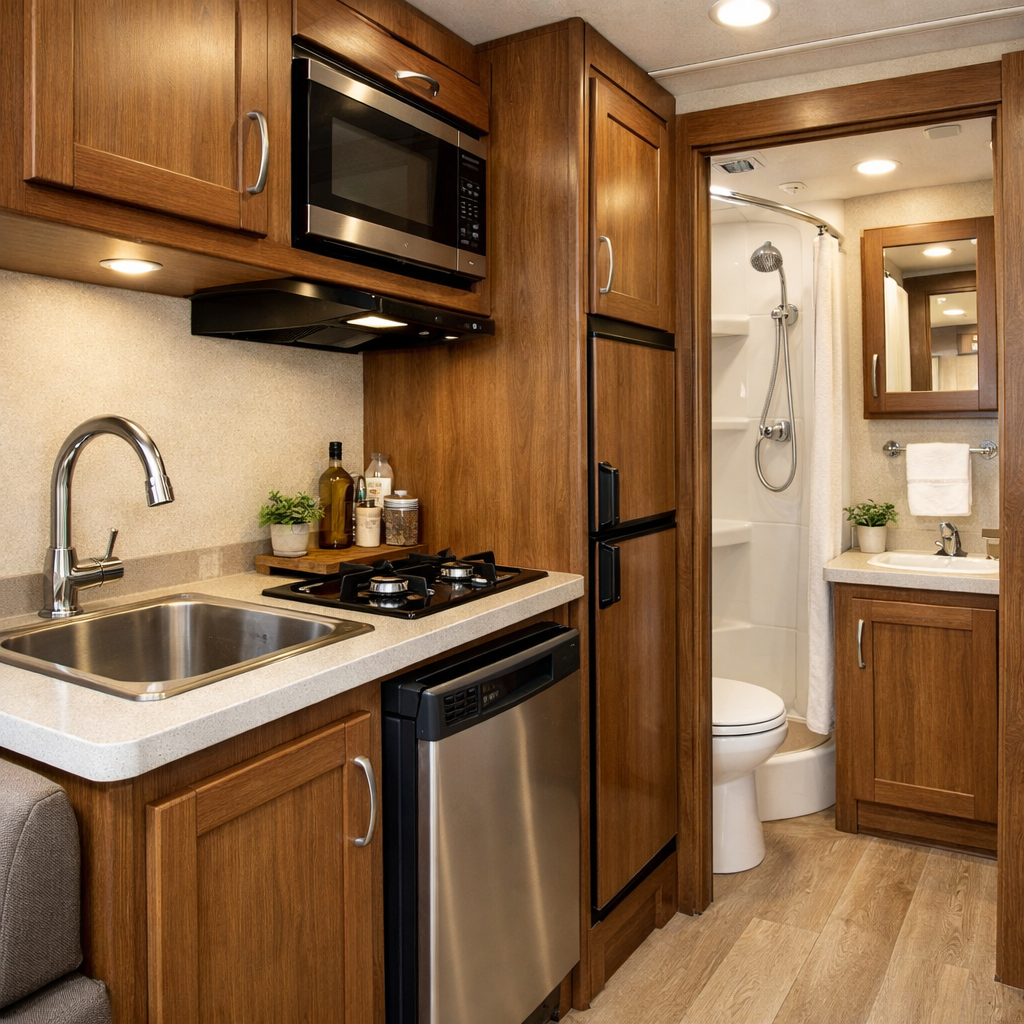
Best RVs With Reliable Kitchens and Bathrooms: Expert Buying Guide
A dependable kitchen and bathroom make or break an RV trip. If you’re wondering how to find RVs with reliable kitchen and bathroom setups, focus on the essentials that actually keep systems running: durable fixtures, right-sized tanks, strong power reserves, thoughtful ventilation, and accessible service. This guide compares standout models and then gives you a step-by-step reliable RV kitchen and bathroom checklist so you can evaluate any rig—on the lot or in a rental listing—with confidence.
RV Critic
RV Critic is a neutral, advice-forward resource for renters and shoppers who prioritize dependable kitchens and bathrooms. We judge rigs on practical criteria: fixture quality, tank sizing and plumbing design, power systems (batteries/solar/generator), maintenance access, safety, service network strength, and total cost of ownership across budget ranges. This guide serves first-time buyers, budget-conscious travelers, and DIY optimizers who want space-efficient, reliable setups. For planning help, explore RV Critic’s latest buyer tips and gear insights on our home base at RV Critic.
Airstream Interstate 24X
Airstream’s rugged Class B is built on the Mercedes-Benz Sprinter with available 4x4 and all-terrain tires, pairing a compact galley with a wet-area bath for go-anywhere durability. The brand’s quality reputation and warranty support strengthen long-term reliability signals for frequent travelers. These traits align with RV Critic’s reliability lens for compact, high-mileage vans.
Wet bath: A compact bathroom where the shower shares floor space with the toilet and sink. It saves space and weight but increases moisture exposure to fixtures and requires diligent ventilation and sealing to prevent mildew and odors, especially in small vans used for daily showers.
- Capability snapshot: Off-road-capable Class B with 4x4 options; interiors designed for extended off-grid stops (as positioned by the brand). Airstream’s warranty policy and consistent brand-quality accolades support confidence in service and support across its lines, as noted in RVezy’s best-brand roundup.
Table: Airstream Interstate 24X quick comparison
| Model | RV type | Kitchen highlights | Bathroom type | Tank/power notes | MSRP/weight | Service/support notes | Best for |
|---|---|---|---|---|---|---|---|
| Airstream Interstate 24X | Class B motorhome | Compact galley with durable hardware and metal-core faucet; efficient storage | Wet bath | Compact Class B tanks; alternator charging with supplemental solar (varies by year) | Premium Class B pricing; specs vary by model year | Strong brand reputation and warranty support (RVezy best-brand context) | Travelers prioritizing diesel efficiency, small footprint, and serviceable systems |
Source: See Airstream’s brand reputation in RVezy’s Best RV Brands overview.
Living Vehicle HD30
Oversized tanks and a robust power system are the backbone of off-grid kitchen and bath reliability. RV.com’s Best in Class guide highlights the HD30’s 100-gallon freshwater supply, 600W solar, and a 4,800Wh lithium house battery with an MSRP around $399,995. The result is consistent hot water recovery, strong ventilation, and stable pump performance during long boondocking stays—key to odor control and fixture longevity. That headroom consistently scores well in RV Critic’s checklists for off-grid kitchens and baths.
Table: Living Vehicle HD30 quick comparison
| Model | RV type | Kitchen highlights | Bathroom type | Tank/power notes | MSRP/weight | Service/support notes | Best for |
|---|---|---|---|---|---|---|---|
| Living Vehicle HD30 | Luxury travel trailer | Residential-style galley; induction-ready power | Separate shower (varies by floorplan) | 100-gal fresh; 600W solar; 4,800Wh lithium | ≈$399,995; weight varies by build | Boutique support; factory-direct assistance | Luxury off-grid buyers prioritizing spa-like baths and long autonomy |
Source: See the Best in Class 2025 features on RV.com.
Bowlus Rivet
Long off-grid power capacity reduces plumbing strain and keeps hot water and ventilation consistent—vital for odor control and moisture management. According to RV.com, the Rivet carries an 8 kWh battery, 660W solar, supports up to two weeks off-grid, measures 25'3", sleeps four, lists around $150,000, and has a 3,500-pound GVWR. Yacht-style galley materials and a strong electrical backbone help stabilize daily kitchen and bath cycles. This balance matches RV Critic’s emphasis on electrical stability for moisture and odor control.
Table: Bowlus Rivet quick comparison
| Model | RV type | Kitchen highlights | Bathroom type | Tank/power notes | MSRP/weight | Service/support notes | Best for |
|---|---|---|---|---|---|---|---|
| Bowlus Rivet | Premium travel trailer | Yacht-inspired galley fit/finish; efficient storage | Separate shower layout (model-specific) | 8 kWh battery; 660W solar; up to 2 weeks off-grid | ≈$150,000; GVWR 3,500 lbs; length 25'3" | Direct factory support; lightweight, easy-tow profile | Lightweight tow setups seeking premium autonomy |
Leisure Travel Vans Serenity
This B+ is known for quality fit/finish with a separate shower and ceramic toilet—two details that reduce moisture exposure and improve long-term reliability versus wet baths. Outdoorsy’s bang-for-your-buck roundup points to LTV among top-quality compact coaches. A fiberglass shower enclosure and ceramic toilet typically mean fewer leaks, better odor control, and simpler cleaning vs multi-piece plastic. Those details map to RV Critic’s reliability criteria for daily-use baths.
Table: Leisure Travel Vans Serenity quick comparison
| Model | RV type | Kitchen highlights | Bathroom type | Tank/power notes | MSRP/weight | Service/support notes | Best for |
|---|---|---|---|---|---|---|---|
| LTV Serenity | B+ motorhome | Upscale galley with solid cabinetry; metal-core faucet | Dry bath with fiberglass shower and ceramic toilet | Balanced Class C/B+ tank sizes; inverter/solar options | Premium B+ pricing; length ~25' | Strong dealer/service presence among premium compacts | Couples wanting upscale finishes without Class A size |
Source: See Outdoorsy’s Top 10 Bang-for-Your-Buck RVs for quality picks.
Keystone Cougar and Raptor
Residential-style kitchens, larger holding tanks, and multi-bath layouts in fifth wheels reduce daily system stress—ideal for extended stays. Bish’s lists the Cougar 25FKD around 29'11" with a ~7,096-pound dry weight and pricing from roughly $41,000–$52,000. For full-time comfort, fifth wheels emphasize residential kitchens and insulation that support durability, as noted by Bent’s RV’s full-time living guide. RV Critic favors these layouts for fewer dumps and steadier daily routines on long stays.
Table: Keystone fifth-wheel quick comparison
| Model | RV type | Kitchen highlights | Bathroom type | Tank/power notes | MSRP/weight | Service/support notes | Best for |
|---|---|---|---|---|---|---|---|
| Keystone Cougar 25FKD | Mid-size travel trailer | Front kitchen; residential-style fixtures | Separate shower; ceramic toilet (trim-dependent) | Larger tanks than small towables; generator-prep options | ≈$41k–$52k; dry wt ~7,096 lbs; length ~29'11" | Wide dealer network; popular parts availability | Couples/small families on longer trips |
| Keystone Raptor (series) | Toy-hauler fifth wheel | Residential galley; high-capacity fridge options | Multi-bath layouts in many floorplans | Large tanks suited to extended stays; generator standard on many | Pricing/weight vary by floorplan | Strong national dealer coverage | Families or long-stay users needing capacity and stable systems |
Sources: See Bish’s 10 Best Travel Trailers 2025 for Cougar details and Bent’s RV’s full-time living guide for fifth-wheel durability context.
Winnebago View 24D and Access
Winnebago pairs balanced layouts with a broad service network—big contributors to real-world reliability. Harvest Hosts highlights the View 24D’s well-rounded feature set at roughly 25.5 feet for easier parking. RV.com positions the Winnebago Access as an affordable, starter-friendly towable with MSRP around $23,000, making reliable kitchens/baths more attainable for first-timers. A strong support network ranks high in RV Critic’s serviceability rubric.
Table: Winnebago quick comparison
| Model | RV type | Kitchen highlights | Bathroom type | Tank/power notes | MSRP/weight | Service/support notes | Best for |
|---|---|---|---|---|---|---|---|
| View 24D | Class C motorhome | Compact, serviceable galley; good storage | Separate shower (trim-dependent) | Balanced Class C tanks; diesel alternator charging | Mid-tier Class C pricing; length ~25.5' | Broad Winnebago dealer/service network | Frequent travelers valuing supportability |
| Access | Travel trailer | Simple, serviceable galley; easy-to-repair fixtures | Separate shower on many floorplans | Modest tanks; ideal for hookups and weekend trips | ≈$23,000 starting MSRP | Large network aids quick parts/warranty help | First-timers and budget buyers |
Sources: See Harvest Hosts’ brand comparison for View highlights and RV.com’s Best in Class for Access affordability.
Mammoth Overland ELE
A sealed cabin and off-road-ready construction protect plumbing from dust, water intrusion, and vibration stress. According to RV.com’s 2025 picks, the ELE features a sealed cabin, off-road suspension, and an MSRP around $67,000. Simplified, protected plumbing runs reduce leak risks on rough roads and make service easier. This design approach matches RV Critic’s focus on protected plumbing and easy field service.
Table: Mammoth Overland ELE quick comparison
| Model | RV type | Kitchen highlights | Bathroom type | Tank/power notes | MSRP/weight | Service/support notes | Best for |
|---|---|---|---|---|---|---|---|
| Mammoth Overland ELE | Off-road travel trailer | Compact, rugged galley modules; exterior-friendly prep | Portable/cassette solutions (varies by spec) | Simplified plumbing; protected lines; off-grid power options | ≈$67,000; off-road-focused weight class | Niche builder support; purpose-built components | Overlanders prioritizing ruggedness and easy service |
Source: See RV.com’s 2025 favorite rigs for ELE highlights.
Ember RV Overland
Ember’s overland-focused towables emphasize lightweight, repairable construction with simplified plumbing—good news when you camp far from service. Look for accessible PEX manifolds, metal-reinforced mounting points, and protected lines to boost reliability on washboard roads. RV.com’s 2025 favorites profile Ember’s remote-camping intent and user-serviceable ethos. That user-serviceable approach aligns with RV Critic’s reliability priorities for remote travel.
Table: Ember Overland quick comparison
| Model | RV type | Kitchen highlights | Bathroom type | Tank/power notes | MSRP/weight | Service/support notes | Best for |
|---|---|---|---|---|---|---|---|
| Ember Overland (series) | Overland travel trailer | Durable galley choices; repairable materials | Separate shower on many floorplans | Off-grid packages; protected plumbing runs | Pricing/weight vary by floorplan | Growing dealer presence; user-friendly access | Towable buyers focused on resilience over luxury |
Source: See RV.com’s 2025 favorites for Ember’s overland design intent.
How to evaluate kitchen reliability
Materials, layout, ventilation, and power capacity predict day-to-day performance better than glossy brochures. Inspect in person where possible: open cabinets, check caulking and reinforcement under sinks, and verify appliance wattage labels against available circuits. Use RV Critic’s on-the-lot checklist below to structure your walk-through.
Solid-surface countertop: A non-porous, seam-minimized counter material (often Corian-style) that resists water intrusion, staining, and heat better than laminates. In RVs, it reduces leak risks at sink cutouts and preserves caulk lines during travel vibrations, improving long-term kitchen reliability and hygiene.
Fixtures and materials that prevent leaks and odors
- Prioritize ceramic or metal-core faucets, stainless sinks with rigid mounts, and solid-surface counters; avoid thin plastic fixtures that flex loose over miles.
- Ceramic toilets and fiberglass shower enclosures in the bath further reduce leak and odor risks compared to multi-piece plastic assemblies (as seen on premium B/B+ picks on Outdoorsy).
- Check P-trap access under sinks, look for Teflon tape or thread sealant on threaded fittings, and braided stainless supply lines for durability.
Layout and ventilation for daily cooking
- Choose range hoods that vent outside, cross-vent windows, and high-capacity ceiling fans to disperse heat and moisture.
- Good galley airflow preserves cabinet finishes and adhesives; it also lowers overall humidity, protecting bath seals—especially on boondocking days when showers and cooking stack moisture.
- Quick test: Run the hood on high and confirm strong airflow at the exterior vent; weak exhaust signals a blocked duct or stuck damper.
Appliance power needs and wattage limits
Right-size power so appliances run without nuisance breaker trips.
Typical loads:
- Induction burner: ~1,500W
- Convection microwave: 1,200–1,600W
- Compressor fridge: 60–150W (running), higher at startup
Lithium batteries, solar arrays, or a generator keep pumps, heater controls, and fans alive off-grid—exactly how rigs like the Living Vehicle sustain comfort for days (RV.com).
Example power table (runtime on a 4,800Wh battery bank)
| Appliance | Watts (approx.) | Amps @120V | Suggested circuit | Est. runtime on 4,800Wh (battery only) |
|---|---|---|---|---|
| Induction burner (med) | 1,000W | 8.3A | Dedicated 15A | ~4.5 hours total cook time |
| Convection microwave | 1,400W | 11.7A | Dedicated 15A | ~3.2 hours total |
| Fridge (compressor) | 120W avg | 1.0A | Shared 15A | ~30–35 hours (duty cycle dependent) |
| Range hood + lights | 60W | 0.5A | Shared 15A | ~70–75 hours |
| Roof vent fan (high) | 40W | 0.3A | 12V circuit via inverter/charger | ~100–110 hours |
Assumes inverter and system losses are modest; actual runtimes vary with duty cycles and ambient temperatures.
How to evaluate bathroom reliability
Dry bath (separate shower): A bathroom with a distinct shower stall isolated from the toilet and sink. It improves privacy and moisture control and typically uses a fiberglass or molded pan with sealed walls, reducing long-term water intrusion risk and simplifying daily cleanup for multi-person travel.
Inspect shower pans and wall seams, toilet mounting bolts and backers, and roof fan CFM ratings. Open every panel you can—good bathrooms are accessible bathrooms. RV Critic prioritizes access and moisture control during inspections.
Separate shower vs wet bath
- Reliability lens: Separate fiberglass showers and ceramic toilets simplify maintenance and reduce moisture issues, a hallmark of premium B/B+ coaches (as reflected in Outdoorsy’s quality picks).
- Use cases:
- Wet bath: Best for compact vans/trailers; requires strong ventilation, waterproof storage, and disciplined squeegee routines.
- Separate shower: Best for extended travel; look for rigid pans, one-piece surrounds, and neatly tooled, continuous caulk lines.
- Quick guide: Under 22 feet or cargo-limited? Consider wet bath. Over 24 feet or multi-week trips? Prioritize a separate shower.
Toilet types and mounting quality
- Choose ceramic or porcelain bowls with rigid floor backing; confirm proper flange alignment and through-bolt mounting.
- In heavier-use rigs (e.g., fifth wheels and high-end coaches), residential-style fixtures elevate durability and reliability during seasonal or full-time living.
- Inspection tips: Rock-test the bowl for wobble, check wax/rubber seal condition, and verify accessible shutoff valves and water-line strain relief.
Moisture control, fans, and seals
- Look for high-CFM roof fans, cross-breeze window placement, and louvered doors to keep air moving.
- Seal quality matters: continuous caulk lines, intact shower-door gaskets, and properly seated vent flanges prevent hidden moisture damage.
- Off-grid reliability depends on power: adequate battery/solar capacity keeps fans running to avoid humidity spikes and odors (as highlighted in off-grid-focused models on RV.com).
Tanks, hot water, and power systems
Tank capacities: Freshwater holds clean supply; gray holds sink/shower wastewater; black holds toilet waste. Larger capacities increase autonomy but add weight; balanced sizing prevents overfilling and reduces odor risks when vents and monitors work correctly. Match capacity to group size, shower frequency, and travel distances. RV Critic weighs these tradeoffs against real travel habits.
A quick comparison of featured models’ tank/power highlights
| Model | Tank highlight | Power highlight | Reliability takeaway |
|---|---|---|---|
| Living Vehicle HD30 | 100-gal freshwater | 600W solar; 4,800Wh lithium | Sustained hot water, fans, and pumps off-grid |
| Bowlus Rivet | Lightweight tanks for two-week autonomy | 8 kWh battery; 660W solar | Electrical capacity stabilizes HVAC/ventilation cycles |
| Keystone fifth wheels | Larger holding tanks | Generator-prep; bigger alternators (tow vehicle) | Fewer dumps; reduced pump cycling during long stays |
| Class B/C (Interstate/View) | Compact to moderate tanks | Alternator charging; optional solar | Reliable for weekends; manage showers and vent run-time |
| Ember Overland | Balanced, protected runs | Off-grid packages | Simplified systems resist vibration-related leaks |
Fresh, gray, and black tank capacities
- The HD30’s 100-gallon fresh tank exemplifies how big capacity extends boondocking windows and keeps pumps from short-cycling (RV.com).
- Fifth wheels with larger tanks need fewer service stops and experience less frequent pump cycling—both improve reliability on extended stays (Bent’s RV full-time guide).
- Aim for ratios that match your travel style: if you shower daily, fresh should meet or slightly exceed gray capacity, or plan for mid-stay gray dumps.
Water heater types and recovery rates
- Types: Propane tank (fast recovery; efficient in cold), electric tank (quiet on hookups), and on-demand tankless (endless hot water, but demands steady power and water flow).
- Recovery rate is how quickly a heater reheats water after use; higher recovery supports back-to-back showers and dishwashing without cold surprises.
- Off-grid tip: Stable battery/solar/generator supply keeps ignition and controls running—one reason long-range systems on premium off-grid trailers perform consistently (RV.com).
Battery, solar, and generator sizing for plumbing
- Examples: A 4,800Wh lithium battery with 600W solar, as on the Living Vehicle, sustains hot-water controls and ventilation for long boondocking windows. Bowlus’ 8 kWh plus 660W solar supports up to two weeks off-grid (RV.com).
- Simple sizing flow:
- Add daily loads (pump, fans, fridge, water-heater controls).
- Convert to watt-hours and compare to battery capacity.
- Ensure solar/generator replenishes at least 80% of daily use to maintain state of charge.
Keywords to consider while planning: lithium RV battery, RV solar sizing, generator for RV plumbing.
Service, warranty, and total cost of ownership
Total cost of ownership (TCO): The full lifetime expense of an RV, including purchase price, financing, insurance, maintenance, repairs, upgrades, fuel/propane, and depreciation. Rigs that are easy to service, use durable, repairable components, and have strong parts availability typically deliver lower TCO and less downtime. These factors heavily influence RV Critic recommendations.
Dealer networks and parts availability
- Brands with broad service networks shorten downtime; Winnebago’s national presence helps View and Access owners secure parts and warranty work faster (as noted in brand comparisons on Harvest Hosts and affordability context from RV.com).
- Airstream’s warranty posture and quality awards signal stronger support expectations across its lines (RVezy).
- Service indicators to ask about:
- Number of authorized service centers within 150 miles
- Typical appointment lead time in peak season
- Parts stocking levels for faucets, pumps, fans, and water heaters
Owner feedback on leak history
- Before buying, search: “model + leak,” “shower pan crack,” “toilet seal,” and “soft floor.” Pay attention to repeated issues by model year.
- Cross-check dealer service bulletins. Shortlists from sources like Outdoorsy’s bang-for-your-buck and RV.com’s annual “best” picks provide a starting pool with better-than-average build consistency.
Maintenance access and DIY friendliness
- Look for removable panels under sinks, accessible pump/accumulator, labeled PEX manifolds, and a clearly marked exterior water bay.
- DIY tips:
- Inspect/renew exterior and bath seals annually
- Clean vent fans and replace gaskets as needed
- Maintain water heater anode (if tank-type) and flush seasonally
- Use winterization ports and blow-out procedures to prevent freeze damage
Quick buying checklist for kitchens and bathrooms
Use this RV Critic checklist when touring rigs.
- Confirm tank sizes and hot-water type; bigger tanks and robust power extend reliability off-grid (RV.com).
- Inspect shower pan rigidity, wall seams, and toilet mounting (Outdoorsy’s premium picks emphasize fiberglass showers and ceramic toilets for fewer leaks).
- Verify power: battery/solar/generator sized to run pumps, heater controls, and fans through your typical day.
- Review brand service ratings, local dealer density, and warranty terms on roof and plumbing components.
Frequently asked questions
What makes an RV kitchen and bathroom reliable?
Durable fixtures (ceramic toilets, fiberglass showers), solid-surface counters, proper ventilation, and right-sized tanks and power systems minimize leaks, odors, and outages for consistent daily use. RV Critic prioritizes these factors in our picks.
Is a wet bath or a separate shower better for long trips?
Separate showers control moisture better and feel roomier on long trips, and RV Critic generally favors them; wet baths maximize space in smaller rigs if paired with strong ventilation and careful sealing.
How big should my tanks be for off-grid camping?
Choose the largest practical freshwater and balanced gray/black capacities your tow and weight limits allow; bigger tanks extend stays and reduce system stress if you shower daily. RV Critic advises matching capacity to group size and shower habits.
Do I need lithium batteries for water heaters and fans?
Not mandatory, but larger lithium banks with solar keep pumps, heater controls, and vent fans running longer off-grid, cutting moisture and odor problems versus small lead-acid setups. RV Critic recommends lithium if you boondock often.
What should I inspect in person before buying an RV?
Check shower pan rigidity, caulk lines, toilet mounting, under-sink plumbing, and fan airflow; verify tank sizes and water-heater type, then confirm dealer network strength and warranty coverage. Use RV Critic’s checklist to stay organized.