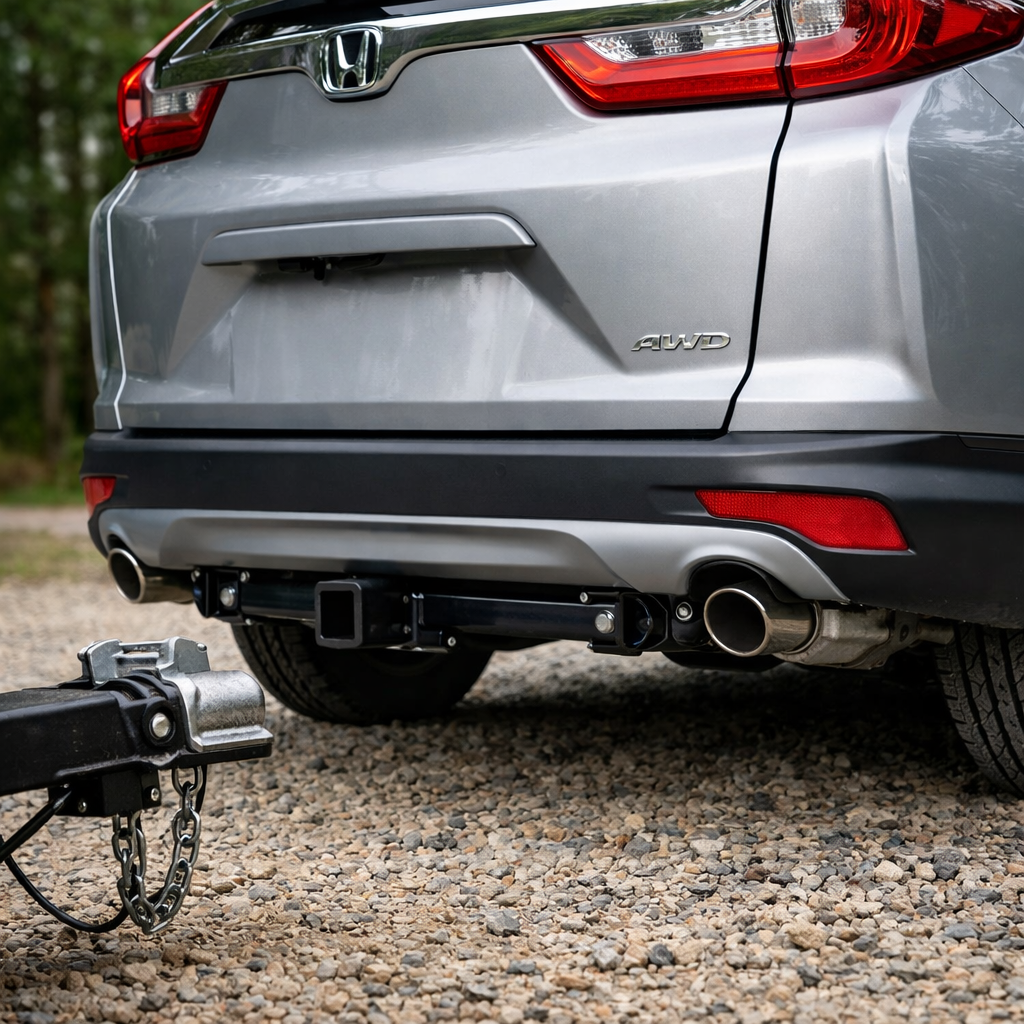
Best Affordable No-Drill Trailer Hitches for Honda CR‑V Owners
Honda CR‑V owners don’t need to pay dealership rates or drill into a unibody to tow a small camper, utility trailer, or run a cargo carrier. Several affordable, bolt-on receiver hitches are engineered for the CR‑V, and a simple Class III 2‑inch ball mount often costs only $25–$35. For most model years, a Class III 2‑inch receiver with ratings around 3,500 lb gross trailer weight and 350 lb tongue weight is the right fit, with the vehicle’s limits always in charge. Below, we explain no‑drill fitment, how to size GTW/TW and drop/rise, what to watch for on hybrids and liftgate sensors, and which budget mounts deliver the best value. RV Critic favors bolt-on, vehicle‑specific hitches that protect the CR‑V’s unibody and finishes.
Quick answer for CR‑V owners asking about no-drill hitches
Yes—multiple affordable, bolt‑on/no‑drill hitch receivers and budget mounts fit most Honda CR‑V model years. Independent roundups show basic, fixed ball mounts commonly priced around $25–$35, with strong ease‑of‑use scores in testing (see RV Critic’s picks below and the Automoblog Best Trailer Hitch guide for pricing snapshots).
A no‑drill hitch is a receiver or mount that uses existing, factory frame holes and hardware to bolt on—no frame drilling or welding required. This reduces install time, limits tool needs, and helps preserve the vehicle’s structure and finishes for everyday towing.
Most CR‑V setups use a Class III 2‑inch receiver; see our side‑by‑side comparison below and confirm model‑year fitment in the product chart.
How to choose a no-drill hitch for a Honda CR‑V
Use this five‑step flow to balance fit, capacity, and everyday usability:
- Confirm receiver and class: Most CR‑Vs use a Class III 2‑inch receiver.
- Verify GTW/TW: Match your expected trailer weight and tongue weight to the lowest‑rated link (vehicle, hitch, or mount).
- Check clearance/height: Measure for the smallest drop or rise that keeps the trailer level.
- Confirm model‑year/hybrid fit: Review fit charts and notes on sensors or fascia trimming.
- Review included hardware/locks: Avoid second trips by checking pins, clips, balls, and any anti‑rattle or locks.
Short definitions:
- GTW (Gross Trailer Weight): The fully loaded trailer weight your hitch and vehicle can safely pull.
- Tongue Weight (TW): The downward force on the hitch; compact SUVs like the CR‑V commonly pair with Class III setups rated around 350 lb TW.
Choose ratings comfortably above your expected loads, but avoid overkill that adds weight or compromises ground clearance. It’s the same simple process we use at RV Critic when vetting budget‑friendly picks.
Receiver size and hitch class for CR‑V
Most Honda CR‑V applications call for a Class III 2‑inch receiver. As a common reference point, the Draw‑Tite Class 3 hitch listing shows typical compact‑SUV ratings around 3,500 lb GTW and 350 lb TW, and fitment notes specific to the CR‑V platform. A practical definition you can rely on: Class III hitches use a 2‑inch receiver and are commonly rated around 3,500 lb GTW/350 lb TW on compact SUVs. They support cargo carriers, bike racks, and light utility or small camper trailers when properly equipped. Always confirm your CR‑V’s receiver class and capacity in the owner’s manual or the product fit chart on the hitch you’re considering.
Draw‑Tite Class 3 hitch product page
GTW and tongue weight limits
Many budget mounts cluster around 3,500 lb GTW and 350 lb TW, which aligns with common CR‑V towing scenarios. Multi‑ball options often advertise much higher capacities, but safe use always defaults to the lowest‑rated component and your vehicle’s limits. For example, Towever’s 84173 lists 3,500 lb GTW/350 lb TW, while the Towever 84180 tri‑ball advertises up to 10,000 lb GTW—numbers that may exceed what a CR‑V can legally and safely tow. Aim to stay 10–20% under the lowest rating among your vehicle, hitch, and ball mount.
AutoGuide’s Top 10 Best Trailer Hitches
Ground clearance and height needs
Level towing keeps the trailer parallel to the ground so weight distributes more evenly across axles, helping braking stability, reducing sway, and minimizing uneven tire wear. Adjustable and drop hitches can hang low on compact SUVs; independent testing notes reduced ground clearance on some adjustable models, which matters on the CR‑V’s modest ride height. Measure receiver height to trailer‑coupler height and choose the smallest drop or rise that achieves level; consider lighter, compact adjustable designs to reduce shank length and weight if you need flexibility. In our CR‑V guidance, clearance planning often makes the biggest day‑to‑day difference between a smooth and a frustrating setup.
CURT Adjustable Hitch Buyer’s Guide
Fitment verification for model years and hybrids
Always check the manufacturer’s fit chart for your exact CR‑V model year, trim, and whether it’s hybrid or gas. Bolt‑on/no‑drill claims are vehicle‑specific. Review product notes for bumper‑fascia trimming, hands‑free liftgate sensor behavior, and weight‑distribution compatibility. For example, some Class 3 receiver listings for CR‑V specify “no weight distribution” support—plan equipment accordingly. Skim install PDFs for torque specs and any temporary exhaust‑hanger drops or panel interference before you buy.
Included hardware and anti-theft locks
Budget and adjustable hitches often omit a locking hitch pin. Testing notes call out that some premium adjustable stacks ship without a lock/pin, requiring a separate purchase. Verify what’s in the kit: ball size(s), pin/clip, torque hardware, and whether anti‑rattle or locks are included. We recommend adding a corrosion‑resistant, keyed‑alike lock and a simple anti‑rattle clamp to protect the mount and quiet the ride.
Side-by-side comparison of affordable no-drill options
RV Critic prioritizes bolt‑on compatibility, clear capacity labeling, and value for CR‑V owners. Automoblog named Curt Fusion “Best Trailer Hitch” overall in its roundup and rated Reese Towpower highly for ease and fit, while also pointing to MaxxHaul’s triple ball as a sub‑$30 multi‑coupler option. Use this matrix to shortlist the right Honda CR‑V hitch mount.
| Product | Receiver/Class | Ball sizes | Drop/Rise | Rated GTW/TW | Notable pros/cons | What’s included | Best for |
|---|---|---|---|---|---|---|---|
| Curt Fusion Trailer Hitch Mount | Fits 2‑inch Class III receivers | 2‑inch fixed (pre‑torqued) | Fixed; low drop options available | Match to vehicle; CR‑V commonly 3,500/350 | + Ultra‑affordable, simple, durable finish; − Fixed height/ball size | Ball mount with welded ball; check for pin/clip | Single trailer owners needing a basic, light‑duty setup |
| Reese Towpower Drop Standard Class III Starter Kit | 2‑inch Class III | 2‑inch | Fixed drop (common 2"–3") | Match to vehicle; CR‑V commonly 3,500/350 | + Ready‑to‑tow bundle, strong ease/fit scores; − Limited adjustability | Ball mount, 2" ball, pin/clip (typical) | First‑timers wanting an out‑of‑box solution |
| MaxxHaul Triple Ball Mount | 2‑inch Class III | 1‑7/8", 2", 2‑5/16" | Fixed; rotate to select ball | Higher ratings on larger balls; CR‑V still limited to ~3,500/350 | + Cheapest path to multiple couplers; − Heavier shank, may reduce clearance | Tri‑ball mount; pin/clip often separate | Households sharing multiple trailers |
| Towever Tri‑Ball Mount (e.g., 84173/84180) | 2‑inch Class III/IV | 1‑7/8", 2", 2‑5/16" | Fixed; rotate to select ball | 84173: 3,500/350; 84180: up to 10,000 GTW | + Wide range of ratings; − Overkill for CR‑V, added weight | Tri‑ball mount; pin/clip varies | Mixed coupler sizes; confirm CR‑V limits |
| BulletProof Hitches Adjustable Drop/Rise | 2‑inch receiver; high‑capacity stack | Dual‑ball options common (2", 2‑5/16") | Adjustable channel (various drops/rises) | Very high hitch ratings; CR‑V still governs | + Maximum configurability, U.S.‑made, lifetime guarantee; − Can sit low; lock often sold separately | Adjustable mount; lock/pin typically separate | Frequent tow‑height changes; careful clearance planning |
Testing notes referenced above come from the Automoblog Best Trailer Hitch guide.
Curt Fusion Trailer Hitch Mount
Automoblog’s top pick earned a 5.0 score for value and simplicity, with pricing commonly around $30. It’s ideal if you tow one trailer at a consistent height, want minimal tools, and prefer a welded, pre‑torqued 2‑inch ball. Typical black powder‑coat finishes help resist corrosion and UV scuffing.
Reese Towpower Drop Standard Class III Starter Kit
Rated highly for ease and fit (4.8 in testing), Reese’s starter kit bundles the ball mount, 2‑inch ball, and pin/clip, making it an easy first‑tow choice for CR‑V owners. Verify the included drop matches your coupler height to keep the trailer level.
MaxxHaul Triple Ball Mount
Listed as an inexpensive multi‑ball option (around $25), this budget tri‑ball covers the three most common coupler sizes without buying extra mounts. It’s convenient for shared or rented trailers—just remember your CR‑V’s towing limits still apply, even if one ball lists a higher capacity.
Towever Tri-Ball Mount
Towever’s 84173 version is rated 3,500 lb GTW/350 lb TW, while the 84180 tri‑ball advertises up to 10,000 lb GTW. Those upper numbers don’t change CR‑V limits, but the mount’s broad compatibility can be useful if you also tow with a higher‑capacity vehicle. Its added mass and length can trim ground clearance on the CR‑V.
BulletProof Hitches Adjustable Drop Rise
Praised for versatility, BulletProof’s adjustable channel makes quick rise/drop changes easy and is backed by a lifetime guarantee. Caveats for small SUVs: the stack can sit low, and many packages ship without a lock/pin—budget for a separate purchase. It’s premium gear that’s often overbuilt for a CR‑V but perfect if you tow varied trailers and prioritize configurability.
Key comparison points that matter on a CR‑V
Installation and true no-drill compatibility
- Why it matters on a CR‑V: A bolt‑on, no‑drill receiver preserves the unibody structure, speeds the install, and keeps warranty confidence high.
- Do this: Choose a vehicle‑listed, bolt‑on/no‑drill receiver and scan the instructions for fascia trimming or sensor notes in advance. Some anti‑sway systems also emphasize no‑drill simplicity to reduce wear points, as highlighted in ProPride’s sway-control primer.
- Suggested tool list and time: Floor jack/stands or ramps, torque wrench, socket set, safety glasses, rust inhibitor. Typical driveway install for a CR‑V receiver: 45–90 minutes with basic hand tools; ball mounts insert in seconds.
Capacity and safety margin for small SUV towing
- Why it matters on a CR‑V: The Class III baseline of about 3,500 lb GTW/350 lb TW is a common reference—stay under your specific model’s ratings from the manual or hitch label.
- Remember: Higher numbers on tri‑ball or adjustable mounts don’t increase vehicle limits. Size for your real load with 10–20% headroom for braking and stability.
Everyday usability and versatility
- Why it matters on a CR‑V: Convenience features make towing less of a chore on a daily driver.
- Multi‑ball convenience: One mount covers 1‑7/8", 2", and 2‑5/16" couplers, ideal for shared or rental trailers.
- Adjustable hitches: Vertical channels enable quick rise/drop tweaks for level towing; dual‑ball stacks often cover 2" and 2‑5/16" couplers.
- Quality‑of‑life: Add anti‑rattle clamps and favor corrosion‑resistant finishes to keep rides quiet and hardware protected.
Ground clearance and ride height impact
- Why it matters on a CR‑V: Adjustable stacks and deep drops can drag on driveways. Testing notes that some adjustable designs sit low—plan carefully on compact SUVs.
- Practical tips: Use the smallest workable drop, flip for rise when appropriate, and pull the mount when not towing to regain clearance. Lightweight aluminum adjustables can save shank weight without excess length.
Price, what’s included, and total cost to tow
- Why it matters on a CR‑V: Budget mounts like Curt Fusion (
$30) and MaxxHaul tri‑ball ($25) keep costs low, while starter kits like Reese add out‑of‑box convenience. - Hidden costs: Many adjustable hitches don’t include a locking pin. Add budget for a lock, wiring, and an anti‑rattle device.
Sample CR‑V towing cost checklist:
- Hitch receiver (no‑drill, vehicle‑specific): $150–$300
- Ball mount (fixed or tri‑ball): $25–$60
- Adjustable mount (if needed): $180–$350+
- Locking hitch pin + anti‑rattle: $25–$60
- Wiring harness (CR‑V T‑harness): $30–$90
- DIY install time: 1–2 hours (receiver), minutes (mount); pro install adds labor
RV Critic recommendations by use case
Best overall budget pick for simple towing
Curt Fusion — Sub‑$40 simplicity with top ease‑of‑install scores and a welded 2‑inch ball. Ideal if you run one trailer at a fixed height.
Best starter kit for first-time CR‑V owners
Reese Towpower Class III Starter Kit — High ease/fit ratings and an all‑in‑one bundle (ball, mount, pin/clip) make first tows straightforward.
Best multi-trailer versatility on a budget
MaxxHaul Triple Ball Mount — Roughly $25 gets you three coupler sizes on one shank; great for shared or rented trailers without swapping mounts.
Best adjustable option for mixed trailer heights
BulletProof Adjustable Drop/Rise — Highly configurable with robust build quality and a lifetime guarantee; measure clearance carefully and plan to buy a separate lock.
When to skip adjustable or heavy multi-ball hitches
If you tow light loads at a single height, bulky stacks add weight and can hurt ground clearance. Choose a compact single‑ball mount and store it when not in use.
Warranty, safety, and wiring considerations for CR‑V owners
Document your install and follow torque specs to protect both safety and warranty peace of mind. Plan wiring early and consider basic sway mitigation if you’re near the upper end of CR‑V towing. At RV Critic, we also suggest saving torque sheets and quick photos of mounting points for future service visits.
Will a bolt-on hitch affect warranty
A proper bolt‑on receiver typically doesn’t void your warranty. Follow the manufacturer’s instructions, avoid drilling when a no‑drill fit exists, record torque values, and apply rust inhibitor to hardware and exposed metal.
Wiring harness and brake light integration
Use a vehicle‑specific T‑harness for a 4‑pin (or 7‑pin if required) so turn signals and brake lights function legally. Cargo carriers without lights generally don’t need wiring unless they block your taillights—always test after installation.
Weight distribution and sway control basics
Sway control reduces side‑to‑side trailer motion from wind, road crown, or passing trucks; premium systems like ProPride’s 3P aim to virtually eliminate sway and emphasize simplified, no‑drill installs. Some CR‑V Class 3 receivers specify “no weight distribution,” so verify compatibility. CURT also notes adjustable mounts can pair with weight distribution for high ratings on trucks, but CR‑V limits still govern.
Frequently asked questions
Are there affordable trailer hitch options for Honda CR‑Vs with no drilling
Yes. Several bolt‑on, no‑drill Class III 2‑inch options and budget mounts fit CR‑Vs, with basic ball mounts often around $25–$35. RV Critic suggests choosing a vehicle‑listed, bolt‑on kit and confirming GTW/TW match your towing needs.
What class hitch and receiver size should I use on my CR‑V
Most CR‑V owners use a Class III 2‑inch receiver with typical ratings around 3,500 lb GTW and 350 lb tongue weight. RV Critic recommends verifying your model year’s limits and choosing components that meet or exceed them.
Do I need a wiring kit to tow a small trailer or cargo carrier
You need wiring for any trailer with lights so turn signals and brake lights work. RV Critic recommends testing all functions after install; a platform carrier without lights usually doesn’t need wiring unless it blocks your taillights.
Will a hitch interfere with hands-free liftgate sensors
Some vehicles see minor sensor sensitivity changes; many CR‑V owners retain hands‑free liftgate by kicking to one side. RV Critic advises checking product notes for sensor guidance and testing after installation.
How do I avoid ground clearance problems with adjustable hitches
Use the smallest drop/rise that keeps your trailer level, consider compact or aluminum adjustable designs, and remove the mount when not towing. RV Critic also recommends measuring receiver‑to‑ground height to select a setup that preserves clearance.