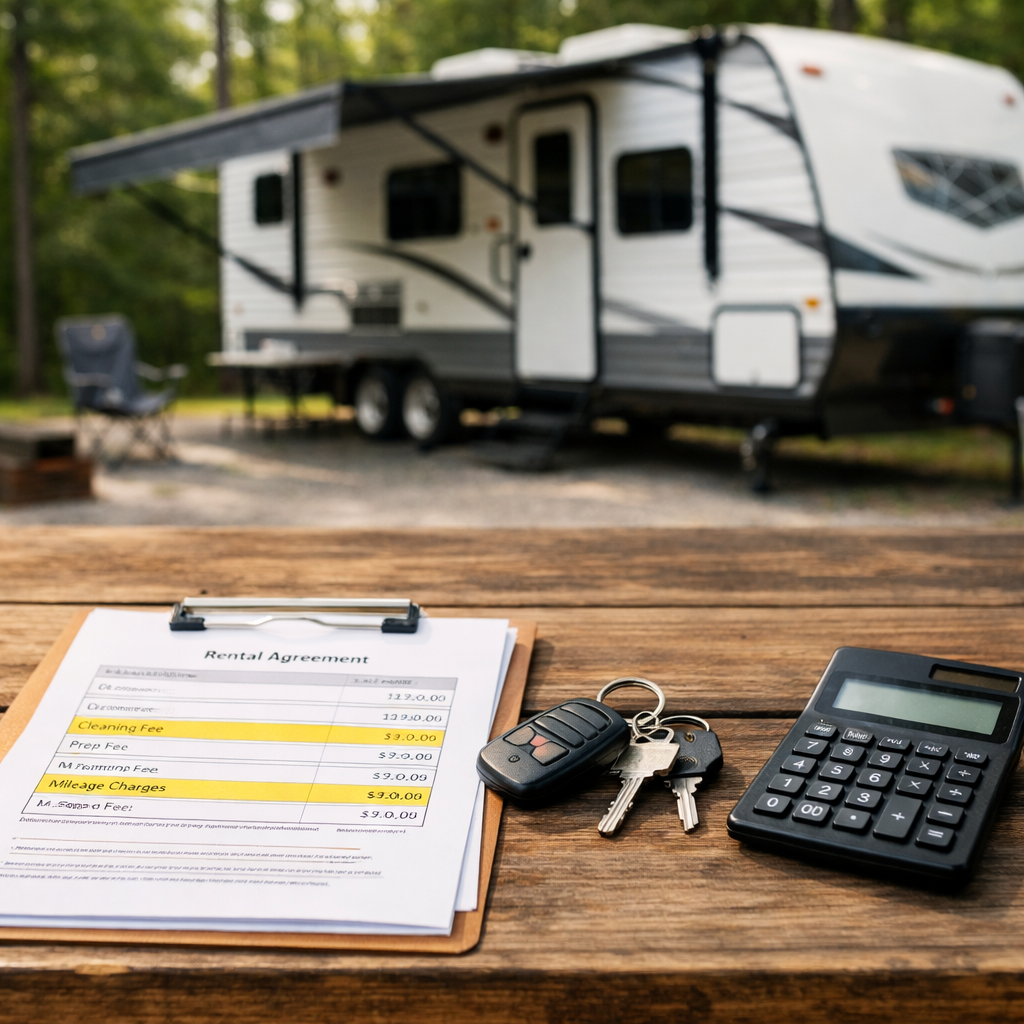
Avoid Surprise Fees: What’s Actually Included With Your RV Rental
Renting an RV feels simple until the extras start stacking up. The nightly price usually covers the RV itself and the built-in systems you need to operate it, but many costs—protection packages, service fees, mileage overages, generator time, cleaning, propane, and comfort kits—sit outside that base. RV rentals bundle lodging, transportation, and utilities into one experience, which is why fees can look more complex than hotels, as outlined in Outdoorsy’s RV rental fees and hidden costs guide. Your best defense is knowing exactly what’s included in your RV rental and confirming the rest in writing before you book. RV Critic breaks down what’s actually included so you can budget confidently and avoid avoidable add-ons.
At a glance:
| Typically included in base rate | Commonly extra (not in base rate) |
|---|---|
| RV unit and legally required safety gear | Platform/service fees and taxes |
| Built-in systems (beds, kitchen, bathroom) | Protection package/insurance and deposit |
| Basic onboard utilities (water, power systems) | Mileage overages and generator hours |
| Standard wear-and-tear cleaning | Deep cleaning, tank dump, propane, delivery, linens, kitchen kits |
What the base RV rental rate actually covers
Most nightly rates cover the RV itself plus standard equipment required to operate it safely and legally. The advertised price often excludes platform or service fees, protection packages, deposits, delivery, and most consumables. As a result, two similar listings can have very different all-in costs.
Base rate (48 words): The base RV rental rate is the advertised nightly price for the vehicle and its built‑in systems (bed, galley, bathroom, climate, and legal safety gear). It typically excludes platform/service fees, required protection packages, deposits, delivery, mileage or generator overages, propane refills, cleaning beyond normal use, and optional comfort kits.
Typical add-ons that are not included
Expect these common line items to influence your real trip budget:
- Service/platform fees: typically 10–25% of the rental subtotal, plus taxes.
- Insurance/protection package: often $30–$70+ per night, depending on rig and coverage.
- Security deposit: commonly $500–$1,500, held or preauthorized.
- Cleaning: $50–$200 for standard cleaning; more for excessive messes.
- Generator overage: $3–$5 per hour after the included allowance.
- Mileage overage: $0.35–$0.75 per mile beyond included miles.
Owners and platforms may also charge for delivery (per mile or zone), pet fees, propane refills, late returns (hourly or full-day charges), and tank-dump services, as covered in SmarterTravel’s guide to the hidden costs of RV rentals. These fees exist to account for depreciation, sanitation, and liability—and because charges are split between platform and owner, totals can feel fragmented until you review the full checkout.
Insurance and protection packages explained
Most platforms require a protection package that includes liability (often up to $1 million) and some combination of comprehensive and collision for the RV, with nightly costs frequently in the $30–$70+ range, according to Outdoorsy’s fees overview. Provider policies vary widely. For instance, El Monte RV cites daily insurance options around $14.95–$29.95 per day and a typical $1,000 security deposit, illustrating how rig class and provider shape pricing and deductibles.
Protection package (45 words): A protection package is a platform‑ or owner‑provided insurance bundle for your rental period. It usually includes liability coverage and comprehensive/collision for the RV, with stated limits, deductibles, and exclusions. It’s separate from the nightly rate, often mandatory, and determines your real out‑of‑pocket risk exposure.
Mileage, generator hours, and fuel policies
Many rentals include about 100–150 miles per day, with overages billed at $0.35–$0.75 per mile. As one example, El Monte RV typically includes 100 miles per night and charges roughly $0.37 per additional mile. Generator use is often capped with a small daily allowance; extra hours usually cost $3–$5 each. RVs generally get about 10–22 mpg depending on size and driving conditions, and you’re typically required to return with a full fuel tank. RV Critic recommends tallying these costs up front.
Estimate your total cost in four steps: Use RV Critic’s checklist alongside these steps.
- Map your route miles, subtract included miles, and multiply any overage by the per-mile rate.
- Estimate generator hours you’ll use vs. the free allowance, then multiply the difference by the hourly rate.
- Estimate fuel: total miles ÷ expected mpg × local gas price.
- Add the protection package cost per night to your subtotal.
Cleaning, dumping, and return condition expectations
Standard cleaning charges often range from $50–$200; smoking or severe messes can trigger additional penalties, with some providers listing up to $250. Returning with full gray or black tanks commonly incurs a dump fee (around $75), and many contracts require you to empty tanks before return to avoid charges. Expect to return with a full fuel tank if that’s specified in the agreement.
Quick return checklist:
- Empty gray/black tanks as required; keep your dump receipt if you have one.
- Refill fuel and propane per policy.
- Remove trash, wipe surfaces, and sweep floors.
- Photograph condition, mileage, and generator hour meter at drop-off.
Delivery, setup, and campsite services
Delivery can be a stress-saver if you don’t want to tow or drive, but it’s usually billed per mile or as a flat fee, with possible add-ons for setup. Ask whether stabilizing, leveling, water/electric hookup, and awning setup are included in the delivery price or billed separately.
Delivery and setup (45 words): Delivery and setup is an optional service where the owner tows or drives the RV to your campsite and completes initial setup: leveling, stabilizing, connecting water/electric, and a walkthrough. It’s priced per mile or as a flat fee within a radius, trading cost for convenience.
Kitchen, bedding, and camp gear inclusions
Don’t assume comfort items are included. During booking, ask for a written inventory of on-board items and a walkthrough at pickup, a best practice Travel + Leisure recommends in its RV rental tips. Verify categories like cookware and utensils, dinnerware, coffee maker, linens and towels, pillows, mattress covers, camp chairs, outdoor rug, grill, and leveling blocks. Pet kits, bike racks, and other outdoor gear may carry separate fees.
What’s usually included vs. bring your own:
- Often included: basic cookware/utensils, a few dishes, a coffee maker, two camp chairs (varies widely).
- Often extra/bring: full bedding sets, extra towels, outdoor rugs, grills, specialty cookware, bike racks, and large gear.
Power, water, and propane essentials
Hookups (45 words): RV hookups are campsite connections that supply electricity (30‑amp or 50‑amp), fresh water, and sometimes sewer. With power and water connected, you can run appliances without the generator. Without a sewer hookup, you’ll need to dump tanks at a station before returning to avoid fees.
Propane is often your responsibility for cooking, heat, and hot water—returning low can trigger refill charges. Generator hours are commonly limited; confirm what adapters (30A/50A), water hoses, pressure regulator, and sewer hoses are included to avoid last-minute purchases.
How to verify what’s included before you book
Use this five-step process (and RV Critic’s checklist below) to eliminate ambiguity:
- Read the full listing, add-ons, and platform fee breakdown before checkout (compare against RV Critic’s checklist; Outdoorsy’s guide to fees is a helpful benchmark).
- Ask direct questions about insurance/deductibles, mileage allowances, cleaning/dump rules, and permitted travel areas, as highlighted by USA RV Rentals’ contract guidance.
- Confirm generator hours, propane expectations, and late-return rules in the platform message thread.
- Request a pre-trip walkthrough and an inventory checklist; photograph condition and meters at handoff (a tip echoed by Travel + Leisure).
- Save screenshots of agreed inclusions and keep all commitments in-platform for dispute protection.
Rental agreement (45 words): A rental agreement is the binding contract for your trip. It names approved drivers and travel limits, and sets insurance terms, mileage and fuel rules, cleaning and tank requirements, deposits, and penalties for violations. It governs obligations for both parties and controls dispute resolution process.
Smart ways to avoid surprise fees
- Bring verified insurance if the platform allows it to reduce daily protection costs, a savings tactic noted by Texas RV Adventures.
- Choose per-mile vs. unlimited carefully: Cruise America explains why per-mile can be cheaper for short trips, while unlimited bundles may pay off on long routes.
- Prebuy discounted mileage packs when offered to avoid higher per-mile overages (a common option with national rental brands).
- At trip’s end: empty tanks, refill fuel, tidy the interior, and return on time to dodge dump, cleaning, and late fees.
What to pack if it’s not included
- Kitchen: pots/pans, spatula, chef’s knife, cutting board, coffee setup, dish soap and sponge, trash bags, paper towels.
- Bedding: fitted sheets, blankets/duvet, pillows, towels, mattress protector (especially with kids or pets).
- Campsite: camp chairs, outdoor mat, headlamps, extension cord, surge protector, water filter, leveling pads.
- Utilities: 30A/50A adapter (if not provided), drinking-water hose, sewer hose support, disposable gloves, RV-safe toilet paper.
Propane, generator fuel, and firewood are often renter expenses and may be restricted by local rules. Confirm campsite hookups in advance to avoid unexpected generator or dump charges.
RV Critic’s checklist to confirm inclusions
Use this table to verify details pre-trip and during your walkaround. Capture photos of the odometer, generator hours, and overall condition at pickup and return.
| Item | Included? | Fee? | Notes |
|---|---|---|---|
| Platform/service fee | 10–25% | Check if taxed separately. | |
| Protection package/insurance | $30–$70+/night | Confirm liability limit and coverage type. | |
| Liability limit | Often up to $1M on platforms. | ||
| Deductible | Note amount per incident. | ||
| Security deposit | $500–$1,500 | Refund timing and conditions. | |
| Included miles per day | 100–150 | Total miles included for your trip. | |
| Mileage overage rate | $0.35–$0.75/mi | Ask about mileage bundles. | |
| Included generator hours/day | List daily and total trip allowance. | ||
| Generator overage rate | $3–$5/hr | Clarify idle-time counting. | |
| Fuel return policy | Usually “return full.” | ||
| Propane policy | Prepaid vs. refill on return. | ||
| Cleaning fee | $50–$200 | Define “excessive mess” threshold. | |
| Tank dump fee | ~ $75 | Required if tanks not emptied. | |
| Late-return terms | Hourly or full-day | Note grace period and cutoff times. | |
| Delivery rate/zone | Per mile or flat | What setup is included? | |
| Travel area limits | States/roads allowed; off-road rules. | ||
| Approved drivers | List names and license checks. | ||
| Kitchen kit included | Inventory cookware, dishes, coffee maker. | ||
| Linens/towels included | Count sets and sizes. | ||
| Camp chairs/outdoor rug | Quantities and condition. | ||
| Hoses/adapters provided | 30A/50A, water hose, sewer hose, regulator. | ||
| Leveling blocks | Count and condition. | ||
| Owner walkthrough scheduled | Date/time and pickup location. |
Frequently asked questions
How do I check if an RV rental includes essential gear?
Read the full listing and ask the owner for a written inventory of kitchen kits, linens, hoses/adapters, and camp chairs. Use RV Critic’s checklist and request a pickup walkthrough to verify each item.
Is insurance included in the nightly rate?
No—insurance is usually a separate protection package and often required, commonly $30–$70+ per night depending on rig and coverage. Confirm your rate in the listing or with RV Critic’s checklist.
How many miles and generator hours are typically included?
Many rentals include about 100–150 miles per day and a small daily generator allowance, with overages billed per mile and per hour. Verify your exact allowances in the listing or via RV Critic’s checklist.
Do I have to return the RV with empty tanks and a full fuel tank?
Usually yes—contracts often require empty gray/black tanks and a full fuel tank to avoid dump and refueling fees. Your rental agreement controls the return condition; RV Critic’s checklist covers these items.
Are linens, cookware, and outdoor chairs usually provided?
Sometimes—some owners include kitchen kits and basic linens, while others charge extra or exclude them. Confirm the inventory before booking using RV Critic’s checklist.