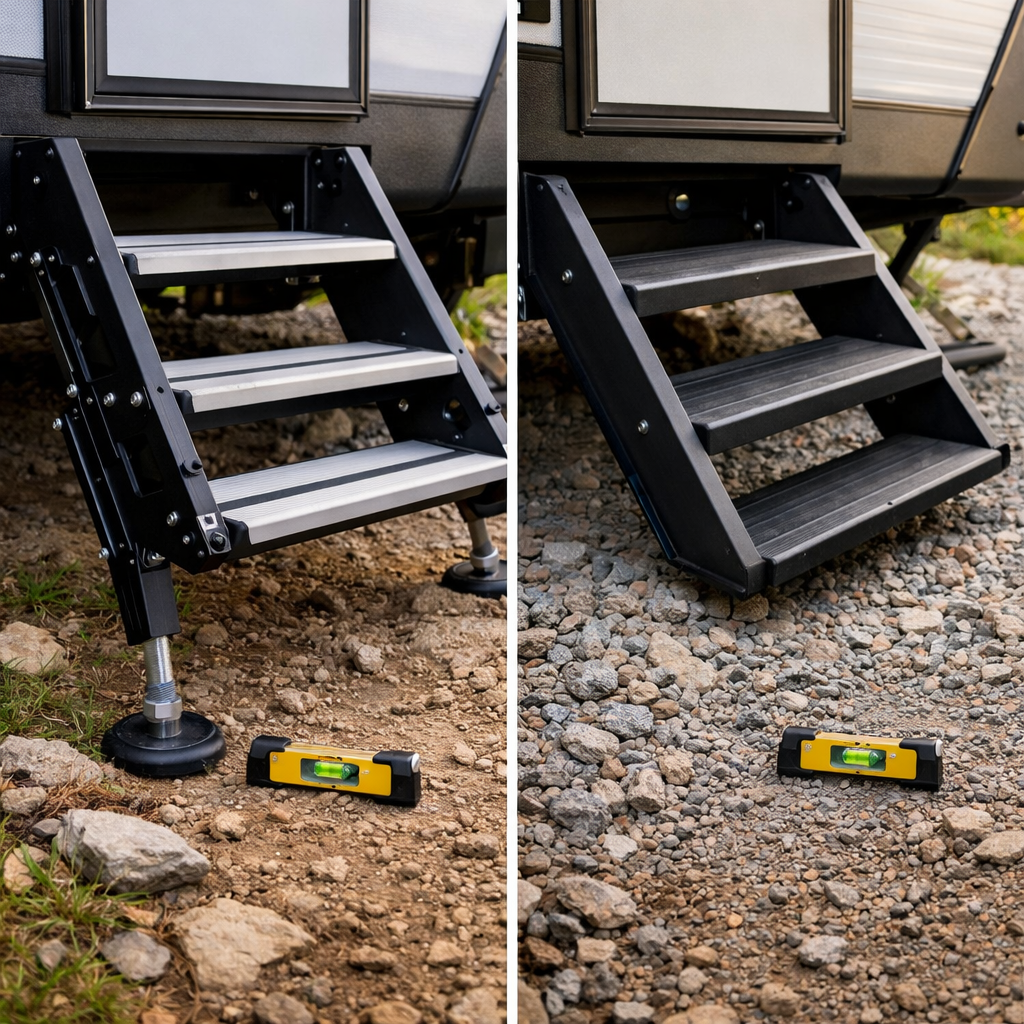
Adjustable vs. Solid RV Steps: Which Handles Uneven Terrain Best?
Getting safely in and out of your rig shouldn’t depend on how flat your campsite is. For sloped, crowned, or rutted sites, adjustable RV steps handle uneven terrain best. Their height-adjustable legs and pivoting feet can level each tread and reduce wobble, while fixed steps rely on a flat pad and can feel springy when one edge bears most of the load. The tradeoff: adjustable mechanisms add complexity, and powered versions introduce motors and electronics that can increase repairs and cost over time, a pattern well documented with adjustable motion bases in other categories (see this adjustable base pros and cons explainer). RV Critic’s bottom line: for the best RV steps for uneven terrain, choose adjustable; for simpler ownership on pavement, fixed steps win.
Quick verdict on uneven terrain
Adjustable RV steps generally provide the best stability on uneven terrain. Adjustable RV steps use telescoping or pivoting legs to level each tread on irregular surfaces, improving sure-footedness and cutting RV step wobble on crowned, soft, or rocky sites. By contrast, solid, fixed steps bolt or weld to the frame and depend on a flat, uniform parking surface; on slopes, one-edge loading can make them feel bouncy at the outer edge. Expect higher price and more upkeep with mechanisms—powered variants add motors/electronics that can require unplanned repairs and cost more than buyers expect, mirroring issues seen with adjustable motion bases in home furnishings.
How RV step types differ
Adjustable RV steps include fold-into-door designs and scissor steps with manually telescoping or powered legs and pivoting feet that meet the ground; locks and latches stiffen the system once leveled. Common examples include MORryde StepAbove with adjustable feet and anti-wobble latches, and Torklift’s GlowStep Revolution with All Terrain Landing Gear leveling feet. Solid RV steps are fixed, welded or bolted under the chassis with no leveling mechanism; they’re rigid and low maintenance but rely on a flat pad.
Stability on uneven ground means each step tread stays level and resists wobble even when the campsite surface slopes, crowns, or is rutted. Leveling legs and rigid locks spread load evenly, cut bounce and one‑edge loading, boost footing confidence, and significantly reduce slips or missteps.
As with any added mechanics or electronics, adjustable features improve function but increase repair risk and service needs over time—another tradeoff seen in adjustable motion products.
Evaluation criteria for uneven sites
Use a simple feature comparison matrix to evaluate models side by side. At RV Critic, we use the criteria below to compare stability, fitment, and cost head to head. Create columns for models and rows for weight capacity, adjust range, lock method, power requirement, footprint, door fitment, warranty, and price. A spreadsheet feature comparison template makes this visual and scannable, and you can adapt a guide on building comparison templates to add check-mark icons and conditional highlights.
- Adjust range: the millimeters/inches of leg travel available to level treads.
- Lock method: pin, cam, over-center latch, or powered lock and how securely it clamps.
- Ground contact: single-foot vs dual-foot per side; bigger, pivoting feet grip soft soil better.
- Capacity: state in pounds, and verify if the rating is per step or for the overall system.
- Fitment: confirm door width/height, step-well, bolt pattern, and first-step height on your leveled rig.
Adjustable RV steps
Adjustable steps shine on crowned pads, gravel, forest roads, and boondocking pullouts because their legs transfer load directly to the ground and keep treads level. Many retrofit cleanly, and some integrate anti-wobble locks to stiffen the feel once deployed. Expect to spend more up front and budget time for seasonal maintenance.
Notable features to look for:
- Dual independent legs with inch-marked telescoping and large pivoting feet
- Over-center or cam locks that pull the frame tight against the threshold
- Anti-wobble brackets or latches to reduce play at the door
Lippert’s Solid Step line illustrates typical fit charts and install guidance for fold-into-door, ground-contacting steps when you’re checking dimensions and door clearances.
Stability and leveling on slopes
Ground-contacting, height-adjustable legs minimize “springboard” bounce by loading the legs into the ground and keeping each tread level on slopes, ruts, or soft pads. Wobble is lateral or vertical movement felt when stepping, often caused by non-level treads or mounts flexing under load. Like mattress edge support, well-supported edges should feel as secure as the center; adjustable legs improve contact, but you still need a stiff tread and solid locks for confidence, an edge-support principle echoed in independent mattress testing.
Durability and maintenance
Adjustable systems add hinges, guides, and sometimes motors or door switches. That boosts functionality but also introduces more wear points; as with powered adjustable bases, breakdowns can be time-consuming and costly without coverage. Plan seasonal care:
- Rinse grit from telescoping legs; let dry
- Lubricate pivots and latches with a dry-film product (avoid attracting dust)
- Inspect lock pins and hardware torque
- Check foot pads for wear, deformation, or fastener loosening
- Touch up chips to prevent corrosion
Installation, power, and compatibility
Manual adjustable legs require no power. Powered steps need 12V wiring, a fused circuit, and often a door or ignition switch; verify harness routing and weather protection. Always confirm frame mounting hole patterns, door swing/threshold clearance, and stored height before you buy. Retrofit compatibility means a step can bolt to your RV’s existing frame or step well without custom fabrication, maintaining door swing and ground clearance.
Load capacity and tread feel
High load ratings matter for bigger travelers and those carrying gear or kids. Look for minimal deflection under a 200–300 lb dynamic load, wide non-slip treads, risers under roughly 8 inches for comfort, and handrail compatibility. Think of it like mattress support: reinforced cores and firmer edges resist collapse and inspire confidence underfoot, a trait linked with better perceived stability in sleep lab overviews.
Cost of ownership
Adjustable systems usually cost more initially. Over time, added mechanisms—and especially motors/electronics—can add repair expense. Compare warranty length, parts availability, and DIY serviceability in your matrix, and consider the real cost of downtime if a latch, spring, or motor fails on a trip.
Solid RV steps
Fixed, under-chassis steps win for simplicity, rigidity, and price. With fewer moving parts, they’re predictable and durable, and many rigs already have factory bolt patterns that accept common replacements. The tradeoff: on irregular ground they can feel tilted or bouncy, because nothing meets the ground to level the treads.
Stability limits on irregular ground
When a campsite slopes, one-edge loading makes one side carry more weight; the step can feel tipped or springy at the edge. Without ground-contacting legs, bounce and wobble are more noticeable on rough sites. Mitigate by adding leveling blocks under tires/jacks, a compatible stabilizer, or a portable adjustable platform like Camco’s adjustable platform step placed under the bottom tread.
Durability and service simplicity
Fewer parts mean fewer failures. Compared with adjustable mechanisms, solid steps lower long-term failure risk and simplify inspections. Maintain by:
- Checking fastener torque at the frame and hinge points
- Treating surface rust and repainting scuffs
- Replacing worn tread grip or traction tape
- Verifying clearance after suspension or tire changes
Fitment and retrofit ease
Many fixed steps are straightforward to retrofit using existing bolt patterns and basic brackets.
Fitment is how precisely a replacement step matches your RV’s dimensions and mounting points. Proper fitment aligns bolt patterns, preserves door clearance, and sets a comfortable first-step height when leveled, avoiding drilling or fabrication while keeping ground clearance, threshold sealing, and handrail positions intact overall.
Load capacity and rigidity
Rigid designs often deliver a firmer, “solid” underfoot feel with less perceptible step flex. For high-capacity RV steps, confirm the rated load and check for bracing under the top tread where the frame ties in; stronger bracing reduces deflection, similar to firm mattress edges holding shape under weight.
Budget considerations
Solid steps are typically more economical up front and cheaper to service over time thanks to simpler construction. Create Good/Better/Best tiers by capacity, tread width, finish, and weather resistance to match your camping needs and climate.
Side-by-side comparison on key factors
| Factor | Adjustable Steps | Solid Steps | Takeaway |
|---|---|---|---|
| Uneven-terrain stability | ✓✓ (best on slopes with leveling legs) | ✓ (good on flat pads) | Adjustable: best on slopes; Solid: best on flats |
| Load capacity | ✓✓ (varies; check per-system rating) | ✓✓ (often very high) | Both can be strong; verify ratings |
| Maintenance risk | ✓ (more parts; inspect latches/legs) | ✓✓ (fewer parts) | Solid: lowest maintenance risk |
| Installation complexity | ✓ (measure door/threshold; possible mods) | ✓✓ (often bolt-on) | Solid: simpler installs overall |
| Retrofit compatibility | ✓ (confirm door clearance) | ✓✓ (common bolt patterns) | Solid: broader drop-in fit |
| Price | $$/$$$ | $/$$ | Solid: budget-friendly; Adjustable: pricier |
| Warranty | Varies by brand/configuration | Varies by brand/configuration | Compare years/coverage in your matrix |
Tip: Build this RV step matrix in a spreadsheet using a feature comparison template and simple checkmark icons for quick scanning.
Which to choose for your camping style
- Mostly boondocking, forest roads, or crowned gravel pads: choose adjustable steps for superior stability on slopes and mobility-friendly heights.
- Mostly paved campgrounds and RV parks, prioritize low upkeep and lower cost: choose solid steps.
- Mixed camping but keeping fixed steps: add leveling blocks and, when compatible, a stabilizer or a portable platform to reduce bounce.
- Mobility needs (knee/hip concerns, pets): adjustable steps with finer height tuning and a handrail improve accessibility.
Field test checklist before you buy
- Park on a representative slope and deploy the steps.
- Verify leg adjust range covers your typical ground-to-threshold height.
- Lock/unlock mechanisms several times; check for play.
- Step near edges to evaluate deflection and wobble.
- Confirm the door clears the stowed and deployed steps.
- Test on soft soil or gravel; ensure feet don’t sink excessively.
- Confirm mounting bolt pattern and measure first-step height when leveled.
Score your matrix: stability (1–5), edge deflection (1–5), setup time (1–5), and fitment pass/fail; tally results to choose confidently.
Safety and maintenance best practices
- After dirty trips: rinse steps and feet; let dry.
- Monthly in season: dry-lube hinges and latches; check anti-slip surfaces.
- Quarterly: torque-check fasteners; inspect for rust and repaint as needed.
- Annually before peak season: replace worn foot pads or tread grip; review warranty/parts.
- If powered: carry spare fuses and plan for service lead times; mechanical complexity increases service risk, so keep documentation and part numbers handy.
Frequently asked questions
What makes RV steps wobble on uneven ground?
Wobble happens when treads aren’t level or the step doesn’t contact the ground evenly, causing flex and bounce. Adjustable steps with leveling legs reduce wobble by setting equal height and firm ground contact—RV Critic’s pick for uneven sites.
Are adjustable RV steps worth it if I mostly camp on pavement?
If you park on flat pads, solid steps are usually simpler and cheaper. Adjustable models pay off if you sometimes hit gravel, slopes, or need mobility-friendly heights.
Do I need power for adjustable steps, and what if the motor fails?
Many adjustable steps are manual; RV Critic favors these for simplicity. Powered versions need 12V wiring, and a failed motor may require repair or manual stowing until serviced.
How much weight should RV steps safely support?
Look for steps rated to at least match your heaviest user plus gear, typically 300–500 lb for travel trailers and fifth-wheels. Always confirm whether the rating is per step or total system.
How do I size and fit new steps to my RV door and threshold?
Measure door width, threshold height, step well dimensions, and ground-to-first-step height when leveled. RV Critic also recommends confirming bolt pattern compatibility and door clearance to ensure a clean retrofit.