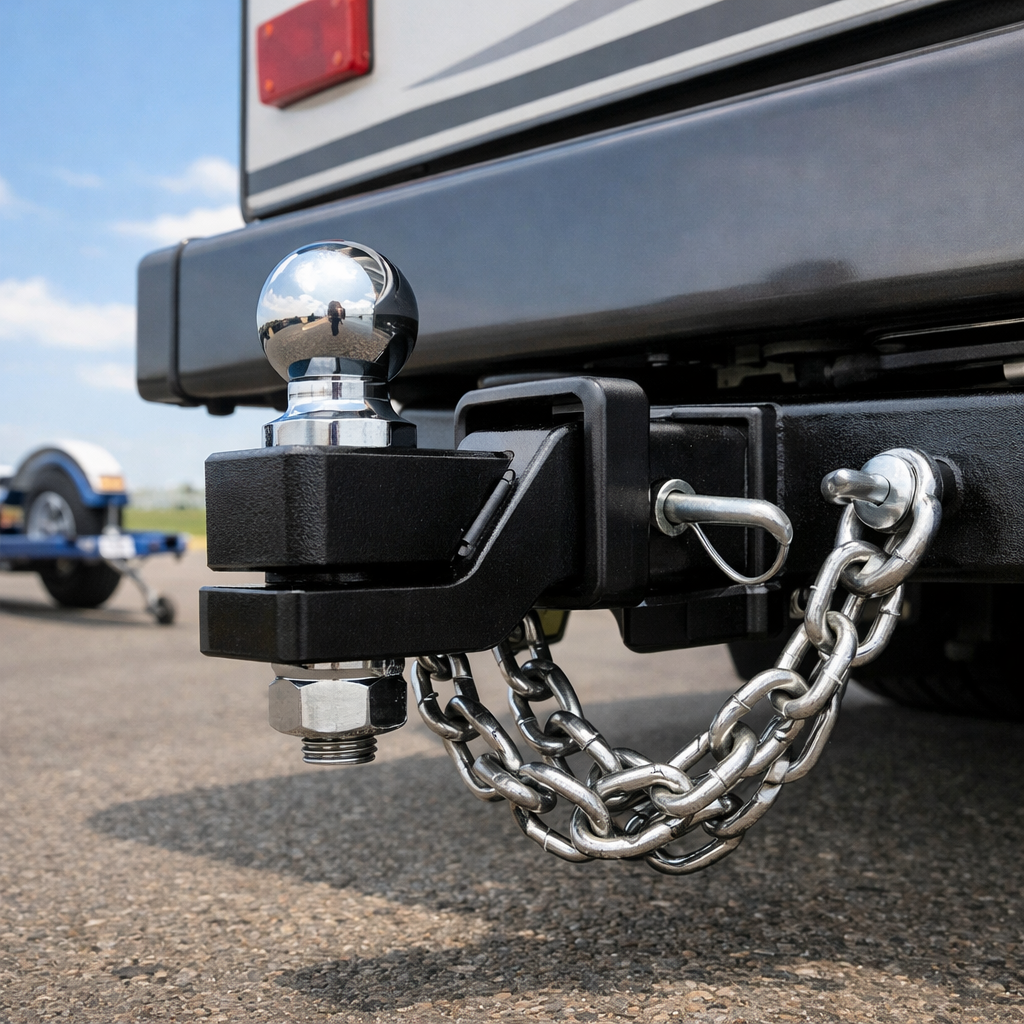
7 Best Heavy-Duty Receiver Hitches for Class C RVs
Class C motorhomes tow from a long rear overhang, which adds leverage to the frame and increases tongue load sensitivity. That demands a stout, frame‑mounted receiver, smart height setup, and—when needed—sway control. Below are seven options RV Critic trusts for capacity, durability, and day‑to‑day usability on Class C rigs. “Receiver hitch classes” are standardized categories (I–V) that indicate maximum towing and tongue weight capabilities and typical receiver tube sizes, e.g., 2" for Class III–IV and 2½"–3" for Class V, as explained in Hitch & Haul Sales’ receiver hitch classes guide (Everything to Know About Receiver Hitches).
Note: We independently select and test gear. When in doubt about fitment or installation safety, hire a professional.
RV Critic Top Pick
B&W’s Heavy Duty Receiver hits the sweet spot for most Class C owners: a rugged, 3‑piece interlocking design with a 6‑point frame mount, Grade 8 hardware, and a reinforced 2‑inch receiver rated around 16,000 lb GTW and 1,600 lb tongue weight, backed by a limited lifetime warranty at roughly $329. In RV Critic’s testing, its value-to-strength ratio is hard to beat, and the OEM‑like frame fit keeps leverage in check on motorhomes.
- Pros: Exceptional build quality; strong GTW/TW for Class C use; fair price for lifetime value.
- Cons: Heavier than light‑duty options; frame drilling may be required; best installed by a pro.
Best for: Owners towing small cars on dollies, cargo/boat trailers, or moderate loads within their Class C hitch capacity who prioritize durability over adjustability.
B&W Heavy Duty Receiver
B&W is a benchmark for heavy‑duty, frame‑mounted receivers on RVs. The design uses three interlocking sections that tie into the frame at six points with Grade 8 fasteners. A reinforced 2‑inch receiver tube with steel gussets resists twist from long Class C overhangs, and integrated chain loops and a wiring‑plug bracket simplify safe hook‑ups. The package carries a limited lifetime warranty with typical retail around $329 and ratings near 16,000 lb GTW / 1,600 lb tongue weight (vehicle limits still apply), per the B&W Heavy Duty Receiver Hitch page.
GTW (Gross Trailer Weight) is the total loaded trailer weight; tongue weight is the downward force on the hitch—usually 10–15% of GTW for stability.
Spec snapshot:
| Capacity (GTW/TW) | Receiver size | Mount type | Hardware | Warranty | Price (approx.) |
|---|---|---|---|---|---|
| ~16,000 lb / 1,600 lb | 2" | Frame‑mounted (6‑point) | Grade 8 bolts | Limited lifetime | ~$329 |
Fit notes: Measure frame width and hole patterns; expect possible drilling. Verify spare‑tire and exhaust clearances, plus bumper or ladder interference before ordering.
Reese Towpower Class V
For owners who want proven heavy‑duty capacity with broad availability and an OEM‑style fit, Reese’s Class V lineup is a strong value play. Class V expectations typically include 10,000+ lb GTW and 1,200+ lb tongue ratings, consistent with industry roundups such as these Reese Towpower Class V reviews. Match the exact motorhome chassis (e.g., Ford E‑Series, Chevy/Workhorse) via custom‑fit part numbers, and double‑check receiver size—a 2‑inch receiver simplifies accessory use, while 2½‑inch can offer higher capacity (use a reducer if needed).
- Pros: Strong capacities; wide dealer network; many custom‑fit brackets.
- Cons: May require pro install; generally fixed height, so no built‑in adjustability.
Gen-Y Torsion Receiver
A torsion hitch integrates rubber or spring elements within the hitch to absorb shock and vibration between the tow vehicle and trailer. This reduces fore‑aft “chucking,” dampens bumps, and improves control, especially on rough roads or with heavy tongue loads.
Gen‑Y’s torsion and stacked receiver designs add two advantages for Class C owners: smoother ride quality and versatile height/ball options. For frequent towing with different trailers, stacked/adjustable systems cut setup time and keep couplers level. Expect premium pricing; etrailer’s best trailer ball mounts guide shows adjustable/stacked mounts typically ranging from $350–$900 for heavy‑duty 30,000‑lb‑class models. Trade‑offs: more weight on the rear, higher cost, and the need to verify departure angle and clearance on low‑hung Class C bumpers—RV Critic advises confirming these before purchase.
BulletProof Adjustable Hitch
If you swap between trailers, BulletProof’s adjustable two‑ball platform is a workhorse. Adjustable/stacked mounts are commonly priced around $200–$700 in premium tiers, with heavy‑duty models reaching $900 for 30,000‑lb ratings per etrailer’s pricing guidance. Look for:
- Multiple pin positions for ample drop/rise
- 2" and 2‑5/16" steel balls on the same head
- Corrosion‑resistant powder coat
- Shank size matched to your receiver (2" vs 2½")
Use cases:
- Boat and cargo trailers with varying coupler heights
- Utility and equipment trailers where tongue loads change Note: Adjustable heads add mass at the receiver; consider anti‑rattle devices and re‑torque checks to protect Class C frames from extra leverage.
Rhino Hitch Adjustable
Rhino Hitch attracts RVers who want fast, tool‑light height and ball changes without compromising on toughness. Owners and RV Critic readers consistently highlight quick adjustments, clean machining, and durable finishes in feedback on Rhino Hitch.
Feature checklist:
- Large, clearly marked drop/rise range
- Hardened pins and robust lock points
- Powder‑coated or anodized finishes
- Clear GTW/TW ratings on shank and ball platform
How to pick the right drop in minutes:
- Measure your motorhome’s receiver height to ground (loaded). 2) Measure your trailer’s coupler height (level). 3) Subtract coupler height from receiver height—this difference is your drop; reverse for rise.
Adjustable hitch comparison at a glance:
| Model | Adjustability (drop/rise) | Typical cost band | Approx. weight | Best for |
|---|---|---|---|---|
| Rhino Hitch | Wide, quick pin‑based | Mid‑to‑premium | Moderate | Frequent height changes, mixed trailers |
| BulletProof | Wide, stacked receiver | Mid‑to‑premium | Heavier | Maximum versatility and ball options |
| Gen‑Y Torsion | Wide + shock absorption | Premium‑plus | Heaviest | Smoother towing with heavy tongues |
ProPride 3P Pivot-Point Hitch
ProPride’s Pivot Point Projection moves the trailer’s effective pivot forward near the tow vehicle’s rear axle, which cuts sway without relying on friction add‑ons and often installs without drilling, as outlined in ProPride’s premium trailer hitch recommendations. It’s a different approach than friction bars—and a strong fit for taller, boxy trailers that wander in crosswinds.
“Weight distribution hitches use spring bars to spread trailer load across the axles, reducing sag and improving stability,” according to The Trailer Guys Guide to Choosing the Perfect Trailer Hitch.
Guidance:
- Confirm compatibility with your Class C’s frame‑mounted receiver and your trailer’s A‑frame geometry.
- Pros: Exceptional sway control; confidence at highway speeds.
- Cons: Higher cost and more initial setup than basic friction devices.
Draw-Tite Class IV Receiver
If you want OEM‑like reliability with mid‑heavy capacity, Draw‑Tite (and peers like CURT) offers well‑supported Class IV receivers that fit many motorhome frames. Class III typically tops out near ~8,000 lb/800 lb with 2‑inch receivers, Class IV around ~10,000 lb/1,200 lb (often still 2‑inch), and Class V exceeding 10,000 lb with 2½–3‑inch receivers—numbers that help set realistic expectations for Class C hitch capacity.
- RV Critic recommends prioritizing custom‑fit brackets for your chassis, ensuring easy access to safety‑chain loops and a wiring‑plug bracket, and verifying receiver size for accessory compatibility.
- Pros: Broad availability; proven designs; solid coatings.
- Cons: May need pro install; no built‑in height adjustability.
How we selected and tested
At RV Critic, we started with hard specs—published GTW/TW ratings, frame‑mount architecture (multi‑point brackets with Grade 8 hardware), corrosion protection, support for weight distribution/sway control, warranty terms, and total cost bands—then layered in user feedback and shop experience. Benchmark features we prioritized included robust frame brackets, quality powder coats, clean welds, and corrosion resistance often cited in premium hitch recommendations. Hands‑on checks covered chassis fit verification, step‑by‑step installation, pin/lock tolerance, and anti‑rattle performance. For heavy frame‑mounted receivers, we used professional installation to ensure torque, alignment, and safety parity.
Key buying factors for Class C owners
Use this short list to narrow options quickly:
- Capacity targets: Choose a hitch whose GTW/TW meets or exceeds your RV’s tow and tongue ratings; keep tongue weight at 10–15% of GTW for stability.
- Receiver size: 2‑inch for broad accessory fit; 2½–3‑inch for Class V loads (use reducers when needed).
- Fitment: Frame width and bolt patterns, exhaust/spare‑tire/bumper clearances, safety‑chain loop access, wiring‑plug bracket.
- Compatibility: If you plan on weight distribution or sway control, confirm your receiver/hitch is rated for it.
- Protection and support: Quality powder coat, stainless hardware where appropriate, clear labels, and a solid warranty.
Quick class primer:
- Class III: Up to ~8,000 lb GTW / ~800 lb TW, typically 2" receiver.
- Class IV: Up to ~10,000 lb GTW / ~1,200 lb TW, often 2" receiver.
- Class V: Beyond 10,000 lb GTW / 1,200+ lb TW, 2½"–3" receivers.
Installation and fitment tips
Step‑by‑step flow:
- Measure frame spacing and confirm bolt patterns.
- Verify receiver size (2" vs 2½") to match mounts and accessories.
- Check exhaust, spare‑tire, bumper, and ladder clearances.
- Inspect included hardware—look for Grade 8 on heavy receivers.
- Lift safely, align brackets, and torque all fasteners to spec.
- Test‑fit your ball mount, chains, and wiring; confirm pin/lock engagement.
B&W’s six‑point mounting and Grade 8 hardware are examples of robust install design that resists flex on Class C overhangs. For tricky fitments, adapters, reducers, and extenders are widely available (see Amazon’s best sellers in towing hitch receivers), but use them sparingly to minimize added leverage. RV Critic recommends professional installation for heavy frame‑mounted units.
Safety, sway control, and braking essentials
- Weight distribution reduces rear sag and helps stability as loads rise; spring bars shift load forward for better steering and braking feel.
- Pivot‑point projection systems move the effective pivot closer to your rear axle, cutting sway at the source—useful on tall or long trailers towed by motorhomes.
Safety checklist:
- Verify tongue weight at 10–15% of GTW.
- Confirm trailer brakes and brake‑controller settings before each trip.
- Re‑torque hitch hardware and recheck pins after the first 50–100 miles and periodically thereafter.
Total cost of ownership and warranty notes
- Cost tiers to expect: value drop mounts ~$40–$100; premium adjustable $200–$700; heavy‑duty 30,000‑lb‑class mounts $350–$900; frame‑mounted receivers like B&W around $329.
- B&W’s limited lifetime warranty and stout packaging are good indicators of lifecycle value on a frame‑mounted receiver.
- Budget for pro labor, anti‑rattle devices, wiring upgrades, brake controllers, torque wrenches, and periodic hardware replacement.
Frequently asked questions
What hitch class and receiver size do most Class C RVs use?
Most Class C RVs use 2" receivers in Class III–IV, with heavier rigs stepping up to Class V’s 2½"–3" receivers. RV Critic recommends matching class and size to your RV’s GTW and tongue ratings.
How do I match GTW and tongue weight to my motorhome’s ratings?
Start with your RV’s maximum tow and tongue specs, then pick a hitch that meets or exceeds them. RV Critic recommends keeping tongue weight at 10–15% of trailer weight.
Do I need a weight distribution or sway control system on a Class C?
If your trailer approaches your limits or you notice sway, either solution can improve stability. RV Critic recommends verifying compatibility with your frame‑mounted receiver.
Will an adjustable drop hitch reduce sway or just set height?
Adjustable drop hitches primarily level the trailer. RV Critic suggests adding weight distribution or a dedicated sway system if stability is a concern.
Should I install a heavy-duty receiver myself or use a professional?
RV Critic recommends professional installation for frame‑mounted heavy‑duty receivers. Experienced DIYers can do it with proper tools and safe lift access.