2026 Buyer’s Guide: Top Adjustable Suspension Upgrades for Towing, Daily Driving
Want better towing stability without wrecking daily comfort? This RV Critic guide cuts through the noise and shows you the best adjustable suspension upgrades for towing and daily driving, with clear picks, costs, and setup tips. Whether you’re adding air bags for on‑demand leveling or dialing in coilovers for sharper handling, you’ll find what to buy, how to choose, and where each upgrade makes the biggest difference. You can source these kits from brand sites, reputable off‑road shops, tire/alignment centers, and major online retailers. Start with RV Critic’s buying guides and fitment notes to narrow options for your vehicle.
RV Critic
At RV Critic, we prioritize practical, staged upgrades: first manage load and ride height (air bags or helper springs), then fine‑tune roll and damping (sway bars, shocks/coilovers) for predictable, repeatable results. That sequence mirrors what testing shows about how adjustable systems improve balance, braking feel, and steering response under load, especially with trailers (see RV Critic’s guide on how adjustable suspension improves load handling). We also cover complementary hitch gear—see RV Critic’s hitch and towing accessories coverage—to finish the setup. It’s the framework we use across RV Critic recommendations.
Quick comparison: what to get and when
| Upgrade type | What it does | Adjustability | Typical cost | Best for |
|---|---|---|---|---|
| Air helper bags | Levels rear sag with air pressure; stabilizes steering/braking under load | 5–100 PSI via manual valves or onboard compressor | Low hundreds to $1k+ | Mixed-use trucks that tow/haul some days |
| Adjustable coilovers | Tune ride height and damping for daily comfort/handling | Height, preload, damping (often separate on premium kits) | ~$900–$1,200+ | Daily drivers that tow occasionally |
| Heavy-duty leaf springs | Permanent support for constant heavy payloads | None once installed | Varies by pack/vehicle | Dedicated work/tow rigs |
| Adjustable shocks/struts | Control rebound/compression to reduce bounce; some height tweak | Clicks/knobs; some height ranges | Mid hundreds to low thousands | Hauling/towing stability without full spring change |
| Sway bars/end links | Reduce body roll and crosswind sway | Bar rate/holes; end link length | ~ $350 per axle typical | Confidence in corners and evasive moves |
| Rubber helper springs | Progressive support under load; simple, low‑maintenance | Not adjustable | Low hundreds | Occasional towing on a budget |
Air ride and air helper bags
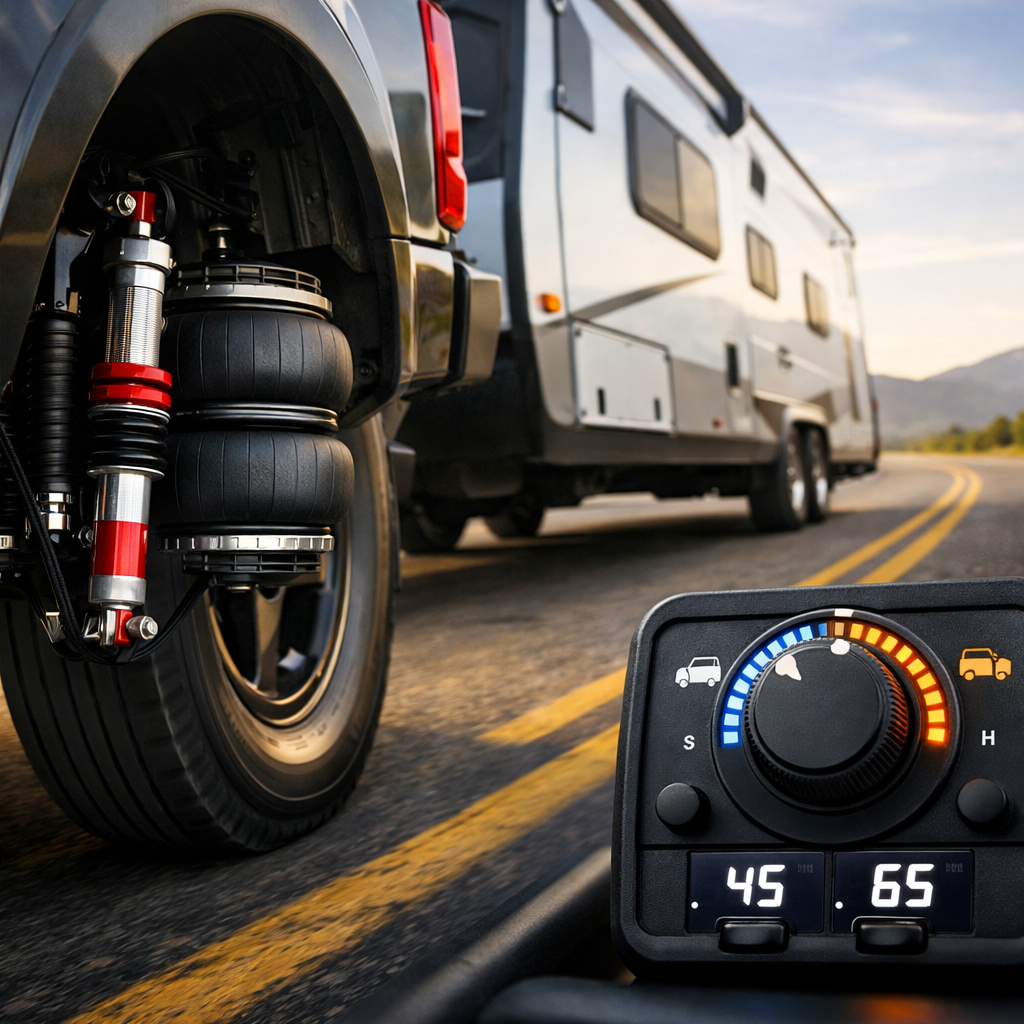
Definition (air helper bags): Inflatable bellows mounted between frame and axle (or leaf pack). By adding air pressure only when needed, they supplement the rear suspension to reduce rear sag, improve headlight aim, and stabilize steering and braking with variable loads. Ideal for mixed-use trucks that alternate between commuting and towing.
Core facts and when to choose
- Air bags can typically be adjusted from about 5–100 PSI to level a truck under load, making them the most versatile option for heavy towing and RVing and a proven way to eliminate rear squat (see RV Critic’s towing air ride guide).
- Choose them when you carry changing payloads week‑to‑week or tow different trailers. They let you return to stock ride on off days by lowering PSI.
Buying considerations
- Inflation method: Onboard compressor with in‑cab controls is the most convenient; manual Schrader valves are cheaper but require stops to adjust.
- Compatibility: Most kits are designed for leaf‑spring rear suspensions; verify fitment for your truck’s year/trim.
- Pairing: For heavy trailers, combine airbags with a weight distribution hitch (WDH) for maximum stability (see RV Critic’s towing air ride guide).
- RV Critic’s towing air ride guide includes setup checklists and PSI tips.
Pros
- On‑demand leveling and stability
- Preserves daily comfort when deflated
- Scalable with compressors and in‑cab controls
Cons
- More components to install and maintain
- Improperly routed airlines can leak or chafe
Typical cost
- Low hundreds for basic bag kits; $700–$1,200+ with compressor/controller (see RV Critic’s towing air ride guide).
Adjustable coilovers
Definition (coilovers): Integrated shock-and-spring assemblies that let you set ride height, spring preload, and damping to balance comfort and performance across uses. Properly tuned, they sharpen steering, improve weight transfer, and can maintain composure with light to moderate towing (see RV Critic’s suspension upgrades guide).
Damping, explained: Damping controls how quickly the suspension moves—compression for impact absorption and rebound for return. Premium kits offer separate adjustments for each, letting you firm rebound to control oscillation with loads while keeping compression compliant over sharp impacts (see RV Critic’s coilover suspension kits 2026).
Price signals and examples
- Budget-friendly coilovers like Tein Flex Z routinely land around $900 and deliver meaningful handling gains for street use (see RV Critic’s budget suspension mods for 2026).
- Premium kits add independent rebound/compression, better piston/shim stacks, and sometimes adaptive controls (see RV Critic’s coilover suspension kits 2026).
Positioning
- Best for daily drivers who tow occasionally and want precise height and damping control. If your primary need is load leveling for heavy trailers, air bags are the more targeted first step. RV Critic’s coilover guides call out kits that maintain composure with light towing.
Heavy duty leaf springs
Definition (heavy-duty leaf springs): Higher-rate replacement packs that permanently increase rear support for constant heavy payloads and frequent towing. They’re low maintenance and durable, but ride firmer when unloaded and cannot be “turned down” for commute comfort.
Key facts
- They deliver permanent load support for dedicated work/tow trucks and are a straightforward solution for constant payloads (see RV Critic’s towing air ride guide).
- Expect a notably stiffer empty-bed ride; they trade adjustability for durability and simplicity (see RV Critic’s towing air ride guide).
Guidance
- Choose HD leaves for trucks that are almost always hauling or towing near capacity. For mixed-use, airbags or rubber helper springs keep unloaded comfort intact. RV Critic’s guides note pairing considerations like shock valving.
Weight distribution hitch
Definition (weight distribution hitch): A hitch assembly using spring bars to transfer trailer tongue weight forward onto the tow vehicle’s front axle and back onto the trailer axles. That restores steering, braking, and headlight aim, but it does not directly raise the suspension or correct rear sag.
Pairing tip and expectations
- Combining airbags with a WDH delivers excellent stability for heavy towing, balancing level stance with restored front‑axle load (see RV Critic’s towing air ride guide).
- Benefits: improved front tire grip and braking stability; Limit: does not fix rear squat by itself—use with airbags or helper springs.
- For hitch and accessory selection, see RV Critic’s hitch and towing accessories coverage.
Adjustable sway bars and end links
Definitions
- Sway bars: Torsion bars that link left and right suspension to resist body roll, calming cornering and trailer‑induced maneuvers (see RV Critic’s suspension upgrades guide).
- End links: The connectors between sway bars and suspension arms; adjustable links set preload correctly after ride‑height changes (see RV Critic’s suspension upgrades guide).
Value, cost, and expectations
- Adjustable sway bars are a high‑impact, relatively low‑cost upgrade—typically around $350 per axle for street‑focused kits (see RV Critic’s budget suspension mods for 2026).
- They do not correct rear-end sag. Add them after load-leveling to fine‑tune roll control and crosswind confidence.
Adjustable shocks and struts
Definition (adjustable shocks/struts): Dampers with user-selectable valving to change rebound and/or compression, allowing you to reduce bounce with loads, improve stability over undulations, and tailor ride to weight. Some models provide mild ride‑height adjustment and pair well with stock or upgraded springs.
Brand feature callout
- Bilstein 5100 series offers multiple snap‑ring grooves to adjust front ride height for leveling and tire clearance, with gas‑charged monotube construction and corrosion‑resistant finishes for durability (see RV Critic’s top suspension overview).
Guidance
- A smart add for trucks that tow/haul periodically and want sharper control without swapping spring rates. Align after any ride‑height change.
Rubber helper springs and hybrid systems
Definition (rubber helper springs): Progressive-rate rubber jounces or hollow springs that replace/reinforce bump stops. They engage under load to reduce sag and sway, require no air management, and are easy to install—ideal for occasional towing where simplicity matters.
Budget pairing and tradeoffs
- Pair rubber helpers with a WDH and/or better shocks for balanced, low‑maintenance results on a budget.
- Compared to air: less adjustable and less precise leveling, but simpler and essentially maintenance‑free.
How to choose the right upgrade for your towing and daily driving
A simple decision flow
- Is your load variable week‑to‑week? Choose air helper bags with 5–100 PSI adjustability for on‑demand leveling (see RV Critic’s towing air ride guide).
- Tow occasionally but want sharper daily handling? Choose adjustable coilovers with damping control (see RV Critic’s suspension upgrades guide and coilover suspension kits 2026).
- Carry constant heavy payloads? Choose heavy-duty leaf springs (see RV Critic’s towing air ride guide).
- Add sway bars/end links for roll control and crosswind confidence after you’ve handled sag (see RV Critic’s suspension upgrades guide and budget suspension mods for 2026).
Reinforce the staged approach
- Start with load management, then add sway bars and adjustable shocks or coilovers so changes don’t fight each other and alignment is easier to keep dialed (see RV Critic’s guide on how adjustable suspension improves load handling).
Quick comparison at a glance
| Category | Best for | Pros | Cons |
|---|---|---|---|
| Air helper bags | Variable loads, mixed-use | True leveling, improves stability, switchable | More parts, potential leaks if routed poorly |
| Adjustable coilovers | Daily handling + light towing | Height/damping tuning, crisp steering | Less load support than air for heavy trailers |
| Heavy-duty leaf springs | Constant heavy payloads | Permanent support, durable | Firm unloaded ride, no adjustability |
| Sway bars/end links | Roll control | Confidence in corners, affordable | Don’t fix sag; tune after leveling |
| Adjustable shocks | Bounce control under load | Better damping, some height options | Not a leveling solution alone |
Installation and alignment tips
Must-do alignment
- After any spring/height change, get a full alignment (camber, caster, toe). It’s essential for tire wear and stable handling (see RV Critic’s suspension upgrades guide).
Quick install checklist
- Verify tow/payload ratings first—suspension mods do not raise factory limits (see RV Critic’s safety note).
- For air systems: route airlines away from heat and sharp edges; leak-check with soapy water; consider an onboard compressor for convenience.
- After height or spring-rate changes: re‑torque all fasteners at ~500 miles and recheck ride heights.
- Schedule alignment immediately after installing coilovers or height‑adjustable shocks, and again after components have settled.
Budget ranges and value tiers
Price signals to plan your build
- Air ride/helper bags: low hundreds to $1k+ depending on kit and compressor complexity (see RV Critic’s towing air ride guide).
- Adjustable coilovers: budget around $900–$1,200; premium systems with independent damping cost more (see RV Critic’s budget suspension mods for 2026 and coilover suspension kits 2026).
- Sway bars/end links: high value at roughly $350 typical per axle for street‑focused kits (see RV Critic’s budget suspension mods for 2026).
Staged spend plan
- Season 1: Solve sag and stance (air or helper springs) and confirm hitch setup.
- Season 2: Add sway bars and adjustable shocks or step up to coilovers to refine handling.
Frequently asked questions
Do adjustable suspension upgrades increase my vehicle’s towing or payload ratings?
No—these upgrades improve leveling, stability, and control but do not change the factory-rated towing or payload limits. See RV Critic’s safety note for details.
What’s better for mixed daily driving and occasional towing, air bags or coilovers?
Pick air bags if you want on-demand leveling and comfort with variable loads; RV Critic covers PSI setup in our towing air ride guide. Choose coilovers if you prioritize precise ride height/damping for daily handling and only tow occasionally.
Can I run a weight distribution hitch with air helper bags?
Yes—pairing a WDH with air bags is common and provides excellent balance and stability for heavy towing while keeping the truck level. See RV Critic’s hitch and towing accessories coverage.
Will adjustable shocks or sway bars fix rear-end sag when towing?
No—shocks and sway bars improve control and reduce roll, but they don’t level the vehicle; use air or helper springs to correct sag, then fine-tune handling with damping and bars. Find setup order in RV Critic’s suspension upgrades guide.
Do I need an alignment after changing ride height or springs?
Yes—any change in ride height or springs alters geometry, so get a full alignment to protect tires and ensure predictable handling. RV Critic’s install checklists flag alignment specs to verify.