10 Best Bolt-On Steering Stabilizers for Lifted Trucks 2026
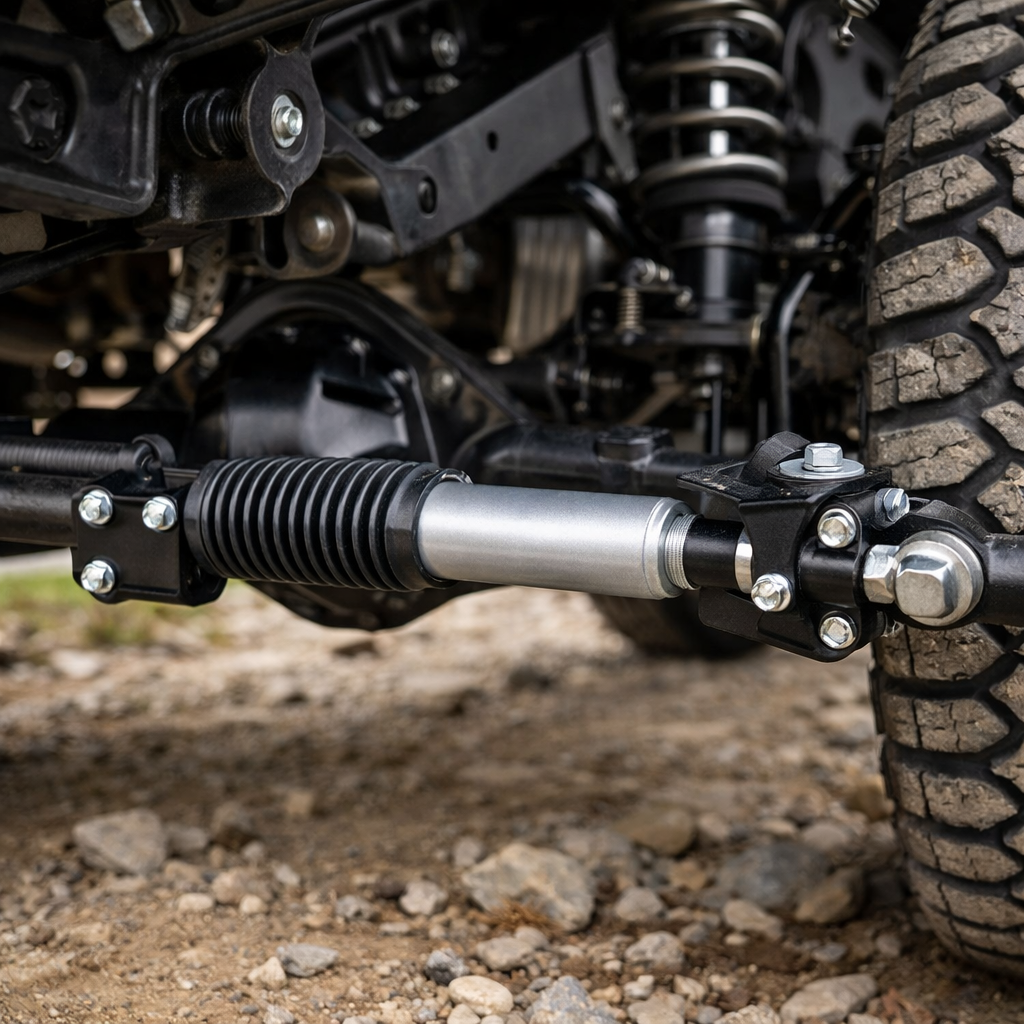
If your lifted truck tows, hauls, or runs larger tires, a bolt-on steering stabilizer is a cost-effective way to tame kickback, shimmy, and road harshness—especially on long highway runs and uneven campsites. A steering stabilizer is a shock-like damper that mounts to a truck’s steering linkages to reduce kickback, shimmy, and vibration from bumps or large tires. It improves directional stability and comfort but doesn’t replace fixing worn parts, alignment, or suspension geometry issues. Below are our 10 best options for comfort-first control in 2026 from RV Critic, with quick fitment and use-case guidance.
RV Critic
For RVers and tow-rig drivers, bolt-on stabilizers deliver noticeable stability per dollar—reducing feedback from heavy trailers, roof loads, or 35–37-inch tires while preserving on-center feel. We favor easy installs that use OE mounting, compact hardware that clears tow gear, and solutions tailored to Super Duty, Ram HD, and popular Jeep-based toads. Our picks reflect real-world RV use: long towing days, crosswinds, and uneven campsites.
Always confirm exact year/axle fitment and mount orientation before purchase.
Top picks at a glance
| Pick | Price range (USD) | Materials | Valving | Fitment focus | Warranty | Rebuildable |
|---|---|---|---|---|---|---|
| FOX Performance Series 2.0 TS | ~375.95 | 6061‑T6 aluminum body, 0.62" chrome shaft | Linear (IFP) | OE-mount, highway/off‑road mix | 1‑year | Yes (model dependent) |
| FOX ATS Adjustable Through Shaft | ~450–600 | Aluminum, through-shaft | Adjustable linear | Large tires, variable terrain | 1‑year | Yes |
| Bilstein 5100 Series | ~130–180 | Zinc-plated steel | Digressive | Highway/towing, firm on‑center | Limited | Generally no |
| BDS Dual FOX Kits | ~400–800 (kit) | Dual FOX 2.0 | Linear (dual) | 35–37"+ tires, aggressive use | Limited | Yes (shocks) |
| Apex Ford HD Steering Kit + mounts | 1,000+ (kit) | DOM linkage, metal-on-metal joints | N/A (mounts for stabilizers) | Death wobble root‑cause fix | N/A | N/A |
| Carli High Mount Stabilizer (Super Duty) | ~400–500 | Premium components | Tuned linear | 2017–2026 F‑250/F‑350 4x4 | Limited | Yes |
| XDP/XTremeDiesel Ram 2500/3500 Options | ~120–380 | Platform-specific | Linear/digressive (varies) | 2025–2026 Ram HD | Varies | Varies |
| OE‑Style Direct Fit Stabilizers | ~80–160 | Steel | Factory‑like | Light lifts, quick replacement | Varies | Typically no |
| Low‑Mount Stabilizer w/ Diff Guard | ~200–400 (mount kit) | Steel/HD mounts | Depends on damper | Left‑pull correction, protection | Varies | Varies |
| Rebuildable Performance Stabilizers | ~180–380 | Aluminum/steel | Linear/adjustable | Long‑term tunability | 1‑year (often) | Yes |
FOX Performance Series 2.0 TS
FOX’s 2.0 TS is a premium bolt-on stabilizer for lifted trucks that see mixed highway and off-road miles on oversized tires. It uses OE mounting locations and hardware, an internal floating piston (IFP) design, and a lightweight 6061‑T6 aluminum body with clear/hard anodizing, a 0.62-inch hard chrome-plated shaft, nitrile rubber bushings, and CNC-machined components. FOX lists a 1‑year warranty and MSRP around $375.95, with noted wobble reduction on trucks and Jeeps running larger tires. Professional installation is recommended on some applications and may take several hours, such as Super Duty and Wrangler JL fitments (see FOX Super Duty and Wrangler product details at AmericanTrucks and ExtremeTerrain for build specs and OE-mount notes).
- Read more: FOX 2.0 TS specs and OE-mount details on the Wrangler JL stabilizer and Super Duty stabilizer pages from ExtremeTerrain and AmericanTrucks.
Sources: FOX SuperDuty Performance Series 2.0 TS stabilizer (AmericanTrucks), FOX Wrangler JL 2.0 TS stabilizer (ExtremeTerrain)
FOX ATS Adjustable Through Shaft
Adjustable Through Shaft (ATS) defined: a damper with a shaft that passes entirely through the piston, keeping fluid volume equal on both sides for consistent damping and external adjustment. This design lets drivers fine-tune steering effort to match larger tires and changing terrain without fade from volume displacement.
Who benefits: drivers switching between towing and trails or running heavier 35–37-inch tires will appreciate the adjustable steering stabilizer’s wider tuning window. Compared with FOX 2.0 TS, ATS adds on-vehicle adjustability and broader tuning, typically at a higher price, with long-term serviceability since most FOX stabilizers are rebuildable. Stage 3 Motorsports notes FOX’s more linear feel suits mixed terrain, while Bilstein’s digressive approach feels firmer on-center for pavement.
- Quick compare:
- Adjustability: ATS yes; 2.0 TS no.
- Tuning range: ATS wider; 2.0 TS fixed.
- Price: ATS higher; 2.0 TS mid.
- Rebuildability: Most FOX models support rebuilds.
Source: FOX vs. Bilstein stabilizers overview (Stage 3 Motorsports)
Bilstein 5100 Series
For a cost-effective, pavement- and towing-friendly feel, Bilstein’s 5100 series uses a 1.9-inch zinc-plated steel body with digressive valving that delivers firmer, highly controlled low-speed damping. Pricing typically falls around $130–$180, and most 5100 stabilizers are not rebuildable, making them economical for highway miles and frequent towing where on-center authority matters.
User benefits:
- Firmer on-center control for heavy payloads and towing.
- Durable, zinc-plated steel construction helps resist corrosion.
- Budget-friendly with predictable pavement manners.
Source: Stage 3 Motorsports FOX vs. Bilstein summary
BDS Dual FOX Kits
Choose a dual steering stabilizer when tire mass and trail loads overpower a single unit. BDS offers bolt-on dual kits that pair matched FOX 2.0 performance shocks with platform-specific brackets, delivering higher total damping and stability for 35–37-inch tires, aggressive off-road use, and heavy front-end accessories.
Dual steering stabilizer defined: two dampers working together—often opposing—mounted to the steering links to increase total damping force and preload. Duals better manage large tire inertia and off-road impacts but add cost, weight, and mounting complexity.
Mini guide to duals
| Tire size | Pros | Cons | Install complexity | Pair with |
|---|---|---|---|---|
| 33–35" | Improved control; future-proof | Added cost vs single | Moderate | HD track bar checks |
| 35–37"+ | Strong shimmy control; stability | Weight; more service points | Moderate–High | HD drag link/tie-rod |
| 37"+ + off-road | Maximum damping; impact control | Clearance checks | High | Steering brace/HD linkage |
Source: BDS dual stabilizer kits with FOX 2.0
Apex Ford HD Steering Kit
When 37-inch tires and hard use expose weak links, a full steering upgrade can do more than any damper. Apex’s Ford HD steering kit addresses common drag-link joint failures implicated in death wobble with greaseable, metal-on-metal joints and heavy DOM tubing, while offering high-mount and low-mount locations and true dual opposing setups to preload joints and reduce play. High-mount is favored to fight right-hand pull or to replace the factory position; low-mount with a diff guard can correct left-hand tire pull.
Chooser for Apex mounting
- Running 37s+ and upgraded drag link? Choose dual opposing.
- Experiencing right pull? Choose high-mount.
- Experiencing left pull? Choose low-mount with diff guard.
Source: Apex KIT175 Ford HD Steering Kit
Carli High Mount Stabilizer
Carli’s high-mount stabilizer is a premium, bolt-in OEM replacement for 2017–2026 Ford F‑250/F‑350 4x4 trucks. It’s designed for leveled and lifted rigs running large tires, improving on-center feel and reducing shimmy while preserving preferred high-mount orientation.
Quick contrasts vs FOX/Bilstein:
- Tuning approach: Carli and FOX lean linear for mixed-terrain smoothness; Bilstein’s digressive valving prioritizes on-road firmness.
- Materials: Premium, serviceable components designed for longevity.
- Price band: Typically above entry-level singles; closer to FOX 2.0 TS range.
- High-mount benefits: Clearance for trail debris; effective for right-pull correction when paired with proper geometry.
Source: Carli high-mount stabilizer for 2017–2026 Super Duty
XDP Ram 2500 3500 Stabilizers
Ram heavy-duty owners should start with platform-specific listings for straightforward OE-mount fitment. XDP/XTremeDiesel catalogs segment stabilizers by year, engine, and axle for 2025–2026 Ram 2500/3500 as well as 2017-era Ford Super Duty, making bolt-on selection faster and reducing return risk.
Ram HD considerations:
- Extra front-end weight from the 6.7L Cummins demands adequate damping and stout mounts.
- Decide early: single vs dual stabilizer, and high- vs low-mount orientation based on pull correction and accessory clearance.
- Confirm steering linkage type (factory vs HD) before ordering brackets.
Fitment checklist for Ram:
- Year range and 4x4 axle type
- Steering linkage and track bar condition
- Primary use: tow/haul, mixed use, or off-road
Sources: 2025 Ram 6.7 Cummins stabilizers (XDP), 2017–2018 Ford Super Duty stabilizers (XDP)
OE Style Direct Fit Stabilizers
OE-style direct-fit stabilizer defined: a replacement damper built to match factory dimensions and mounting points, preserving original steering geometry and quick installation. Ideal for light lifts that keep stock linkage, these deliver modest improvement over worn parts without dramatically changing handling.
Benefits:
- True bolt-on simplicity using OE mounting
- Preserves alignment and geometry
- Lower price and fast install
Drawbacks:
- Limited damping for very large tires
- Fewer tuning options and rarely rebuildable
Low Mount Stabilizer With Diff Guard
Low-mount positioning can correct specific pull tendencies and protect components. Apex’s guidance: a low-mount stabilizer paired with a differential guard can correct a left-hand tire pull; meanwhile, a high-mount location is favored to fight right-hand pull and to replace the factory position. Choose based on your truck’s symptom and accessory layout.
Pull correction guide
| Symptom | Mount choice | Add‑on |
|---|---|---|
| Right-hand pull | High-mount | None typically |
| Left-hand pull | Low-mount | Diff guard recommended |
Source: Apex HD Steering Kit mounting guidance
Rebuildable Performance Stabilizers
Serviceability and tunability matter for frequent off-roaders and long-haul towers. Most FOX stabilizers can be rebuilt, which restores damping and preserves feel over time, while many Bilstein 5100 units are not rebuildable—affecting long-term cost of ownership. Pricing for rebuildable options often ranges ~$180–$240, with premium units like FOX 2.0 TS listing around $375.95 and a 1‑year limited warranty depending on fitment.
Rebuild planning
| Rebuild interval | Service kit availability | Ride-tuning benefits |
|---|---|---|
| 30k–60k miles for hard use; inspect sooner if leaking | FOX kits widely available via performance dealers | Restore like-new damping; adjust nitrogen charge/valving where supported |
| Light-duty/highway: inspect each 5k–7.5k miles | Model-dependent (check part number) | Maintain consistent on-center feel with large tires |
Sources: Stage 3 FOX/Bilstein serviceability overview, FOX 2.0 TS pricing/warranty example
How to choose the right stabilizer for your lifted truck
RV Critic prioritizes predictable towing stability and long-haul comfort; use the guide below to match valving style and mounting to your setup.
Decision flow
- 33–35" tires; highway/towing focus: choose Bilstein 5100 for digressive valving and economical steel durability.
- 35–37"+; mixed off-road: choose FOX 2.0 TS for linear valving, IFP control, and aluminum weight savings.
- Extreme loads or upgraded drag link: consider dual setups or HD steering like Apex dual opposing to address root-cause play.
Price/warranty snapshot
- Singles: ~$130–$380 per unit typical.
- Many premium units list 1‑year limited warranties.
Linear vs digressive valving defined: Linear valving delivers consistent damping that feels smoother and more compliant off-road, while digressive valving provides higher low-speed damping for firmer on-center control on pavement. Choose based on terrain, tire size, and towing priorities.
Sources: Stage 3 FOX vs Bilstein guidance, FOX 2.0 TS product details
Installation tips for a clean bolt-on setup
Most modern stabilizers bolt to OE locations with supplied hardware—no drilling—preserving steering geometry.
Install checklist
- Verify year/axle fitment and mount orientation (high vs low) before disassembly.
- Center the steering wheel, then attach the stabilizer; torque to spec at ride height.
- Plan several hours for some applications like FOX 2.0 TS on Super Duty or JL, or consider professional install.
- Review safety notices (including Prop 65 where shown) and use proper PPE.
Sources: FOX Wrangler JL 2.0 TS OE-mount and install notes, FOX Super Duty 2.0 TS install time/safety notes
Safety checks and maintenance for stable steering
- Inspect bushings, shaft chrome, and mounts for play or leaks every 5,000–7,500 miles or before big trips.
- Rebuild where supported (FOX) to restore damping; replace non‑rebuildable units (e.g., many 5100s) as performance fades.
- Pair with front-end checks: drag-link and tie-rod ends, track bar, wheel bearings; if recurring play is found, consider HD linkage upgrades—Apex’s kit directly addresses common drag-link failures linked to death wobble.
Sources: Stage 3 on serviceability, Apex HD linkage benefits
Frequently asked questions
Do I need a single or dual steering stabilizer for my lift and tire size
Singles cover moderate lifts and 33–35" tires; RV Critic recommends dual or opposing stabilizers for 35–37"+ tires, heavy bumpers, or HD steering where extra damping helps control shimmy.
Will a steering stabilizer fix death wobble on a lifted truck
No—stabilizers may mask symptoms; RV Critic advises fixing worn joints, track bar, and alignment first, then adding a quality stabilizer or HD steering kit for control and comfort.
How do adjustable stabilizers help with larger tires
They let you tune damping for tire mass and terrain; RV Critic finds this useful when switching between towing and trail use or after upsizing tires.
Can I install a bolt-on stabilizer at home without alignment changes
Yes—most bolt to OE mounts and don’t alter alignment; center the wheel and torque at ride height, or use a pro for duals/complex geometry.
How often should I inspect or service a steering stabilizer
Inspect every 5,000–7,500 miles or before trips; rebuild serviceable units to restore feel and replace non‑rebuildable dampers when control fades.